




A string is wrapped on a wheel of moment of inertia 0.20 kg.m² and radius 10 cm and goes through a light pulley to support a block of mass 2.0 kg as shown in figure, Find the acceleration of the block?
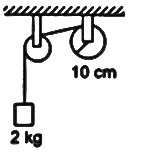
A) 0.89 ms-2
B) 1.12 ms-2
C) 0.69 ms-2
D) none
Answer
 Verified
659.7k+ views
Hint: Draw the free body diagram considering the tension (T) in it. Convert angular acceleration using $\alpha = \dfrac{a}{r}$
Formula: Torque = (moment of inertia) (angular acceleration) i.e. $T = I\alpha $,
$\alpha = \dfrac{a}{r}$
Complete step by step solution:
T= tension, g = acceleration due to gravity
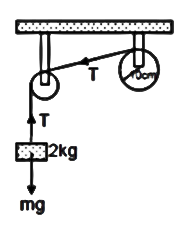
From the free body diagram, we get
mg – T = ma
∴mg=ma + T
Given, m = 2kg, r =10cm=0.1m, I=0.20 kg.m²
Using $T = I\alpha $ and $\alpha = \dfrac{a}{r}$we get,
\[
mg = ma + I\alpha = ma + I\dfrac{a}{r} \\
\Rightarrow mg = (m + \dfrac{I}{r})a \\
\Rightarrow 2 \times 9.8 = (2 + \dfrac{{0.2}}{{0.01}})a \\
\Rightarrow a = \dfrac{{2 \times 9.8}}{{(2 + \dfrac{{0.2}}{{0.01}})}} = \dfrac{{19.6}}{{22}} = 0.89{\text{ m}}{{\text{s}}^{{\text{ - 2}}}} \\
\]
Therefore, acceleration of the block = 0.89 ms-2
Correct Answer: A) 0.89 ms-2
Note: In rotational motion, torque is required to produce an angular acceleration of an object. The amount of torque required to produce an angular acceleration depends on the distribution of the mass of the object. The moment of inertia is a value that describes the distribution.
Formula: Torque = (moment of inertia) (angular acceleration) i.e. $T = I\alpha $,
$\alpha = \dfrac{a}{r}$
Complete step by step solution:
T= tension, g = acceleration due to gravity
From the free body diagram, we get
mg – T = ma
∴mg=ma + T
Given, m = 2kg, r =10cm=0.1m, I=0.20 kg.m²
Using $T = I\alpha $ and $\alpha = \dfrac{a}{r}$we get,
\[
mg = ma + I\alpha = ma + I\dfrac{a}{r} \\
\Rightarrow mg = (m + \dfrac{I}{r})a \\
\Rightarrow 2 \times 9.8 = (2 + \dfrac{{0.2}}{{0.01}})a \\
\Rightarrow a = \dfrac{{2 \times 9.8}}{{(2 + \dfrac{{0.2}}{{0.01}})}} = \dfrac{{19.6}}{{22}} = 0.89{\text{ m}}{{\text{s}}^{{\text{ - 2}}}} \\
\]
Therefore, acceleration of the block = 0.89 ms-2
Correct Answer: A) 0.89 ms-2
Note: In rotational motion, torque is required to produce an angular acceleration of an object. The amount of torque required to produce an angular acceleration depends on the distribution of the mass of the object. The moment of inertia is a value that describes the distribution.
Recently Updated Pages
What is BLO What is the full form of BLO class 8 social science CBSE

Explain the Treaty of Vienna of 1815 class 10 social science CBSE
10 examples of friction in our daily life
Draw a diagram of nephron and explain its structur class 11 biology CBSE
Write structures of the following compounds i 2 Chloro3methylpentane class 11 chemistry CBSE
A Paragraph on Pollution in about 100-150 Words
Trending doubts
Draw a labelled sketch of the human eye class 12 physics CBSE
Which are the Top 10 Largest Countries of the World?
Differentiate between homogeneous and heterogeneous class 12 chemistry CBSE
Draw ray diagrams each showing i myopic eye and ii class 12 physics CBSE
Materials which do not allow an electric current to class 12 physics CBSE
Which is the correct genotypic ratio of mendel dihybrid class 12 biology CBSE