




A string can bear maximum tension of \[3.16{\text{ kg - wt}}\]. What maximum number of revolutions per second can be made by a stone of mass \[49{\text{ g}}\] tied to one end of a \[{\text{1 m}}\] long piece of this string so that the string may not break?
Answer
 Verified
526.2k+ views
Hint:The maximum tension is the maximum force the string can bear while revolving in the circular path. While revolving in circular it will experience tension due to the weight of stone tied to it and the centripetal force. With the help of this we will find the maximum velocity with which it can revolve. Then we will find the angular frequency of the stone.
Formula used:
For centripetal force:
\[F{\text{ = }}\dfrac{{m{v^2}}}{r}\]
Here, \[m\] is the mass of stone, \[v\] is the velocity of stone while revolving and \[r\] is the radius of a circular path which is formed during revolution.
Complete step by step answer:
The tension experienced by a string is the force exerted on the string due to the weight of any object tied to it. But here due to circular revolution, the tension in the string is also due to centripetal motion of stone. Due to this centripetal force acts on the string which adds up in the tension of the string. Thus we can write as net force or tension on string as,
Maximum tension of string \[ = {\text{ }}{{\text{F}}_{weight}}{\text{ + }}{{\text{F}}_{centripetal}}\]
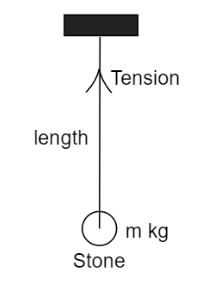
We know that \[{F_{weight}}{\text{ = mg}}\] and \[{F_{centripetal}}{\text{ = }}\dfrac{{m{v^2}}}{r}\]. Therefore the equation can be deduced as,
Maximum tension of string \[ = {\text{ mg + }}\dfrac{{m{v^2}}}{r}\]
The maximum tension of string is given as \[3.16{\text{ kg - wt = 3}}{\text{.16 }} \times {\text{ 10 = 31}}{\text{.6 N}}\] , mass of stone is \[49{\text{ g = 0}}{\text{.049 kg}}\] and radius of circular path will be equal to length of string which is equal to \[{\text{1 m}}\]. Thus on substituting the values we get the result as,
\[{\text{31}}{\text{.6 }} = {\text{ 0}}{\text{.049 }} \times {\text{ 9}}{\text{.8 + }}\dfrac{{{\text{0}}{\text{.049 }} \times {\text{ }}{{\text{v}}^2}}}{1}\]
\[\Rightarrow {\text{31}}{\text{.6 }} = {\text{ 0}}{\text{.4802 + 0}}{\text{.049 }} \times {\text{ }}{{\text{v}}^2}\]
\[\Rightarrow {{\text{v}}^2}{\text{ }} = {\text{ }}\sqrt {634.89} \]
\[ \Rightarrow {\text{ v }} = {\text{ 25}}{\text{.19 m }}{{\text{s}}^{ - 1}}\]
We know that in circular motion, angular speed can be found as ratio of its linear speed and radius of circular path.
\[\omega {\text{ = }}\dfrac{v}{r}\]
On substituting values we get angular velocity as,
\[\omega {\text{ = }}\dfrac{{25.19}}{1}{\text{ = 25}}{\text{.19 }}\]radians per second
Also angular velocity can be represented in terms of frequency as:
\[\omega {\text{ = 2}}\pi \upsilon \]
We get frequency or number of revolutions per second as,
\[\upsilon {\text{ = }}\dfrac{\omega }{{2\pi }}\]
On substituting values we number of revolutions per second as,
\[ \Rightarrow {\text{ }}\upsilon {\text{ = }}\dfrac{{25.19}}{{2{\text{ }} \times {\text{ 3}}{\text{.14}}}}\]
\[ \therefore {\text{ }}\upsilon {\text{ = 4}}{\text{.01}}\]
Thus the maximum number of revolutions it can make is four revolutions per second.
Note: It is always prefer to use value of \[{\text{g = 9}}{\text{.8 m }}{{\text{s}}^{ - 2}}\] unless it is asked to take \[{\text{g = 10 m }}{{\text{s}}^{ - 2}}\]. The mass of stone must be converted into kilograms before substituting in the equation. The tension of the string must be in Newton. We can take approximate values of speed and angular speed and decimal value up to two places of decimals.
Formula used:
For centripetal force:
\[F{\text{ = }}\dfrac{{m{v^2}}}{r}\]
Here, \[m\] is the mass of stone, \[v\] is the velocity of stone while revolving and \[r\] is the radius of a circular path which is formed during revolution.
Complete step by step answer:
The tension experienced by a string is the force exerted on the string due to the weight of any object tied to it. But here due to circular revolution, the tension in the string is also due to centripetal motion of stone. Due to this centripetal force acts on the string which adds up in the tension of the string. Thus we can write as net force or tension on string as,
Maximum tension of string \[ = {\text{ }}{{\text{F}}_{weight}}{\text{ + }}{{\text{F}}_{centripetal}}\]
We know that \[{F_{weight}}{\text{ = mg}}\] and \[{F_{centripetal}}{\text{ = }}\dfrac{{m{v^2}}}{r}\]. Therefore the equation can be deduced as,
Maximum tension of string \[ = {\text{ mg + }}\dfrac{{m{v^2}}}{r}\]
The maximum tension of string is given as \[3.16{\text{ kg - wt = 3}}{\text{.16 }} \times {\text{ 10 = 31}}{\text{.6 N}}\] , mass of stone is \[49{\text{ g = 0}}{\text{.049 kg}}\] and radius of circular path will be equal to length of string which is equal to \[{\text{1 m}}\]. Thus on substituting the values we get the result as,
\[{\text{31}}{\text{.6 }} = {\text{ 0}}{\text{.049 }} \times {\text{ 9}}{\text{.8 + }}\dfrac{{{\text{0}}{\text{.049 }} \times {\text{ }}{{\text{v}}^2}}}{1}\]
\[\Rightarrow {\text{31}}{\text{.6 }} = {\text{ 0}}{\text{.4802 + 0}}{\text{.049 }} \times {\text{ }}{{\text{v}}^2}\]
\[\Rightarrow {{\text{v}}^2}{\text{ }} = {\text{ }}\sqrt {634.89} \]
\[ \Rightarrow {\text{ v }} = {\text{ 25}}{\text{.19 m }}{{\text{s}}^{ - 1}}\]
We know that in circular motion, angular speed can be found as ratio of its linear speed and radius of circular path.
\[\omega {\text{ = }}\dfrac{v}{r}\]
On substituting values we get angular velocity as,
\[\omega {\text{ = }}\dfrac{{25.19}}{1}{\text{ = 25}}{\text{.19 }}\]radians per second
Also angular velocity can be represented in terms of frequency as:
\[\omega {\text{ = 2}}\pi \upsilon \]
We get frequency or number of revolutions per second as,
\[\upsilon {\text{ = }}\dfrac{\omega }{{2\pi }}\]
On substituting values we number of revolutions per second as,
\[ \Rightarrow {\text{ }}\upsilon {\text{ = }}\dfrac{{25.19}}{{2{\text{ }} \times {\text{ 3}}{\text{.14}}}}\]
\[ \therefore {\text{ }}\upsilon {\text{ = 4}}{\text{.01}}\]
Thus the maximum number of revolutions it can make is four revolutions per second.
Note: It is always prefer to use value of \[{\text{g = 9}}{\text{.8 m }}{{\text{s}}^{ - 2}}\] unless it is asked to take \[{\text{g = 10 m }}{{\text{s}}^{ - 2}}\]. The mass of stone must be converted into kilograms before substituting in the equation. The tension of the string must be in Newton. We can take approximate values of speed and angular speed and decimal value up to two places of decimals.
Recently Updated Pages
Master Class 11 Social Science: Engaging Questions & Answers for Success

Master Class 11 Chemistry: Engaging Questions & Answers for Success
Master Class 12 Business Studies: Engaging Questions & Answers for Success
Master Class 12 Chemistry: Engaging Questions & Answers for Success
Master Class 12 Biology: Engaging Questions & Answers for Success
Class 12 Question and Answer - Your Ultimate Solutions Guide
Trending doubts
One Metric ton is equal to kg A 10000 B 1000 C 100 class 11 physics CBSE
Difference Between Prokaryotic Cells and Eukaryotic Cells
How many of the following diseases can be studied with class 11 biology CBSE
Two of the body parts which do not appear in MRI are class 11 biology CBSE
Which of the following enzymes is used for carboxylation class 11 biology CBSE
Explain zero factorial class 11 maths CBSE