




A street light is 6 m high. A man 180 cm tall goes away from the street light at a speed of 120 cm/sec. Find the rate of increase of length of his shadow when he is 9 m away from the light. Also find the rate at which the tip of the shadow moves on the road.
Answer
 Verified
655.2k+ views
Hint: We will use the similarity of triangles to solve this question. We will also use differentiation to find the rate at which shadow moves. The speed of an object is found using the formula speed = distance/time. We will use this formula to solve the given question.
Complete step-by-step answer:
Now, we will first draw a figure according to the question.
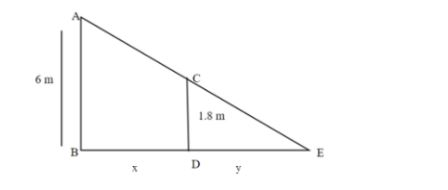
Now, in this figure AB represents the street light which is 6 m high. The CD represents the man 1.8 m or 180 cm tall. BD is the distance of the man from the street light and DE is the length of shadow of the man. Let BD be x and DE be y.
Now, by using similarity of triangles, in $\Delta ABE$ and $\Delta CDE$, we have
$\angle AEB = \angle CED$ (Common)
$\angle ABE = \angle CDE = 90^\circ $
So, by AA similarity, we get $\Delta ABE \sim \Delta CDE$
So, we can write, $\dfrac{{AB}}{{CD}} = \dfrac{{BE}}{{DE}}$
Now, BE = BD +DE,
So, we have $\dfrac{6}{{1.8}} = \dfrac{{x + y}}{y}$,
$\dfrac{{10}}{3} = \dfrac{{x + y}}{y}$
So, we get $y = \dfrac{3}{7}x$ … (1)
Now, the speed at which man is moving away from the light is 120 cm/sec.
Also, speed of man moving away from street light = $\dfrac{{dx}}{{dt}}$
Therefore, $\dfrac{{dx}}{{dt}}$ = 120 cm/sec
Now, to get the rate at which tip of shadow is moving, we will differentiate equation (1) with respect to t.
So, the rate at which the tip of shadow is moving = $\dfrac{{dy}}{{dt}} = \dfrac{{d\left( {\dfrac{3}{7}x} \right)}}{{dt}}$ = $\dfrac{3}{7}(120)$ = $\dfrac{{360}}{7}$ cm/sec
So, we get, $\dfrac{{dy}}{{dt}} = \dfrac{{360}}{7}$ cm/sec.
Now, we can see that $\dfrac{{dy}}{{dt}}$ is independent of x, so the rate of increase of length is constant.
Note: Whenever we come up with such types of questions, we will first draw a diagram according to the question. Then, we will assume variables x and y as distance of man from street light and distance of shadow from street light. Then, we will use the property of similarity which states that if two triangles are similar then, their corresponding sides are in the same ratio or proportion. To find the rate at which any object moves we use the technique of differentiation. Like in this question, we first use similarity to find a relation between the distance between man and street light and length of shadow. After it, we use the technique of differentiation to find the rate at which the tip of the shadow is moving.
Complete step-by-step answer:
Now, we will first draw a figure according to the question.
Now, in this figure AB represents the street light which is 6 m high. The CD represents the man 1.8 m or 180 cm tall. BD is the distance of the man from the street light and DE is the length of shadow of the man. Let BD be x and DE be y.
Now, by using similarity of triangles, in $\Delta ABE$ and $\Delta CDE$, we have
$\angle AEB = \angle CED$ (Common)
$\angle ABE = \angle CDE = 90^\circ $
So, by AA similarity, we get $\Delta ABE \sim \Delta CDE$
So, we can write, $\dfrac{{AB}}{{CD}} = \dfrac{{BE}}{{DE}}$
Now, BE = BD +DE,
So, we have $\dfrac{6}{{1.8}} = \dfrac{{x + y}}{y}$,
$\dfrac{{10}}{3} = \dfrac{{x + y}}{y}$
So, we get $y = \dfrac{3}{7}x$ … (1)
Now, the speed at which man is moving away from the light is 120 cm/sec.
Also, speed of man moving away from street light = $\dfrac{{dx}}{{dt}}$
Therefore, $\dfrac{{dx}}{{dt}}$ = 120 cm/sec
Now, to get the rate at which tip of shadow is moving, we will differentiate equation (1) with respect to t.
So, the rate at which the tip of shadow is moving = $\dfrac{{dy}}{{dt}} = \dfrac{{d\left( {\dfrac{3}{7}x} \right)}}{{dt}}$ = $\dfrac{3}{7}(120)$ = $\dfrac{{360}}{7}$ cm/sec
So, we get, $\dfrac{{dy}}{{dt}} = \dfrac{{360}}{7}$ cm/sec.
Now, we can see that $\dfrac{{dy}}{{dt}}$ is independent of x, so the rate of increase of length is constant.
Note: Whenever we come up with such types of questions, we will first draw a diagram according to the question. Then, we will assume variables x and y as distance of man from street light and distance of shadow from street light. Then, we will use the property of similarity which states that if two triangles are similar then, their corresponding sides are in the same ratio or proportion. To find the rate at which any object moves we use the technique of differentiation. Like in this question, we first use similarity to find a relation between the distance between man and street light and length of shadow. After it, we use the technique of differentiation to find the rate at which the tip of the shadow is moving.
Recently Updated Pages
Which will be the least stable resonating structure class 11 chemistry CBSE

How many 5 digit telephone numbers can be construc-class-11-maths-CBSE
How do you find the angle of the resultant vector class 11 physics CBSE
Draw labelled diagram of the following i Gram seed class 11 biology CBSE
1 Quintal is equal to a 110 kg b 10 kg c 100kg d 1000 class 11 physics CBSE
What is the need and importance of classification class 11 biology CBSE
Trending doubts
One Metric ton is equal to kg A 10000 B 1000 C 100 class 11 physics CBSE
Find the value of the expression given below sin 30circ class 11 maths CBSE
Draw a diagram of nephron and explain its structur class 11 biology CBSE
10 examples of friction in our daily life
Proton was discovered by A Thomson B Rutherford C Chadwick class 11 chemistry CBSE
The teeth used for biting and cutting food are called class 11 biology CBSE