




A straight line through origin O meets the parallel lines $4x+2y=9$ and $2x+y+6=0$ at point P and Q respectively. Then the point O divides the segment PQ in the ratio.
$\begin{align}
& a)1:2 \\
& b)3:4 \\
& c)2:1 \\
& d)4:3 \\
\end{align}$
Answer
 Verified
639.6k+ views
Hint: Now we are given that a straight line through origin O meets the parallel lines $4x+2y=9$ and $2x+y+6=0$ at point P and Q respectively. We know that equation of line passing through origin is in $y=mx$ hence we will use this equation to solve with both lines to get the coordinates P and Q. Now we have coordinates of P, Q and O. hence we can use section formula which says if (x, y) divides the line joining $\left( {{x}_{1}},{{x}_{2}} \right)$ and $\left( {{y}_{1}},{{y}_{2}} \right)$ in ration m : n. then we have.
$\left( x,y \right)=\left( \left( \dfrac{m{{x}_{1}}+n{{x}_{2}}}{m+n} \right),\left( \dfrac{m{{y}_{1}}+n{{y}_{2}}}{m+n} \right) \right)$ . hence we can find the ratio m : n.
Complete step-by-step answer:
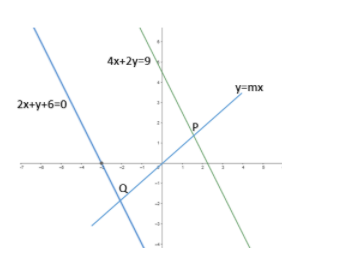
Now consider the equation of line passing through origin
We know that the equation of line passing through origin is $y=mx$
Now let us say the equation of line PQ is $y=mx$
Now Let us first find the point of intersection P.
P lies on line $4x+2y=9$ and the line $y=mx$
Now consider the line $4x+2y=9$
Dividing throughout by 2 we get
$2x+y=\dfrac{9}{2}$
Hence we get $y=\dfrac{9}{2}-2x$
Now at intersection point of line $4x+2y=9$ and the line $y=mx$ which is P we have
\[\begin{align}
& mx=\dfrac{9}{2}-2x \\
& mx+2x=\dfrac{9}{2} \\
& x\left( m+2 \right)=\dfrac{9}{2} \\
& x=\dfrac{9}{2\left( m+2 \right)}
\end{align}\]
Now substituting \[x=\dfrac{9}{2\left( m+2 \right)}\] in $y=mx$ we get.
$y=\dfrac{9m}{2\left( m+2 \right)}$
Hence the coordinates of P is $\left( \dfrac{9}{2\left( m+2 \right)},\left( \dfrac{9m}{2\left( m+2 \right)} \right) \right).............(1)$
Now line $2x+y+6=0$ and $y=mx$ intersects at Q.
Rearranging the terms of $2x+y+6=0$ we get $y=-2x-6$
Now at interaction point Q of line $2x+y+6=0$ and $y=mx$we will have
$mx=-2x-6$
Hence we get
$\begin{align}
& mx+2x=6 \\
& \Rightarrow x=\dfrac{6}{\left( m+2 \right)} \\
\end{align}$
Now substituting $x=\dfrac{6}{\left( m+2 \right)}$ in $y=mx$ we get $y=\dfrac{6m}{\left( m+2 \right)}$
Hence the coordinates of Q are $\left( \dfrac{6}{m+2},\dfrac{6m}{m+2} \right).....................(2)$
Now we have coordinates of P is $\left( \dfrac{9}{2\left( m+2 \right)},\left( \dfrac{9m}{2\left( m+2 \right)} \right) \right)$ and coordinates of Q are $\left( \dfrac{6}{m+2},\dfrac{6m}{m+2} \right)$
Now we have O = (0, 0) divides the line PQ internally.
Let us say that that the point O divides the line PQ in ratio λ : 1.
Then we know by section formula if (x, y) divides the line joining $\left( {{x}_{1}},{{x}_{2}} \right)$ and $\left( {{y}_{1}},{{y}_{2}} \right)$ in ration m : n. then we have.
$\left( x,y \right)=\left( \left( \dfrac{m{{x}_{1}}+n{{x}_{2}}}{m+n} \right),\left( \dfrac{m{{y}_{1}}+n{{y}_{2}}}{m+n} \right) \right)$
Hence for the line PQ we have.
$\left( 0,0 \right)=\left( \dfrac{\left( \dfrac{\lambda 9}{2\left( m+2 \right)}-\dfrac{6}{m+2} \right)}{\lambda +1},\dfrac{\left( \dfrac{\lambda 9m}{2\left( m+2 \right)}-\dfrac{6m}{m+2} \right)}{\lambda +1} \right)$
Now first equating x coordinate we get
\[\begin{align}
& \dfrac{\left( \dfrac{\lambda 9}{2\left( m+2 \right)}-\dfrac{6}{m+2} \right)}{\lambda +1}=0 \\
& \Rightarrow \left( \dfrac{\lambda 9}{2\left( m+2 \right)}-\dfrac{6}{m+2} \right)=0 \\
& \Rightarrow \dfrac{\lambda 9}{2\left( m+2 \right)}=\dfrac{6}{m+2} \\
& \Rightarrow \dfrac{3\lambda }{2}=\dfrac{2}{1} \\
& \Rightarrow \lambda =\dfrac{4}{3} \\
\end{align}\]
Hence the value of λ is $\dfrac{4}{3}$ .
Now we have point O divides the line PQ in ratio λ : 1.
Hence O divides PQ in $\dfrac{4}{3}:1=4:3$
Hence we have O divides line PQ in 4 : 3.
Option d is the correct answer.
Note: In section formula we use the ratio as m : n, and to solve we have assumed the ratio to be λ : 1 for simplicity. The answer through both the methods will be the same.
$\left( x,y \right)=\left( \left( \dfrac{m{{x}_{1}}+n{{x}_{2}}}{m+n} \right),\left( \dfrac{m{{y}_{1}}+n{{y}_{2}}}{m+n} \right) \right)$ . hence we can find the ratio m : n.
Complete step-by-step answer:
Now consider the equation of line passing through origin
We know that the equation of line passing through origin is $y=mx$
Now let us say the equation of line PQ is $y=mx$
Now Let us first find the point of intersection P.
P lies on line $4x+2y=9$ and the line $y=mx$
Now consider the line $4x+2y=9$
Dividing throughout by 2 we get
$2x+y=\dfrac{9}{2}$
Hence we get $y=\dfrac{9}{2}-2x$
Now at intersection point of line $4x+2y=9$ and the line $y=mx$ which is P we have
\[\begin{align}
& mx=\dfrac{9}{2}-2x \\
& mx+2x=\dfrac{9}{2} \\
& x\left( m+2 \right)=\dfrac{9}{2} \\
& x=\dfrac{9}{2\left( m+2 \right)}
\end{align}\]
Now substituting \[x=\dfrac{9}{2\left( m+2 \right)}\] in $y=mx$ we get.
$y=\dfrac{9m}{2\left( m+2 \right)}$
Hence the coordinates of P is $\left( \dfrac{9}{2\left( m+2 \right)},\left( \dfrac{9m}{2\left( m+2 \right)} \right) \right).............(1)$
Now line $2x+y+6=0$ and $y=mx$ intersects at Q.
Rearranging the terms of $2x+y+6=0$ we get $y=-2x-6$
Now at interaction point Q of line $2x+y+6=0$ and $y=mx$we will have
$mx=-2x-6$
Hence we get
$\begin{align}
& mx+2x=6 \\
& \Rightarrow x=\dfrac{6}{\left( m+2 \right)} \\
\end{align}$
Now substituting $x=\dfrac{6}{\left( m+2 \right)}$ in $y=mx$ we get $y=\dfrac{6m}{\left( m+2 \right)}$
Hence the coordinates of Q are $\left( \dfrac{6}{m+2},\dfrac{6m}{m+2} \right).....................(2)$
Now we have coordinates of P is $\left( \dfrac{9}{2\left( m+2 \right)},\left( \dfrac{9m}{2\left( m+2 \right)} \right) \right)$ and coordinates of Q are $\left( \dfrac{6}{m+2},\dfrac{6m}{m+2} \right)$
Now we have O = (0, 0) divides the line PQ internally.
Let us say that that the point O divides the line PQ in ratio λ : 1.
Then we know by section formula if (x, y) divides the line joining $\left( {{x}_{1}},{{x}_{2}} \right)$ and $\left( {{y}_{1}},{{y}_{2}} \right)$ in ration m : n. then we have.
$\left( x,y \right)=\left( \left( \dfrac{m{{x}_{1}}+n{{x}_{2}}}{m+n} \right),\left( \dfrac{m{{y}_{1}}+n{{y}_{2}}}{m+n} \right) \right)$
Hence for the line PQ we have.
$\left( 0,0 \right)=\left( \dfrac{\left( \dfrac{\lambda 9}{2\left( m+2 \right)}-\dfrac{6}{m+2} \right)}{\lambda +1},\dfrac{\left( \dfrac{\lambda 9m}{2\left( m+2 \right)}-\dfrac{6m}{m+2} \right)}{\lambda +1} \right)$
Now first equating x coordinate we get
\[\begin{align}
& \dfrac{\left( \dfrac{\lambda 9}{2\left( m+2 \right)}-\dfrac{6}{m+2} \right)}{\lambda +1}=0 \\
& \Rightarrow \left( \dfrac{\lambda 9}{2\left( m+2 \right)}-\dfrac{6}{m+2} \right)=0 \\
& \Rightarrow \dfrac{\lambda 9}{2\left( m+2 \right)}=\dfrac{6}{m+2} \\
& \Rightarrow \dfrac{3\lambda }{2}=\dfrac{2}{1} \\
& \Rightarrow \lambda =\dfrac{4}{3} \\
\end{align}\]
Hence the value of λ is $\dfrac{4}{3}$ .
Now we have point O divides the line PQ in ratio λ : 1.
Hence O divides PQ in $\dfrac{4}{3}:1=4:3$
Hence we have O divides line PQ in 4 : 3.
Option d is the correct answer.
Note: In section formula we use the ratio as m : n, and to solve we have assumed the ratio to be λ : 1 for simplicity. The answer through both the methods will be the same.
Recently Updated Pages
Basicity of sulphurous acid and sulphuric acid are

Master Class 12 Economics: Engaging Questions & Answers for Success
Master Class 12 Biology: Engaging Questions & Answers for Success
Master Class 11 English: Engaging Questions & Answers for Success
Master Class 11 Physics: Engaging Questions & Answers for Success
Master Class 11 Computer Science: Engaging Questions & Answers for Success
Trending doubts
Draw a labelled sketch of the human eye class 12 physics CBSE
The chemical formula of tear gas is A CO Cl 2 B C 10 class 12 chemistry CBSE
Draw ray diagrams each showing i myopic eye and ii class 12 physics CBSE
Which are the Top 10 Largest Countries of the World?
Differentiate between homogeneous and heterogeneous class 12 chemistry CBSE
Which is the correct genotypic ratio of mendel dihybrid class 12 biology CBSE