




A store sells two types of toys, A and B. The store owner pays \[Rs.{\rm{ }}8\] and \[Rs.{\rm{ }}14\] for each unit of toy A and toy B respectively. One unit of toy A yields a profit of \[Rs.{\rm{ 2}}\] while a unit of toy B yields a profit of \[Rs.{\rm{ 3}}\]. The store owner estimates that no more than \[2000\] toys will be sold every month and he does not plan to invest more than \[Rs.{\rm{ }}20,000\] in inventory of these toys. How many units of each type of toys should be stocked in order to maximize his monthly total profit?
Answer
 Verified
585.3k+ views
Hint: When we assume the variables, a thing to remember is that they can not be negative as the number of items of any entity is always positive or zero, but it can never be negative. The same is the case with the price, total amount, et cetera; it has to always be positive or zero, but can never be negative. In the given question, we have to maximize the profit of the shopkeeper. So, we need to find the equations which represent the system of inequality, plot them on a graph, find the vertices of the obtained shape or curve and then solve under the restraints to find the maximum and that is going to be our answer.
Complete step by step answer:
Let the number of toys of \[A\] and \[B\] be \[x\] and \[y\] respectively. Either of the two cannot be negative, so:
\[x \ge 0\]
\[y \ge 0\]
Now, the store owner estimates that no more than \[2000\] toys will be sold, so:
\[x + y \le 2000\]
Given, the cost of \[A\] is \[Rs.{\rm{ 8}}\] and that of \[B\] is \[Rs.{\rm{ 14}}\].
Also, he says that he is not going to invest more than \[Rs.{\rm{ 20000}}\], so:
\[8x + 14y \le 20000\]
One unit of toy \[A\] earns a profit of \[Rs.{\rm{ }}2\] and that of \[B\] does \[Rs.{\rm{ }}3\], so,
\[P = 2x + 3y\]
So, we have to solve this equation, for finding the maximum profit.
\[ \Rightarrow x \ge 0\]
\[ \Rightarrow y \ge 0\]
\[ \Rightarrow x + y \le 2000\]
\[ \Rightarrow 8x + 14y \le 20000\]
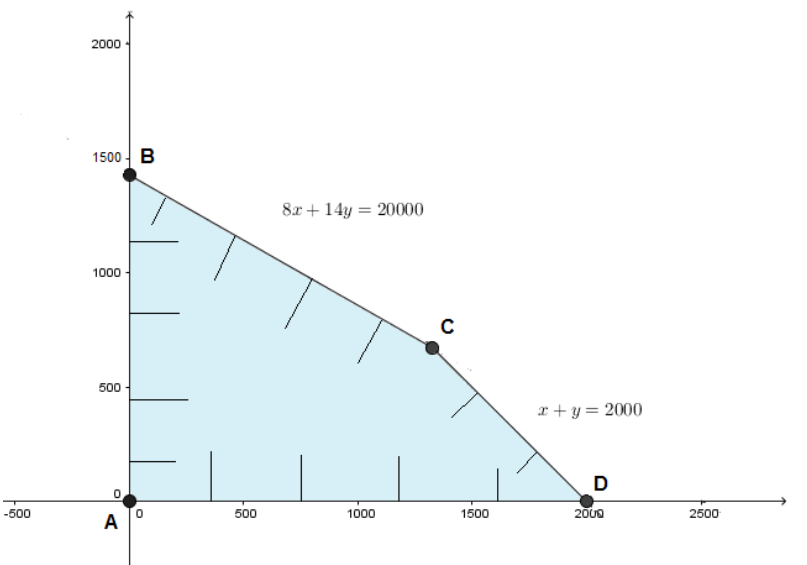
The vertices of the formed shape are:
\[ \Rightarrow A\left( {0,0} \right)\]
\[ \Rightarrow B\left( {0,1429} \right)\]
\[ \Rightarrow C\left( {1333,667} \right)\]
\[ \Rightarrow D\left( {2000,0} \right)\]
Calculating the profit at each vertex:
\[ \Rightarrow A\left( {0,0} \right) = 0\]
\[ \Rightarrow B\left( {0,1429} \right) = 4287\]
\[ \Rightarrow C\left( {1333,667} \right) = 4667\]
\[ \Rightarrow D\left( {2000,0} \right) = 4000\]
The maximum profit is at vertex \[C\].
So, the shopkeeper must sell \[1333\] units of toy \[A\] and \[667\] of toy \[B\].
Note: So, we saw that in solving questions like these, it is a cake walk if we just approach things systematically. In questions like these, we first find the equations which we are going to need to represent the system of inequality, plot the obtained system of the equations on a graph, find the vertices of the shape or curve we obtain by plotting the equations. Then, we just put in the values under the restraints and find the maximum or minimum (which depends upon what is being asked in the question) and then we are going to have the answer.
Complete step by step answer:
Let the number of toys of \[A\] and \[B\] be \[x\] and \[y\] respectively. Either of the two cannot be negative, so:
\[x \ge 0\]
\[y \ge 0\]
Now, the store owner estimates that no more than \[2000\] toys will be sold, so:
\[x + y \le 2000\]
Given, the cost of \[A\] is \[Rs.{\rm{ 8}}\] and that of \[B\] is \[Rs.{\rm{ 14}}\].
Also, he says that he is not going to invest more than \[Rs.{\rm{ 20000}}\], so:
\[8x + 14y \le 20000\]
One unit of toy \[A\] earns a profit of \[Rs.{\rm{ }}2\] and that of \[B\] does \[Rs.{\rm{ }}3\], so,
\[P = 2x + 3y\]
So, we have to solve this equation, for finding the maximum profit.
\[ \Rightarrow x \ge 0\]
\[ \Rightarrow y \ge 0\]
\[ \Rightarrow x + y \le 2000\]
\[ \Rightarrow 8x + 14y \le 20000\]
The vertices of the formed shape are:
\[ \Rightarrow A\left( {0,0} \right)\]
\[ \Rightarrow B\left( {0,1429} \right)\]
\[ \Rightarrow C\left( {1333,667} \right)\]
\[ \Rightarrow D\left( {2000,0} \right)\]
Calculating the profit at each vertex:
\[ \Rightarrow A\left( {0,0} \right) = 0\]
\[ \Rightarrow B\left( {0,1429} \right) = 4287\]
\[ \Rightarrow C\left( {1333,667} \right) = 4667\]
\[ \Rightarrow D\left( {2000,0} \right) = 4000\]
The maximum profit is at vertex \[C\].
So, the shopkeeper must sell \[1333\] units of toy \[A\] and \[667\] of toy \[B\].
Note: So, we saw that in solving questions like these, it is a cake walk if we just approach things systematically. In questions like these, we first find the equations which we are going to need to represent the system of inequality, plot the obtained system of the equations on a graph, find the vertices of the shape or curve we obtain by plotting the equations. Then, we just put in the values under the restraints and find the maximum or minimum (which depends upon what is being asked in the question) and then we are going to have the answer.
Recently Updated Pages
Three beakers labelled as A B and C each containing 25 mL of water were taken A small amount of NaOH anhydrous CuSO4 and NaCl were added to the beakers A B and C respectively It was observed that there was an increase in the temperature of the solutions contained in beakers A and B whereas in case of beaker C the temperature of the solution falls Which one of the following statements isarecorrect i In beakers A and B exothermic process has occurred ii In beakers A and B endothermic process has occurred iii In beaker C exothermic process has occurred iv In beaker C endothermic process has occurred

Master Class 9 Social Science: Engaging Questions & Answers for Success
Master Class 9 Science: Engaging Questions & Answers for Success
Master Class 9 Maths: Engaging Questions & Answers for Success
Master Class 9 General Knowledge: Engaging Questions & Answers for Success
Class 9 Question and Answer - Your Ultimate Solutions Guide
Three beakers labelled as A B and C each containing 25 mL of water were taken A small amount of NaOH anhydrous CuSO4 and NaCl were added to the beakers A B and C respectively It was observed that there was an increase in the temperature of the solutions contained in beakers A and B whereas in case of beaker C the temperature of the solution falls Which one of the following statements isarecorrect i In beakers A and B exothermic process has occurred ii In beakers A and B endothermic process has occurred iii In beaker C exothermic process has occurred iv In beaker C endothermic process has occurred
Master Class 9 Social Science: Engaging Questions & Answers for Success
Master Class 9 Science: Engaging Questions & Answers for Success
Trending doubts
Find the sum of series 1 + 2 + 3 + 4 + 5 + + 100 class 9 maths CBSE
Fill the blanks with the suitable prepositions 1 The class 9 english CBSE
Difference Between Plant Cell and Animal Cell
What is pollution? How many types of pollution? Define it
Name 10 Living and Non living things class 9 biology CBSE
Which are the Top 10 Largest States of India?