




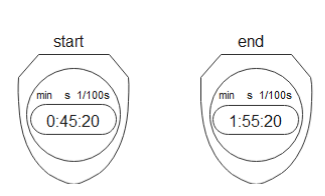
A stopwatch is used to time a runner in a race. The diagrams show the stopwatch at the start and the end of the race. How long did the runner take to run the race?
A. $70:00{\text{sec}}$
B. $110:00{\text{sec}}$
C. $115:00{\text{sec}}$
D. $155:00{\text{sec}}$
Answer
 Verified
519.9k+ views
Hint: This is a very simple question where we just need to carefully read the stopwatch time and subtract the start time from the time and we will get the total time taken by the runner to run the race.
Complete step by step answer:
Start time: $0:45:20$ which means ${\text{45min}}$ and $20{\text{sec}}$.
End time: $1:55:20$ which means $1{\text{h}}$, $55{\text{min}}$ and $20{\text{sec}}$
Now to calculate the time taken by the runner to run the race, we have to subtract the start time from the end time.
$1{\text{h}}:55\min :20\sec - 0:45\min :20\sec \\$
$ \Rightarrow 1{\text{h:10min}}$
We know that one hour consists of sixty minutes therefore the time required for the run to complete the race is $70\sec $.
Hence, option A is correct.
Additional information: A stopwatch is a handy timepiece designed to record the period which elapses between its activation and deactivation. In a manual stopwatch, the watch is started and stopped by a user pressing the button on it. However, in automatic timing, both starting and stopping are stimulated automatically, by sensors.
A mechanical stopwatch is powered by a mainspring that should be wound up by turning the knurled knob located at the top of the stopwatch. A big digital version of a stopwatch is created for viewing from a distance that can often be seen in stadiums and stations. These are more accurate timepieces than mechanical ones because of their crystal oscillator timing element.
Note: The least count of stopwatches are negligible. The less the least count more is the precision. Reading of the stopwatches should be read carefully in terms of hours and seconds. Keep the basic rule subtraction that only alike quantities be subtracted in mind when solving this problem.
Complete step by step answer:
Start time: $0:45:20$ which means ${\text{45min}}$ and $20{\text{sec}}$.
End time: $1:55:20$ which means $1{\text{h}}$, $55{\text{min}}$ and $20{\text{sec}}$
Now to calculate the time taken by the runner to run the race, we have to subtract the start time from the end time.
$1{\text{h}}:55\min :20\sec - 0:45\min :20\sec \\$
$ \Rightarrow 1{\text{h:10min}}$
We know that one hour consists of sixty minutes therefore the time required for the run to complete the race is $70\sec $.
Hence, option A is correct.
Additional information: A stopwatch is a handy timepiece designed to record the period which elapses between its activation and deactivation. In a manual stopwatch, the watch is started and stopped by a user pressing the button on it. However, in automatic timing, both starting and stopping are stimulated automatically, by sensors.
A mechanical stopwatch is powered by a mainspring that should be wound up by turning the knurled knob located at the top of the stopwatch. A big digital version of a stopwatch is created for viewing from a distance that can often be seen in stadiums and stations. These are more accurate timepieces than mechanical ones because of their crystal oscillator timing element.
Note: The least count of stopwatches are negligible. The less the least count more is the precision. Reading of the stopwatches should be read carefully in terms of hours and seconds. Keep the basic rule subtraction that only alike quantities be subtracted in mind when solving this problem.
Recently Updated Pages
Master Class 11 Social Science: Engaging Questions & Answers for Success

Master Class 11 Physics: Engaging Questions & Answers for Success
Master Class 11 Maths: Engaging Questions & Answers for Success
Master Class 11 Economics: Engaging Questions & Answers for Success
Master Class 11 Computer Science: Engaging Questions & Answers for Success
Master Class 11 Chemistry: Engaging Questions & Answers for Success
Trending doubts
There are 720 permutations of the digits 1 2 3 4 5 class 11 maths CBSE
1 Quintal is equal to a 110 kg b 10 kg c 100kg d 1000 class 11 physics CBSE
Which among the following are examples of coming together class 11 social science CBSE
Discuss the various forms of bacteria class 11 biology CBSE
What organs are located on the left side of your body class 11 biology CBSE
Draw a labelled diagram showing structure of LS of class 11 biology CBSE