




A stone tied to the string of $1m$ long is whirled in a horizontal circle with a constant speed.if the stone makes $22$ revolutions in $44$ seconds what would be the magnitude and direction of the stone.
A.${{\pi }^{2}}m{{s}^{-2}}$ and direction along the tangent to the circle
B.${{\pi }^{2}}m{{s}^{-2}}$ and direction along the radius towards the centre
C.$2{{\pi }^{2}}m{{s}^{-2}}$and direction along the radius towards the centre
D.${{\pi }^{2}}m{{s}^{-2}}$ and direction along the radius away from the centre
Answer
 Verified
577.8k+ views
Hint: The concept of centripetal acceleration is to be applied here, Motion of a particle in a horizontal circle is an example of uniform circular motion. Centripetal acceleration is towards the centre that gives rise to the force which actually is responsible for particles to move in a circular path.
Complete step by step answer:
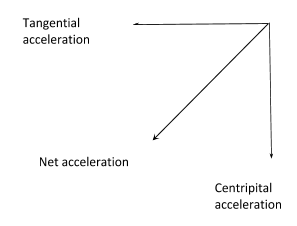
A particle while moving in a circular path has two types of acceleration
Centripetal and tangential acceleration.
Since a horizontal circle is an example of uniform circular motion it does not have any tangential force or a tangential acceleration along the tangent and hence only has centripetal acceleration that promotes its motion in a horizontal circle.
Centripetal acceleration arises due to centripetal force which is acting along centre and hence direction of centripetal acceleration is towards the centre or radius of the circle.
Centripetal acceleration in terms of angular velocity $w$, radius $r$ is defined as ${{w}^{2}}\times r$ where $w=2\pi f$ (f is frequency).
$frequency=\dfrac{no\,of\,revolutions}{time\,in\,\sec ond}$
$r=1m$
No. of revolutions = 22
Time = 44 seconds
$frequency=\dfrac{22}{44}hertz=\dfrac{1}{2}hertz$
The magnitude of centripetal acceleration=${{w}^{2}}r$
$\Rightarrow {{\left( 2\times \pi \times frequency \right)}^{2}}\times 1m$
$\Rightarrow {{\left( 2\times \pi \times \dfrac{1}{2} \right)}^{2}}\times 1m$
$\therefore {{\pi }^{2}}m/{{s}^{2}}$ is the magnitude and direction is towards the center.
Hence the correct option is B.
Note:
Motion of a particle in a vertical circle is an example of non-uniform vertical motion. In this motion the net acceleration of the particle is the vector sum of tangential velocity and centripetal velocity.
Complete step by step answer:
A particle while moving in a circular path has two types of acceleration
Centripetal and tangential acceleration.
Since a horizontal circle is an example of uniform circular motion it does not have any tangential force or a tangential acceleration along the tangent and hence only has centripetal acceleration that promotes its motion in a horizontal circle.
Centripetal acceleration arises due to centripetal force which is acting along centre and hence direction of centripetal acceleration is towards the centre or radius of the circle.
Centripetal acceleration in terms of angular velocity $w$, radius $r$ is defined as ${{w}^{2}}\times r$ where $w=2\pi f$ (f is frequency).
$frequency=\dfrac{no\,of\,revolutions}{time\,in\,\sec ond}$
$r=1m$
No. of revolutions = 22
Time = 44 seconds
$frequency=\dfrac{22}{44}hertz=\dfrac{1}{2}hertz$
The magnitude of centripetal acceleration=${{w}^{2}}r$
$\Rightarrow {{\left( 2\times \pi \times frequency \right)}^{2}}\times 1m$
$\Rightarrow {{\left( 2\times \pi \times \dfrac{1}{2} \right)}^{2}}\times 1m$
$\therefore {{\pi }^{2}}m/{{s}^{2}}$ is the magnitude and direction is towards the center.
Hence the correct option is B.
Note:
Motion of a particle in a vertical circle is an example of non-uniform vertical motion. In this motion the net acceleration of the particle is the vector sum of tangential velocity and centripetal velocity.
Recently Updated Pages
Master Class 11 Computer Science: Engaging Questions & Answers for Success

Master Class 11 Business Studies: Engaging Questions & Answers for Success
Master Class 11 Economics: Engaging Questions & Answers for Success
Master Class 11 English: Engaging Questions & Answers for Success
Master Class 11 Maths: Engaging Questions & Answers for Success
Master Class 11 Biology: Engaging Questions & Answers for Success
Trending doubts
One Metric ton is equal to kg A 10000 B 1000 C 100 class 11 physics CBSE
There are 720 permutations of the digits 1 2 3 4 5 class 11 maths CBSE
Discuss the various forms of bacteria class 11 biology CBSE
Draw a diagram of a plant cell and label at least eight class 11 biology CBSE
State the laws of reflection of light
Explain zero factorial class 11 maths CBSE