




A stone of mass 1 kg is attached to the one end of a string of length 1 m and breaking strength 500 N, and is whirled in a horizontal circle on a frictionless table top. The other end of the string is kept fixed. Find the maximum speed the stone can attain, without breaking the string.
Answer
 Verified
603.6k+ views
Hint: In this question, breaking point means that after 500 N if the tension is further increased, the rope will break. Use this information while making the net force equation. The centripetal force will be acting against the string.
Formula used:
For solving this question, we will be using the formula for the centripetal force, i.e.,
${{F}_{C}}=\dfrac{m{{v}^{2}}}{r}$
Complete answer:
Now, before we start solving the above question, let us take a look at all the given parameters
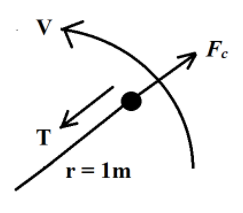
m = 1 kg, where m is the mass of the stone
r = 1 m. where r is the length of the rope
T = 500 N, where T is the breaking point of the rope, and in this case tension for calculating the maximum velocity
Now, as we are calculating the maximum speed attained,
We will take F = 500 N, as after 500 N the rope will break
So, We have
$F=\dfrac{m{{v}^{2}}}{r}$
$500=\dfrac{1\times {{v}^{2}}}{1}$
$500={{v}^{2}}$
$v=\sqrt{500}m/s$
$v=10\sqrt{5}m/s$
So, the maximum speed the stone can attain, without breaking the string will be, $v=10\sqrt{5}m/s$
Note:
If you are calculating the speed for any instance apart from the maximum velocity case, there will be one more variable in the equation, i.e., the weight of the stone. So the equation will become
$T+mg=\dfrac{m{{v}^{2}}}{r}$
Formula used:
For solving this question, we will be using the formula for the centripetal force, i.e.,
${{F}_{C}}=\dfrac{m{{v}^{2}}}{r}$
Complete answer:
Now, before we start solving the above question, let us take a look at all the given parameters
m = 1 kg, where m is the mass of the stone
r = 1 m. where r is the length of the rope
T = 500 N, where T is the breaking point of the rope, and in this case tension for calculating the maximum velocity
Now, as we are calculating the maximum speed attained,
We will take F = 500 N, as after 500 N the rope will break
So, We have
$F=\dfrac{m{{v}^{2}}}{r}$
$500=\dfrac{1\times {{v}^{2}}}{1}$
$500={{v}^{2}}$
$v=\sqrt{500}m/s$
$v=10\sqrt{5}m/s$
So, the maximum speed the stone can attain, without breaking the string will be, $v=10\sqrt{5}m/s$
Note:
If you are calculating the speed for any instance apart from the maximum velocity case, there will be one more variable in the equation, i.e., the weight of the stone. So the equation will become
$T+mg=\dfrac{m{{v}^{2}}}{r}$
Recently Updated Pages
Master Class 11 Social Science: Engaging Questions & Answers for Success

Master Class 11 Physics: Engaging Questions & Answers for Success
Master Class 11 Maths: Engaging Questions & Answers for Success
Master Class 11 Economics: Engaging Questions & Answers for Success
Master Class 11 Computer Science: Engaging Questions & Answers for Success
Master Class 11 Chemistry: Engaging Questions & Answers for Success
Trending doubts
One Metric ton is equal to kg A 10000 B 1000 C 100 class 11 physics CBSE
There are 720 permutations of the digits 1 2 3 4 5 class 11 maths CBSE
1 Quintal is equal to a 110 kg b 10 kg c 100kg d 1000 class 11 physics CBSE
State and prove Bernoullis theorem class 11 physics CBSE
Difference Between Prokaryotic Cells and Eukaryotic Cells
Discuss the various forms of bacteria class 11 biology CBSE