




A stone of 1kg is thrown with a velocity of 20 m/s across the frozen surface of a lake and comes to rest after travelling a distance of 50m. What is the force of friction between the stone and the ice?
Answer
 Verified
665.1k+ views
Hint: The frictional force acting on the stone balances the force propelling the stone forward when the stone comes to rest. By using the equations of motion and the known values we can calculate the magnitude of frictional force.
Detailed step by step solution:
We are given a stone whose mass is given as
$m = 1kg$
It is thrown across the surface of a frozen lake with a velocity given as
$u = 20m/s$
As the stone slides across the surface of lake, the ice exerts a frictional force, denoted by f, on the stone due to which the stone loses its energy and eventually comes to rest after travelling a distance of
$S = 50m$
Now we can draw a free body diagram for stone and ice in the following way:
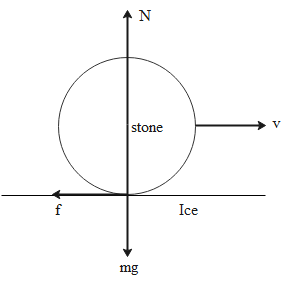
Now we see that as the stone comes to rest, it is due to the frictional force f which balances the force with which the stone is propelled forward. Therefore, we can say that
$
f - ma = 0 \\
\therefore f = ma \\
$
Now we can use the equation of motion given as
${{\text{v}}^2} - {u^2} = 2aS$
Now since the stone comes to rest, the final velocity v = 0. Therefore we can calculate the value of acceleration of stone by using the known values in above equation as follows:
$
{u^2} + 2aS = 0 \\
\Rightarrow {\left( {20} \right)^2} + 2a\left( {50} \right) = 0 \\
\Rightarrow 100a = - 400 \\
\Rightarrow a = - 4m/{s^2} \\
$
Hence, the magnitude of frictional force is given as follows:
$f = ma = 1 \times \left( { - 4} \right) = - 4N$
This is the required answer to the question.
Note: The frictional force always acts in the direction opposite to the direction of motion of the body. The negative sign for frictional force means that the force is acting in the opposite direction and deceleration is taking place in the motion of the stone when it slides over the surface of the lake.
Detailed step by step solution:
We are given a stone whose mass is given as
$m = 1kg$
It is thrown across the surface of a frozen lake with a velocity given as
$u = 20m/s$
As the stone slides across the surface of lake, the ice exerts a frictional force, denoted by f, on the stone due to which the stone loses its energy and eventually comes to rest after travelling a distance of
$S = 50m$
Now we can draw a free body diagram for stone and ice in the following way:
Now we see that as the stone comes to rest, it is due to the frictional force f which balances the force with which the stone is propelled forward. Therefore, we can say that
$
f - ma = 0 \\
\therefore f = ma \\
$
Now we can use the equation of motion given as
${{\text{v}}^2} - {u^2} = 2aS$
Now since the stone comes to rest, the final velocity v = 0. Therefore we can calculate the value of acceleration of stone by using the known values in above equation as follows:
$
{u^2} + 2aS = 0 \\
\Rightarrow {\left( {20} \right)^2} + 2a\left( {50} \right) = 0 \\
\Rightarrow 100a = - 400 \\
\Rightarrow a = - 4m/{s^2} \\
$
Hence, the magnitude of frictional force is given as follows:
$f = ma = 1 \times \left( { - 4} \right) = - 4N$
This is the required answer to the question.
Note: The frictional force always acts in the direction opposite to the direction of motion of the body. The negative sign for frictional force means that the force is acting in the opposite direction and deceleration is taking place in the motion of the stone when it slides over the surface of the lake.
Recently Updated Pages
If x a + bt + ct2 where x is in meters and t is in class 11 physics CBSE

A car covers the first half distance between two places class 11 physics CBSE
The resultant of two vectors overrightarrow P and overrightarrow class 11 physics CBSE
Find the value of cos 135 class 11 maths CBSE
A mass M is held in place by an applied force F and class 11 physics CBSE
A solution of glucose in water is labelled as 10 dfracwv class 11 chemistry CBSE
Trending doubts
One Metric ton is equal to kg A 10000 B 1000 C 100 class 11 physics CBSE
Find the value of the expression given below sin 30circ class 11 maths CBSE
What do you mean by retardation What is its SI uni class 11 physics CBSE
Draw a diagram of nephron and explain its structur class 11 biology CBSE
10 examples of friction in our daily life
Difference between physical and chemical change class 11 chemistry CBSE