




A stone is thrown vertically upwards and it reaches a maximum height of $30{\text{ }}m$. What was its initial velocity?
Answer
 Verified
552k+ views
Hint: In the given question the maximum height attained by the stone is given. Hence, the stone follows projectile motion. We will use the formula used to find the maximum height and hence by substituting the values we will find the answer.
Complete answer:
It is given in the question that the maximum height attained by the stone is $30{\text{ }}m$.
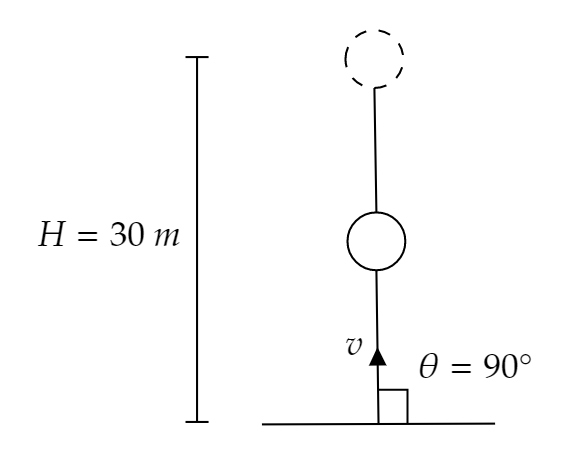
The stone thus follows projectile motion.
The formula to find the maximum height attained by a particle in projectile motion is,
$H = \dfrac{{{v^2}{{\sin }^2}\theta }}{{2g}} - - - - \left( 1 \right)$
The variables are defined as,
$H = $ maximum height attained by the body that is thrown
$v = $ initial velocity at which the body is thrown
$\theta = $ angle at which the body is thrown
$g = $ acceleration due to gravity
The maximum height $H = 30{\text{ }}m$
The angle of projection $\theta = {90^ \circ }$ as the question is mentioned that the stone is thrown vertically upwards.
$g = 9.8{\text{ }}\dfrac{m}{{{s^2}}}$
Substituting the values in equation $\left( 1 \right)$ we get,
$30 = \dfrac{{{v^2}{{\sin }^2}{{90}^ \circ }}}{{2 \times 9.8}}$
From trigonometric values we know, $\sin {90^ \circ } = 1$. Now, we get,
${v^2} = 588$
Square root of the given equation we get,
$v = 24.24$
The initial velocity of the stone which is thrown vertically upward is $24.24{\text{ }}\dfrac{m}{s}$.
Note: Students tend to make errors while solving these types of questions because they fail to apply the formulas correctly, as well as to use the correct sign based on the direction of motion of the object. So, they should make sure to understand the problem's scenario clearly and then solve it without any error in calculation.
Complete answer:
It is given in the question that the maximum height attained by the stone is $30{\text{ }}m$.
The stone thus follows projectile motion.
The formula to find the maximum height attained by a particle in projectile motion is,
$H = \dfrac{{{v^2}{{\sin }^2}\theta }}{{2g}} - - - - \left( 1 \right)$
The variables are defined as,
$H = $ maximum height attained by the body that is thrown
$v = $ initial velocity at which the body is thrown
$\theta = $ angle at which the body is thrown
$g = $ acceleration due to gravity
The maximum height $H = 30{\text{ }}m$
The angle of projection $\theta = {90^ \circ }$ as the question is mentioned that the stone is thrown vertically upwards.
$g = 9.8{\text{ }}\dfrac{m}{{{s^2}}}$
Substituting the values in equation $\left( 1 \right)$ we get,
$30 = \dfrac{{{v^2}{{\sin }^2}{{90}^ \circ }}}{{2 \times 9.8}}$
From trigonometric values we know, $\sin {90^ \circ } = 1$. Now, we get,
${v^2} = 588$
Square root of the given equation we get,
$v = 24.24$
The initial velocity of the stone which is thrown vertically upward is $24.24{\text{ }}\dfrac{m}{s}$.
Note: Students tend to make errors while solving these types of questions because they fail to apply the formulas correctly, as well as to use the correct sign based on the direction of motion of the object. So, they should make sure to understand the problem's scenario clearly and then solve it without any error in calculation.
Recently Updated Pages
Master Class 11 Social Science: Engaging Questions & Answers for Success

Master Class 11 English: Engaging Questions & Answers for Success
Master Class 11 Accountancy: Engaging Questions & Answers for Success
Master Class 11 Physics: Engaging Questions & Answers for Success
Master Class 11 Computer Science: Engaging Questions & Answers for Success
Master Class 11 Business Studies: Engaging Questions & Answers for Success
Trending doubts
One Metric ton is equal to kg A 10000 B 1000 C 100 class 11 physics CBSE
Find the value of the expression given below sin 30circ class 11 maths CBSE
Draw a diagram of nephron and explain its structur class 11 biology CBSE
10 examples of friction in our daily life
Proton was discovered by A Thomson B Rutherford C Chadwick class 11 chemistry CBSE
The teeth used for biting and cutting food are called class 11 biology CBSE