




A stone is thrown vertically upward from the cliff with velocity $5m/s$ . It strikes the pond near the base of the cliff after \[4s\]. The height of the cliff is?
\[\begin{align}
& A.6m \\
& B.60m \\
& C.40m \\
& D100m \\
\end{align}\]
Answer
 Verified
611.4k+ views
Hint: Here the initial velocity of the stone and the time taken by the stone to reach the pond is given. Then from the third equation of motion, we can calculate the distance covered by the stone. Since the stone is thrown from the cliff, the distance covered by the stone is the height of the stone.
Formula used:
$s=ut+\dfrac{1}{2}at^{2}$
Complete step-by-step answer:
Given that the initial velocity of the stone is $u=5m/s$. And it takes $t=4s$ to reach the pond.
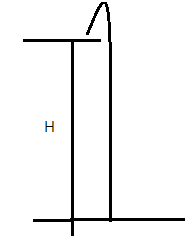
Let $H$ be the height of the cliff. Since the stone is thrown vertically upward from the cliff, we can say that the stone experiences the acceleration due to gravity given as $-g$.
Then from the third equation of motion, we know $s=ut+\dfrac{1}{2}at^{2}$
Substituting all the values on the respective places , we get, $H=5\times 4+\dfrac{1}{2}(-10)(4^{2})$
$\implies H=20-80=-60m$
The negative sign is because the distance I measured with respect to the cliff.
Hence the answer is \[B.60m\]
So, the correct answer is “Option B”.
Additional Information: There are three equations of motions, which interrelate the initial velocity $u$, final velocity $v$, acceleration $a$ during the time $t$ and the distance $s$ covered by the body. They are as follows:
1. the first equation of motion; $v=u+at$
2. the second equation of motion; $s=ut+\dfrac{1}{2}at^{2}$
3. the third equation of motion; $v^{2}-u^{2}=2as$
However these can only be used if and only if the body travels in one dimension or a straight line.
Note: This sum may look complicated like a projectile motion. But it is easy sums which can be solved using the equation of motion. Here we are assuming that the stone travels in a straight line. We also ignore the small distance it travelled above the cliff.
Formula used:
$s=ut+\dfrac{1}{2}at^{2}$
Complete step-by-step answer:
Given that the initial velocity of the stone is $u=5m/s$. And it takes $t=4s$ to reach the pond.
Let $H$ be the height of the cliff. Since the stone is thrown vertically upward from the cliff, we can say that the stone experiences the acceleration due to gravity given as $-g$.
Then from the third equation of motion, we know $s=ut+\dfrac{1}{2}at^{2}$
Substituting all the values on the respective places , we get, $H=5\times 4+\dfrac{1}{2}(-10)(4^{2})$
$\implies H=20-80=-60m$
The negative sign is because the distance I measured with respect to the cliff.
Hence the answer is \[B.60m\]
So, the correct answer is “Option B”.
Additional Information: There are three equations of motions, which interrelate the initial velocity $u$, final velocity $v$, acceleration $a$ during the time $t$ and the distance $s$ covered by the body. They are as follows:
1. the first equation of motion; $v=u+at$
2. the second equation of motion; $s=ut+\dfrac{1}{2}at^{2}$
3. the third equation of motion; $v^{2}-u^{2}=2as$
However these can only be used if and only if the body travels in one dimension or a straight line.
Note: This sum may look complicated like a projectile motion. But it is easy sums which can be solved using the equation of motion. Here we are assuming that the stone travels in a straight line. We also ignore the small distance it travelled above the cliff.
Recently Updated Pages
Master Class 11 Social Science: Engaging Questions & Answers for Success

Master Class 11 English: Engaging Questions & Answers for Success
Master Class 11 Maths: Engaging Questions & Answers for Success
Master Class 11 Chemistry: Engaging Questions & Answers for Success
Master Class 11 Biology: Engaging Questions & Answers for Success
Master Class 11 Physics: Engaging Questions & Answers for Success
Trending doubts
One Metric ton is equal to kg A 10000 B 1000 C 100 class 11 physics CBSE
Difference Between Prokaryotic Cells and Eukaryotic Cells
Draw a diagram of a plant cell and label at least eight class 11 biology CBSE
Two of the body parts which do not appear in MRI are class 11 biology CBSE
Which gas is abundant in air class 11 chemistry CBSE
10 examples of friction in our daily life