




A stone is thrown vertically up from the tower of height $25{\text{ }}m$ with a speed of $20{\text{ }}\dfrac{m}{s}$ time taken to reach the ground?
Answer
 Verified
540.9k+ views
Hint: First of all, we have to find the height which is achieved by the stone when thrown vertically upwards. Then we have to find the total height required by the stone to reach the ground. By using motion’s equation we will find separate time intervals. Then by their algebraic sum we will find the total time required to reach the ground.
Complete step by step answer:
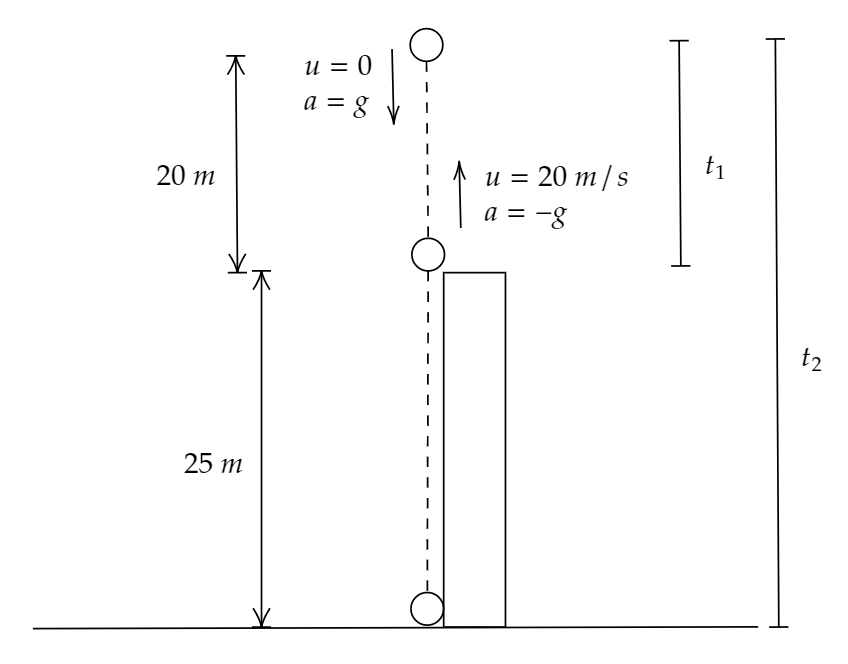
It is given that the stone is thrown upward from a tower of height $25{\text{ }}m$ with a speed of $20{\text{ }}\dfrac{m}{s}$.
Let us consider that the height which the stone attains when it is thrown vertically from the tower be $h$.
From the Motion’s Equation, we get,
${v^2} - {u^2} = 2as - - - \left( 1 \right)$
The variables are defined as,
$v = $ final velocity achieved by the object
$u = $ initial velocity applied to the object
$a = $ acceleration of the object
$s = $ distance covered by the object
For the given question, when the stone is thrown,
The final velocity $v = 0$
Initial velocity is given as $u = 20{\text{ }}\dfrac{m}{s}$
Acceleration of the stone is the acceleration due to gravity $a = - g = - 10{\text{ }}\dfrac{m}{{{s^2}}}$
The height achieved by the stone $s = h$
Substituting the values in equation $\left( 1 \right)$ we get,
$0 - {\left( {20} \right)^2} = 2 \times - 10 \times h$
$ \Rightarrow h = \dfrac{{ - 400}}{{ - 20}} = 20$
The height attained by the stone is $20{\text{ }}m$.
Let the time required to reach height $20{\text{ }}m$ by the stone be ${t_1}$.
From the relation $v = u + at - - - - \left( 2 \right)$ where $v = $final velocity, $u = $ initial velocity, $a = $acceleration and $t = $ time.
Here, $v = 0,{\text{ }}u = 20,{\text{ }}a = - g = - 10,{\text{ }}t = {t_1}$
Substituting the value in equation $\left( 2 \right)$ we get,
$0 = 20 - 10{t_1}$
$ \Rightarrow {t_1} = 2{\text{ }}s$
Now, the distance to be covered by the stone to reach ground$ = \left( {20 + 25} \right)m = 45{\text{ }}m$
Now, we have to use the relation $s = ut + \dfrac{1}{2}a{t^2} - - - - \left( 3 \right)$, where $s = $ distance to be covered$ = 45{\text{ }}m$, $t = $ time required$ = {t_2}$, initial velocity $ = u = 0{\text{ }}\dfrac{m}{s}$ and $a = $ acceleration$ = g = 10{\text{ }}\dfrac{m}{{{s^2}}}$
Substituting all the values in equation $\left( 3 \right)$ we get,
$45 = 0 + \dfrac{1}{2} \times 10 \times t_2^2$
$ \Rightarrow {t_2} = 3{\text{ }}s$
The total time required by the stone to reach the ground$ = \left( {{t_1} + {t_2}} \right) = \left( {2 + 3} \right) = 5{\text{ }}s$.
The stone takes $5{\text{ }}s$ to reach the ground.
Note:It must be noted that the acceleration of the particle is considered to be acceleration due to gravity as the stone thrown and returned is in vertical direction. When the stone is thrown upward the acceleration is negative as it acts opposite to the direction of the acceleration due to gravity.
Complete step by step answer:
It is given that the stone is thrown upward from a tower of height $25{\text{ }}m$ with a speed of $20{\text{ }}\dfrac{m}{s}$.
Let us consider that the height which the stone attains when it is thrown vertically from the tower be $h$.
From the Motion’s Equation, we get,
${v^2} - {u^2} = 2as - - - \left( 1 \right)$
The variables are defined as,
$v = $ final velocity achieved by the object
$u = $ initial velocity applied to the object
$a = $ acceleration of the object
$s = $ distance covered by the object
For the given question, when the stone is thrown,
The final velocity $v = 0$
Initial velocity is given as $u = 20{\text{ }}\dfrac{m}{s}$
Acceleration of the stone is the acceleration due to gravity $a = - g = - 10{\text{ }}\dfrac{m}{{{s^2}}}$
The height achieved by the stone $s = h$
Substituting the values in equation $\left( 1 \right)$ we get,
$0 - {\left( {20} \right)^2} = 2 \times - 10 \times h$
$ \Rightarrow h = \dfrac{{ - 400}}{{ - 20}} = 20$
The height attained by the stone is $20{\text{ }}m$.
Let the time required to reach height $20{\text{ }}m$ by the stone be ${t_1}$.
From the relation $v = u + at - - - - \left( 2 \right)$ where $v = $final velocity, $u = $ initial velocity, $a = $acceleration and $t = $ time.
Here, $v = 0,{\text{ }}u = 20,{\text{ }}a = - g = - 10,{\text{ }}t = {t_1}$
Substituting the value in equation $\left( 2 \right)$ we get,
$0 = 20 - 10{t_1}$
$ \Rightarrow {t_1} = 2{\text{ }}s$
Now, the distance to be covered by the stone to reach ground$ = \left( {20 + 25} \right)m = 45{\text{ }}m$
Now, we have to use the relation $s = ut + \dfrac{1}{2}a{t^2} - - - - \left( 3 \right)$, where $s = $ distance to be covered$ = 45{\text{ }}m$, $t = $ time required$ = {t_2}$, initial velocity $ = u = 0{\text{ }}\dfrac{m}{s}$ and $a = $ acceleration$ = g = 10{\text{ }}\dfrac{m}{{{s^2}}}$
Substituting all the values in equation $\left( 3 \right)$ we get,
$45 = 0 + \dfrac{1}{2} \times 10 \times t_2^2$
$ \Rightarrow {t_2} = 3{\text{ }}s$
The total time required by the stone to reach the ground$ = \left( {{t_1} + {t_2}} \right) = \left( {2 + 3} \right) = 5{\text{ }}s$.
The stone takes $5{\text{ }}s$ to reach the ground.
Note:It must be noted that the acceleration of the particle is considered to be acceleration due to gravity as the stone thrown and returned is in vertical direction. When the stone is thrown upward the acceleration is negative as it acts opposite to the direction of the acceleration due to gravity.
Recently Updated Pages
Master Class 11 English: Engaging Questions & Answers for Success

Master Class 11 Physics: Engaging Questions & Answers for Success
Master Class 11 Computer Science: Engaging Questions & Answers for Success
Master Class 11 Chemistry: Engaging Questions & Answers for Success
Master Class 11 Social Science: Engaging Questions & Answers for Success
Master Class 11 Accountancy: Engaging Questions & Answers for Success
Trending doubts
Difference Between Prokaryotic Cells and Eukaryotic Cells
Two of the body parts which do not appear in MRI are class 11 biology CBSE
One Metric ton is equal to kg A 10000 B 1000 C 100 class 11 physics CBSE
10 examples of friction in our daily life
Draw a diagram of nephron and explain its structur class 11 biology CBSE
Draw a diagram of a plant cell and label at least eight class 11 biology CBSE