




A stone is projected vertically up from the ground with velocity $40\,m{s^{ - 1}}$. The internal of time between the two instants at which the stone is at a height of $60\,m$ above the ground is: [$g = 10\,m{s^{ - 2}}$]
(A) $4\,s$
(B) $6\,s$
(C) $8\,s$
(D) $12\,s$
Answer
 Verified
527.5k+ views
Hint:This problem can be calculated by using the second law of motion. Use this formula, substitute the parameters given in the question and find the answer for the time taken. The height of the projection should be taken as the distance covered.
Useful formula:
(1) The second equation of motion is given by
$s = ut + \dfrac{1}{2}{\left( {at} \right)^2}$
Where $s$ is the distance travelled by the stone, $u$ is the initial velocity of the stone, $t$ is the time taken by the stone for the projection and $a$ is the acceleration of the stone.
Complete step by step solution:
The given data from the question are
The velocity in which the stone thrown upward, $v = 40\,m{s^{ - 1}}$
Height at which the stone thrown, $h = 60\,m$
The acceleration due to the gravity is approximately given, $a = 10\,m{s^{ - 2}}$.
By taking the second law of motion,
$s = ut + \dfrac{1}{2}{\left( {at} \right)^2}$
Substituting the values of the terms in the above equation, taking the height of the projection as the distance travelled.
$60 = (40t) - \dfrac{1}{2}(10){t^2}$
$60 = 40t - 5{t^2}$
By rearranging the given terms,
$5{t^2} - 40t = - 60$
By further simplifying the equation,
${t^2} - 8t = - 12$
By solving the above equation,
$t\left( {t - 6} \right) - 2\left( {t - 6} \right) = 0$
$t - 2 = 0,\,t - 6 = 0$
${t_1} = 2$ or ${t_2} = 6$
Hence the two instances of the time are $6\,s$ and $2\,s$.
The interval of time between the two instances is given by $6 - 2 = 4\,s$. Hence the interval between the two instances of the stone projection is $4\,s$.
Thus the option (A) is correct.
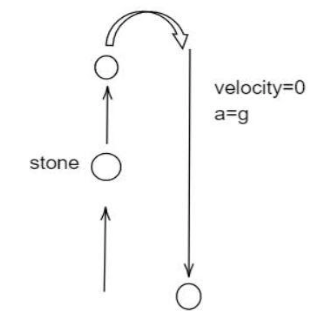
Note:Here the stone is thrown upward. It moves until its velocity becomes zero. After that it stops its upward motion and reaches the ground with the acceleration due to gravity. It is the peculiar case in which the acceleration with the zero velocity.
Useful formula:
(1) The second equation of motion is given by
$s = ut + \dfrac{1}{2}{\left( {at} \right)^2}$
Where $s$ is the distance travelled by the stone, $u$ is the initial velocity of the stone, $t$ is the time taken by the stone for the projection and $a$ is the acceleration of the stone.
Complete step by step solution:
The given data from the question are
The velocity in which the stone thrown upward, $v = 40\,m{s^{ - 1}}$
Height at which the stone thrown, $h = 60\,m$
The acceleration due to the gravity is approximately given, $a = 10\,m{s^{ - 2}}$.
By taking the second law of motion,
$s = ut + \dfrac{1}{2}{\left( {at} \right)^2}$
Substituting the values of the terms in the above equation, taking the height of the projection as the distance travelled.
$60 = (40t) - \dfrac{1}{2}(10){t^2}$
$60 = 40t - 5{t^2}$
By rearranging the given terms,
$5{t^2} - 40t = - 60$
By further simplifying the equation,
${t^2} - 8t = - 12$
By solving the above equation,
$t\left( {t - 6} \right) - 2\left( {t - 6} \right) = 0$
$t - 2 = 0,\,t - 6 = 0$
${t_1} = 2$ or ${t_2} = 6$
Hence the two instances of the time are $6\,s$ and $2\,s$.
The interval of time between the two instances is given by $6 - 2 = 4\,s$. Hence the interval between the two instances of the stone projection is $4\,s$.
Thus the option (A) is correct.
Note:Here the stone is thrown upward. It moves until its velocity becomes zero. After that it stops its upward motion and reaches the ground with the acceleration due to gravity. It is the peculiar case in which the acceleration with the zero velocity.
Recently Updated Pages
Master Class 11 English: Engaging Questions & Answers for Success

Master Class 11 Maths: Engaging Questions & Answers for Success
Master Class 11 Biology: Engaging Questions & Answers for Success
Master Class 11 Social Science: Engaging Questions & Answers for Success
Master Class 11 Physics: Engaging Questions & Answers for Success
Master Class 11 Accountancy: Engaging Questions & Answers for Success
Trending doubts
One Metric ton is equal to kg A 10000 B 1000 C 100 class 11 physics CBSE
There are 720 permutations of the digits 1 2 3 4 5 class 11 maths CBSE
Discuss the various forms of bacteria class 11 biology CBSE
Draw a diagram of a plant cell and label at least eight class 11 biology CBSE
State the laws of reflection of light
Explain zero factorial class 11 maths CBSE