




A stone is projected from the ground with velocity 50 m/s at an angle of 30° It crosses a wall after 3 sec. How far beyond the wall the stone will strike the ground? (g = 10 $m/{s^2}$)
Answer
 Verified
586.5k+ views
Hint: As the body is projected at an angle, it will be a projectile motion and then we can find the time of flight for complete motion, then for the required distance, time will be the difference between the total and crossing the wall.
Velocity vectors will be $u\sin \theta $ and $u\cos \theta $respectively for x and y axes.
Formula used:
$s = ut + \dfrac{1}{2}a{t^2}$, where s is displacement, u is initial velocity, a is acceleration and t is time
$speed = \dfrac{{dis\tan ce}}{{time}}$
Complete step by step answer:
As the stone is projected at an angle $\theta $ of 30°, it will be in a projectile motion
The time of flight of this projectile will tell after how much time it will come to rest.
Using Newton’s laws of motion:
$s = ut + \dfrac{1}{2}a{t^2}$
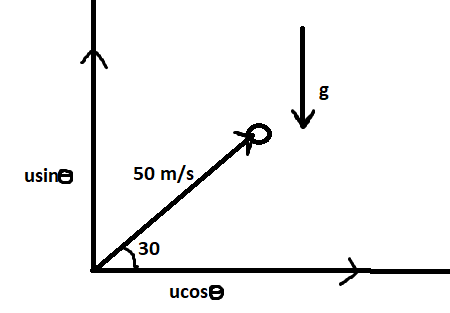
The motion of this projectile is in y – direction so the quantities with respect to that are:
Displacement (s) = 0 [displacement is only along x – axis]
Initial velocity (u) = $u\sin \theta $ [along y - axis]
Acceleration (a) = g [since in air acceleration is only due to gravitational force
Time (t) = T [time of flight]
$ \Rightarrow 0 = u\sin \theta T + \dfrac{1}{2}g{T^2}$
$
\implies 2u\sin \theta = gT \\
\Rightarrow T = \dfrac{{2u\sin \theta }}{g} \\
$
For the given projected stone:
Angle $\left( \theta \right)$ = 30°
Initial speed (u) = 50 m/s [given]
Calculating its time of flight:
$
T = \dfrac{{2 \times 50\sin 30}}{{10}}\left( {\because g = 10} \right) \\
\implies T = \dfrac{{2 \times 50}}{{10}} \times \dfrac{1}{2}\left( {\because \sin 30 = \dfrac{1}{2}} \right) \\
\implies T = 5 \\
$
Thus, in 5 seconds the stone will come to rest.
It is given that it crosses the wall in 3 seconds.
The time left before it touch the ground is:
t = (5 – 3) seconds
t = 2 seconds.
The distance it will cover beyond wall will be along x – axis
Using the formula:
$
speed = \dfrac{{dis\tan ce}}{{time}} \\
dis\tan ce = speed \times time \\
$
Speed = $u\cos \theta $ [along x – axis]
Time = 2s [remaining time]
$\Rightarrow dis\tan ce = u\cos 30 \times 2\left( {\because \theta = {{30}^o}} \right) \\$
$dis\tan ce$= $50 \times$ $\dfrac{{\sqrt 3 }}{2}$ $\times2$ $\because \theta$ = $\dfrac{{\sqrt 3 }}{2} \\$
$dis\tan ce = 50\sqrt 3 m \\ $
Therefore, the distance the stone covers beyond the wall is $50\sqrt 3 m$ or 86.6 m.
Note:
When a body is thrown at an angle in air, it is known as projectile, its motion is called projectile motion and its path is called trajectory
When the object is in air, it is only under the force of gravity acting at all its position downward in direction, due to this reason, always a parabolic path is covered.
Velocity vectors will be $u\sin \theta $ and $u\cos \theta $respectively for x and y axes.
Formula used:
$s = ut + \dfrac{1}{2}a{t^2}$, where s is displacement, u is initial velocity, a is acceleration and t is time
$speed = \dfrac{{dis\tan ce}}{{time}}$
Complete step by step answer:
As the stone is projected at an angle $\theta $ of 30°, it will be in a projectile motion
The time of flight of this projectile will tell after how much time it will come to rest.
Using Newton’s laws of motion:
$s = ut + \dfrac{1}{2}a{t^2}$
The motion of this projectile is in y – direction so the quantities with respect to that are:
Displacement (s) = 0 [displacement is only along x – axis]
Initial velocity (u) = $u\sin \theta $ [along y - axis]
Acceleration (a) = g [since in air acceleration is only due to gravitational force
Time (t) = T [time of flight]
$ \Rightarrow 0 = u\sin \theta T + \dfrac{1}{2}g{T^2}$
$
\implies 2u\sin \theta = gT \\
\Rightarrow T = \dfrac{{2u\sin \theta }}{g} \\
$
For the given projected stone:
Angle $\left( \theta \right)$ = 30°
Initial speed (u) = 50 m/s [given]
Calculating its time of flight:
$
T = \dfrac{{2 \times 50\sin 30}}{{10}}\left( {\because g = 10} \right) \\
\implies T = \dfrac{{2 \times 50}}{{10}} \times \dfrac{1}{2}\left( {\because \sin 30 = \dfrac{1}{2}} \right) \\
\implies T = 5 \\
$
Thus, in 5 seconds the stone will come to rest.
It is given that it crosses the wall in 3 seconds.
The time left before it touch the ground is:
t = (5 – 3) seconds
t = 2 seconds.
The distance it will cover beyond wall will be along x – axis
Using the formula:
$
speed = \dfrac{{dis\tan ce}}{{time}} \\
dis\tan ce = speed \times time \\
$
Speed = $u\cos \theta $ [along x – axis]
Time = 2s [remaining time]
$\Rightarrow dis\tan ce = u\cos 30 \times 2\left( {\because \theta = {{30}^o}} \right) \\$
$dis\tan ce$= $50 \times$ $\dfrac{{\sqrt 3 }}{2}$ $\times2$ $\because \theta$ = $\dfrac{{\sqrt 3 }}{2} \\$
$dis\tan ce = 50\sqrt 3 m \\ $
Therefore, the distance the stone covers beyond the wall is $50\sqrt 3 m$ or 86.6 m.
Note:
When a body is thrown at an angle in air, it is known as projectile, its motion is called projectile motion and its path is called trajectory
When the object is in air, it is only under the force of gravity acting at all its position downward in direction, due to this reason, always a parabolic path is covered.
Recently Updated Pages
Master Class 11 Social Science: Engaging Questions & Answers for Success

Master Class 11 Physics: Engaging Questions & Answers for Success
Master Class 11 Maths: Engaging Questions & Answers for Success
Master Class 11 Economics: Engaging Questions & Answers for Success
Master Class 11 Computer Science: Engaging Questions & Answers for Success
Master Class 11 Chemistry: Engaging Questions & Answers for Success
Trending doubts
One Metric ton is equal to kg A 10000 B 1000 C 100 class 11 physics CBSE
There are 720 permutations of the digits 1 2 3 4 5 class 11 maths CBSE
1 Quintal is equal to a 110 kg b 10 kg c 100kg d 1000 class 11 physics CBSE
State and prove Bernoullis theorem class 11 physics CBSE
Difference Between Prokaryotic Cells and Eukaryotic Cells
Which among the following are examples of coming together class 11 social science CBSE