




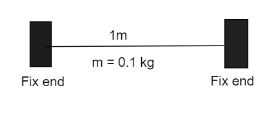
A steel wire of length \[1{\text{ m}}\], mass \[0.1{\text{ kg}}\] and uniform cross sectional area \[{10^{ - 6}}{\text{ }}{{\text{m}}^2}\] is rigidly fixed at both ends. The temperature of the wire is lowered by \[20{{\text{ }}^ \circ }C\]. If transverse waves are set up by plucking the string in the middle, calculate the frequency of the fundamental mode of vibration. Young’s modulus of steel is \[2{\text{ }} \times {\text{ 1}}{{\text{0}}^{11}}{\text{ N }}{{\text{m}}^{ - 2}}\] and coefficient of linear expansion of steel is \[1.2{\text{ }} \times {\text{ 1}}{{\text{0}}^{ - 5}}{\text{ }}{{\text{C}}^{ - 1}}\].
Answer
 Verified
493.2k+ views
Hint: Since the coefficient of linear expansion of steel is given, we will find the change in length of steel wire when temperature is reduced by \[20{{\text{ }}^ \circ }C\]. Then we will find the stress produced in the wire when it is being plucked. With the help of velocity of the transmitted wave we will find the frequency of the transmitted wave.
Formula Used:
Stress \[ = \] Young’s modulus \[ \times \] strain
\[v{\text{ = }}\sqrt {\dfrac{T}{m}} \]
Here, $T$= Tension in the wire and $m$=mass.
Complete step by step answer:
Let us assume a steel wire of length \[l\] , mass \[m\] and area of cross sectional \[A\] is rigidly fixed at both ends. The temperature is now reduced to \[\Delta \theta \], then the change in length of wire \[\Delta l\] can be found by using the formula as,
\[\alpha {\text{ = }}\dfrac{{\Delta l}}{{l{\text{ }} \times {\text{ }}\Delta \theta }}\]
Here \[\alpha \] is known as the coefficient of linear expansion. Hence according to question,
\[l{\text{ = 1 m}}\]
\[\Rightarrow \Delta \theta {\text{ = 20}}{{\text{ }}^ \circ }C\]
\[\Rightarrow \alpha {\text{ = }}1.2{\text{ }} \times {\text{ 1}}{{\text{0}}^{ - 5}}{\text{ }}{{\text{C}}^{ - 1}}\]
On substituting the given values the change in length of wire will be:
\[\alpha {\text{ = }}\dfrac{{\Delta l}}{{l{\text{ }} \times {\text{ }}\Delta \theta }}\]
\[\Rightarrow {\text{1}}{\text{.2 }} \times {\text{ 1}}{{\text{0}}^{ - 5}}{\text{ = }}\dfrac{{\Delta l}}{{{\text{1 }} \times {\text{ 20}}}}\]
\[\Rightarrow \Delta l{\text{ = 1}}{\text{.2 }} \times {\text{ 1}}{{\text{0}}^{ - 5}}{\text{ }} \times {\text{ 20 }}\]
\[\Rightarrow \Delta l{\text{ = 24 }} \times {\text{ 1}}{{\text{0}}^{ - 5}}{\text{ m}}\]
Hence we will calculate the stress produced in the wire when it is plucked. It can be calculated as:
Stress \[ = \] Young’s modulus \[ \times \] strain
We know that strain produced in wire is \[\dfrac{{\Delta l}}{l}\] which is equal to \[\Delta l\] because length of wire is \[1{\text{ m}}\].
Hence, stress \[ = \] Young’s modulus \[ \times \] \[\Delta l\]
It is given that Young’s modulus of steel is \[2{\text{ }} \times {\text{ 1}}{{\text{0}}^{11}}{\text{ N }}{{\text{m}}^{ - 2}}\] and we have calculated \[\Delta l{\text{ = 24 }} \times {\text{ 1}}{{\text{0}}^{ - 5}}{\text{ m}}\]. Therefore,
Stress \[ = {\text{ }}2{\text{ }} \times {\text{ 1}}{{\text{0}}^{11}}{\text{ }} \times {\text{ 24 }} \times {\text{ 1}}{{\text{0}}^{ - 5}}\]
Stress \[ = {\text{ 48 }} \times {\text{ 1}}{{\text{0}}^6}{\text{ N }}{{\text{m}}^{ - 1}}\]
On plucking the steel wire a tension is developed in the wire which is equal to the product of area of cross section of wire and stress produced in wire. Therefore,
Tension \[ = \] Area of cross section \[ \times \] Stress
Tension \[ = {\text{ 1}}{{\text{0}}^6}{\text{ }} \times {\text{ 48 }} \times {\text{ 1}}{{\text{0}}^6}{\text{ N m}}\]
Tension \[ = {\text{ 48 }} \times {\text{ 1}}{{\text{0}}^{12}}{\text{ N m}}\]
The wave velocity \[v\] of the wave produced in the wave can be found as:
\[v{\text{ = }}\sqrt {\dfrac{T}{m}} \]
Also frequency of wave \[n\] can be founded as,
\[n{\text{ = }}\dfrac{1}{{2l}}{\text{ }}\sqrt {\dfrac{T}{m}} \]
On putting the values we get the frequency of wave as,
\[n{\text{ = }}\dfrac{1}{{2{\text{ }} \times {\text{ 1}}}}{\text{ }}\sqrt {\dfrac{{48{\text{ }} \times {\text{ 1}}{{\text{0}}^{12}}}}{{0.1}}} \]
\[\Rightarrow n{\text{ = }}\dfrac{1}{2}{\text{ }}\sqrt {48{\text{ }} \times {\text{ 1}}{{\text{0}}^{13}}} \]
\[\therefore n{\text{ = 11 Hz}}\]
Thus the frequency of transverse waves is \[11{\text{ Hz}}\].
Note: Tension is produced in the wire since both its ends are fixed. If somehow one end is not fixed then tension will not be produced within the wire. Young’s modulus is the elasticity range of any material. The frequency we get is an approximate value and its S.I unit is Hertz. Whenever the temperature is reduced or increased the original length of wire will be changed.
Formula Used:
Stress \[ = \] Young’s modulus \[ \times \] strain
\[v{\text{ = }}\sqrt {\dfrac{T}{m}} \]
Here, $T$= Tension in the wire and $m$=mass.
Complete step by step answer:
Let us assume a steel wire of length \[l\] , mass \[m\] and area of cross sectional \[A\] is rigidly fixed at both ends. The temperature is now reduced to \[\Delta \theta \], then the change in length of wire \[\Delta l\] can be found by using the formula as,
\[\alpha {\text{ = }}\dfrac{{\Delta l}}{{l{\text{ }} \times {\text{ }}\Delta \theta }}\]
Here \[\alpha \] is known as the coefficient of linear expansion. Hence according to question,
\[l{\text{ = 1 m}}\]
\[\Rightarrow \Delta \theta {\text{ = 20}}{{\text{ }}^ \circ }C\]
\[\Rightarrow \alpha {\text{ = }}1.2{\text{ }} \times {\text{ 1}}{{\text{0}}^{ - 5}}{\text{ }}{{\text{C}}^{ - 1}}\]
On substituting the given values the change in length of wire will be:
\[\alpha {\text{ = }}\dfrac{{\Delta l}}{{l{\text{ }} \times {\text{ }}\Delta \theta }}\]
\[\Rightarrow {\text{1}}{\text{.2 }} \times {\text{ 1}}{{\text{0}}^{ - 5}}{\text{ = }}\dfrac{{\Delta l}}{{{\text{1 }} \times {\text{ 20}}}}\]
\[\Rightarrow \Delta l{\text{ = 1}}{\text{.2 }} \times {\text{ 1}}{{\text{0}}^{ - 5}}{\text{ }} \times {\text{ 20 }}\]
\[\Rightarrow \Delta l{\text{ = 24 }} \times {\text{ 1}}{{\text{0}}^{ - 5}}{\text{ m}}\]
Hence we will calculate the stress produced in the wire when it is plucked. It can be calculated as:
Stress \[ = \] Young’s modulus \[ \times \] strain
We know that strain produced in wire is \[\dfrac{{\Delta l}}{l}\] which is equal to \[\Delta l\] because length of wire is \[1{\text{ m}}\].
Hence, stress \[ = \] Young’s modulus \[ \times \] \[\Delta l\]
It is given that Young’s modulus of steel is \[2{\text{ }} \times {\text{ 1}}{{\text{0}}^{11}}{\text{ N }}{{\text{m}}^{ - 2}}\] and we have calculated \[\Delta l{\text{ = 24 }} \times {\text{ 1}}{{\text{0}}^{ - 5}}{\text{ m}}\]. Therefore,
Stress \[ = {\text{ }}2{\text{ }} \times {\text{ 1}}{{\text{0}}^{11}}{\text{ }} \times {\text{ 24 }} \times {\text{ 1}}{{\text{0}}^{ - 5}}\]
Stress \[ = {\text{ 48 }} \times {\text{ 1}}{{\text{0}}^6}{\text{ N }}{{\text{m}}^{ - 1}}\]
On plucking the steel wire a tension is developed in the wire which is equal to the product of area of cross section of wire and stress produced in wire. Therefore,
Tension \[ = \] Area of cross section \[ \times \] Stress
Tension \[ = {\text{ 1}}{{\text{0}}^6}{\text{ }} \times {\text{ 48 }} \times {\text{ 1}}{{\text{0}}^6}{\text{ N m}}\]
Tension \[ = {\text{ 48 }} \times {\text{ 1}}{{\text{0}}^{12}}{\text{ N m}}\]
The wave velocity \[v\] of the wave produced in the wave can be found as:
\[v{\text{ = }}\sqrt {\dfrac{T}{m}} \]
Also frequency of wave \[n\] can be founded as,
\[n{\text{ = }}\dfrac{1}{{2l}}{\text{ }}\sqrt {\dfrac{T}{m}} \]
On putting the values we get the frequency of wave as,
\[n{\text{ = }}\dfrac{1}{{2{\text{ }} \times {\text{ 1}}}}{\text{ }}\sqrt {\dfrac{{48{\text{ }} \times {\text{ 1}}{{\text{0}}^{12}}}}{{0.1}}} \]
\[\Rightarrow n{\text{ = }}\dfrac{1}{2}{\text{ }}\sqrt {48{\text{ }} \times {\text{ 1}}{{\text{0}}^{13}}} \]
\[\therefore n{\text{ = 11 Hz}}\]
Thus the frequency of transverse waves is \[11{\text{ Hz}}\].
Note: Tension is produced in the wire since both its ends are fixed. If somehow one end is not fixed then tension will not be produced within the wire. Young’s modulus is the elasticity range of any material. The frequency we get is an approximate value and its S.I unit is Hertz. Whenever the temperature is reduced or increased the original length of wire will be changed.
Recently Updated Pages
Master Class 11 Computer Science: Engaging Questions & Answers for Success

Master Class 11 Business Studies: Engaging Questions & Answers for Success
Master Class 11 Economics: Engaging Questions & Answers for Success
Master Class 11 English: Engaging Questions & Answers for Success
Master Class 11 Maths: Engaging Questions & Answers for Success
Master Class 11 Biology: Engaging Questions & Answers for Success
Trending doubts
One Metric ton is equal to kg A 10000 B 1000 C 100 class 11 physics CBSE
There are 720 permutations of the digits 1 2 3 4 5 class 11 maths CBSE
Discuss the various forms of bacteria class 11 biology CBSE
Draw a diagram of a plant cell and label at least eight class 11 biology CBSE
State the laws of reflection of light
10 examples of friction in our daily life