



A steady current $I$ flows along an infinitely long hollow cylindrical conductor of radius $R$. This cylinder is placed coaxially inside an infinite solenoid of radius $2\;R$. The solenoid has $n$ turns per unit length and carries a steady current $I$. Consider a point $P$ at a distance $r$ from the common axis. The correct statements are: ( This question has multiple correct answers)
A. in the region $0 < r < R$, the magnetic field is non-zero,
B. in the region $R < r < 2R$, the magnetic field is along the common on axis
C. in the region $R < r < 2R$, the magnetic field is tangential to the circle of radius r, centred on the axis
D. in the region $r > 2R$, the magnetic field is non-zero
Answer
 Verified
601.2k+ views
Hint: We know that a current carrying conductor can produce magnetic fields around itself. And we also know that current can be produced by a varying magnetic field. The current produced is called induced current and its direction is given by right hand thumb rule.
Complete Answer:
Consider a hollow cylinder of radius $R$ and an infinite solenoid of radius $2\;R$ to carry current $I$ in the direction as shown in the figure below.
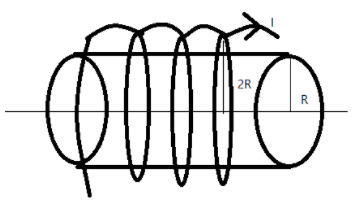
We know that the current in the solenoid induces a magnetic field in the hollow cylinder. Then, for any point $r$ which $0 < r < R$, clearly, there exists a magnetic field. Thus option A is correct.
Due to the current in the solenoid, there is an induced current in the hollow cylinder. The current in the cylinder produces a magnetic field in the outer of the solenoid also. Then we can say that, for a point $r > 2R$, there exists some magnetic field. Thus the option D is also correct.
Hence the correct answer is A. in the region $0 < r < R$, the magnetic field is non-zero, and D. in the region $r > 2R$, the magnetic field is non-zero.
Note:
Here, option B and C are incorrect, as clearly, $R < r < 2R$, it doesn’t lie on the common axis. Also, the magnetic field is a vector sum and hence it cannot lie on the tangent of the solenoid. We also know that direction of current and the direction of magnetic field are interrelated; when one is given the other can be found using the right hand thumb rule.
Complete Answer:
Consider a hollow cylinder of radius $R$ and an infinite solenoid of radius $2\;R$ to carry current $I$ in the direction as shown in the figure below.
We know that the current in the solenoid induces a magnetic field in the hollow cylinder. Then, for any point $r$ which $0 < r < R$, clearly, there exists a magnetic field. Thus option A is correct.
Due to the current in the solenoid, there is an induced current in the hollow cylinder. The current in the cylinder produces a magnetic field in the outer of the solenoid also. Then we can say that, for a point $r > 2R$, there exists some magnetic field. Thus the option D is also correct.
Hence the correct answer is A. in the region $0 < r < R$, the magnetic field is non-zero, and D. in the region $r > 2R$, the magnetic field is non-zero.
Note:
Here, option B and C are incorrect, as clearly, $R < r < 2R$, it doesn’t lie on the common axis. Also, the magnetic field is a vector sum and hence it cannot lie on the tangent of the solenoid. We also know that direction of current and the direction of magnetic field are interrelated; when one is given the other can be found using the right hand thumb rule.
Recently Updated Pages
Master Class 11 Economics: Engaging Questions & Answers for Success

Master Class 11 English: Engaging Questions & Answers for Success
Master Class 11 Maths: Engaging Questions & Answers for Success
Class 11 Question and Answer - Your Ultimate Solutions Guide
Master Class 11 Social Science: Engaging Questions & Answers for Success
Master Class 11 Business Studies: Engaging Questions & Answers for Success
Trending doubts
One Metric ton is equal to kg A 10000 B 1000 C 100 class 11 physics CBSE
There are 720 permutations of the digits 1 2 3 4 5 class 11 maths CBSE
Differentiate between an exothermic and an endothermic class 11 chemistry CBSE
In what year Guru Nanak Dev ji was born A15 April 1469 class 11 social science CBSE
Difference Between Prokaryotic Cells and Eukaryotic Cells
State and prove Bernoullis theorem class 11 physics CBSE