




A statue $1.6$m tall stands on a top of pedestal. From a point on the ground, the angle of elevation of the top of the statue is $60{}^\circ $ and from the same point the angle of elevation at the top of the pedestal is $45{}^\circ $. Find the height of the pedestal.
Answer
 Verified
641.7k+ views
Hint: We will first convert the given data into diagrammatic format. There we get the two triangles with the same base. Now using the given data(elevations) and trigonometric ratios we will form the equation with base and height of the pedestal as variables. By solving those equations using the substitutions we will get the value of height of the Pedestal.
Complete step by step answer:
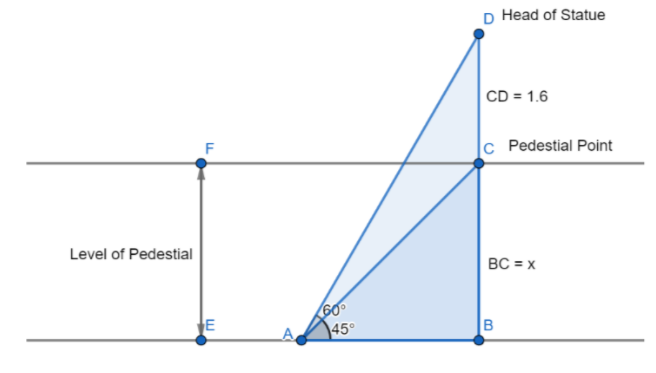
Given that, A statue $1.6$m tall stands on a top of pedestal and the pedestal is at some height from the ground. That height is called the ‘Level of Pedestal’. Also given that the elevation from the ground to the top of the statue is $60{}^\circ $ and the elevation of pedestal from the same point as $45{}^\circ $. The diagrammatic representation of above statements is given below.
Here
$D$ is the head of the statue.
$C$ is the pedestal point.
$A$ is the point from where the elevations of the head of statue and pedestal are given.
$CD$ is the height of the statue $\Rightarrow CD=1.6m$
$BC$ is the height of pedestal/level of pedestal which we are going to find, take it as $x$m
$\angle DAB$ is the elevation of head of statue from the point $A$ i.e. $\angle DAB=60{}^\circ $
$\angle CAB$ is the elevation of pedestal from the point $A$ i.e. $\angle CAB=45{}^\circ $
Finding the value of $AB$ from the triangle $ABD$
We know that $\tan \theta =\dfrac{\text{Opposite side to }\theta }{\text{Adjacent side to }\theta }$, so
$\Rightarrow \tan \left( \angle DAB \right)=\dfrac{\text{Opposite side to }\angle DAB}{\text{Adjacent side to }\angle DAB}$
Substituting the value of $\angle DAB$ in the above equation, then
$\Rightarrow \tan \left( 60{}^\circ \right)=\dfrac{BD}{AB}$
From the diagram we can write $BD=BC+CD$, So
$\begin{align}
&\Rightarrow \tan \left( 60{}^\circ \right)=\dfrac{BC+CD}{AB} \\
&\Rightarrow AB=\dfrac{BC+CD}{\tan \left( 60{}^\circ \right)}
\end{align}$
Substituting the values of $CD=1.6$m and $BC=x$m and $\tan \left( 60{}^\circ \right)=\sqrt{3}$ in above equation then
$\Rightarrow AB=\dfrac{x+1.6}{\sqrt{3}}....\left( \text{i} \right)$
Now finding the value of $AB$ from the triangle $ACB$.
Here,
$\Rightarrow \tan \left( \angle CAB \right)=\dfrac{\text{Opposite side to }\angle CAB}{\text{Adjacent side to }\angle CAB}$
Substituting the value of $\angle CAB$ in the above equation, then
$\Rightarrow \tan \left( 45{}^\circ \right)=\dfrac{CB}{AB}$
Substituting the value of $\tan 45{}^\circ =1$ and $BC=x$ in the above equation then
$\begin{align}
&\Rightarrow 1=\dfrac{x}{AB} \\
&\Rightarrow AB=x.....\left( \text{ii} \right)
\end{align}$
From equations $\left( \text{i} \right)$ and $\left( \text{ii} \right)$, substituting $\left( \text{ii} \right)$ in $\left( \text{i} \right)$ then
$\begin{align}
&\Rightarrow x=\dfrac{x+1.6}{\sqrt{3}} \\
&\Rightarrow \sqrt{3}x-x=1.6 \\
&\Rightarrow x=\dfrac{1.6}{\sqrt{3}-1} \\
&\Rightarrow x =2.186
\end{align}$
Hence the height of the pedestal is $2.186m$.
Note: We can simply find the value of $AB$ by observing that $ABC$ is a right-angled isosceles triangle. Hence the value of $AB=BC=x$. Now we can find the value of $AB$ from the triangle $ADB$ and equate them to get the result. Don’t substitute $x=AB$ which is obtained in the second equation in the first equation since we don’t need the value of $AB$.
Complete step by step answer:
Given that, A statue $1.6$m tall stands on a top of pedestal and the pedestal is at some height from the ground. That height is called the ‘Level of Pedestal’. Also given that the elevation from the ground to the top of the statue is $60{}^\circ $ and the elevation of pedestal from the same point as $45{}^\circ $. The diagrammatic representation of above statements is given below.
Here
$D$ is the head of the statue.
$C$ is the pedestal point.
$A$ is the point from where the elevations of the head of statue and pedestal are given.
$CD$ is the height of the statue $\Rightarrow CD=1.6m$
$BC$ is the height of pedestal/level of pedestal which we are going to find, take it as $x$m
$\angle DAB$ is the elevation of head of statue from the point $A$ i.e. $\angle DAB=60{}^\circ $
$\angle CAB$ is the elevation of pedestal from the point $A$ i.e. $\angle CAB=45{}^\circ $
Finding the value of $AB$ from the triangle $ABD$
We know that $\tan \theta =\dfrac{\text{Opposite side to }\theta }{\text{Adjacent side to }\theta }$, so
$\Rightarrow \tan \left( \angle DAB \right)=\dfrac{\text{Opposite side to }\angle DAB}{\text{Adjacent side to }\angle DAB}$
Substituting the value of $\angle DAB$ in the above equation, then
$\Rightarrow \tan \left( 60{}^\circ \right)=\dfrac{BD}{AB}$
From the diagram we can write $BD=BC+CD$, So
$\begin{align}
&\Rightarrow \tan \left( 60{}^\circ \right)=\dfrac{BC+CD}{AB} \\
&\Rightarrow AB=\dfrac{BC+CD}{\tan \left( 60{}^\circ \right)}
\end{align}$
Substituting the values of $CD=1.6$m and $BC=x$m and $\tan \left( 60{}^\circ \right)=\sqrt{3}$ in above equation then
$\Rightarrow AB=\dfrac{x+1.6}{\sqrt{3}}....\left( \text{i} \right)$
Now finding the value of $AB$ from the triangle $ACB$.
Here,
$\Rightarrow \tan \left( \angle CAB \right)=\dfrac{\text{Opposite side to }\angle CAB}{\text{Adjacent side to }\angle CAB}$
Substituting the value of $\angle CAB$ in the above equation, then
$\Rightarrow \tan \left( 45{}^\circ \right)=\dfrac{CB}{AB}$
Substituting the value of $\tan 45{}^\circ =1$ and $BC=x$ in the above equation then
$\begin{align}
&\Rightarrow 1=\dfrac{x}{AB} \\
&\Rightarrow AB=x.....\left( \text{ii} \right)
\end{align}$
From equations $\left( \text{i} \right)$ and $\left( \text{ii} \right)$, substituting $\left( \text{ii} \right)$ in $\left( \text{i} \right)$ then
$\begin{align}
&\Rightarrow x=\dfrac{x+1.6}{\sqrt{3}} \\
&\Rightarrow \sqrt{3}x-x=1.6 \\
&\Rightarrow x=\dfrac{1.6}{\sqrt{3}-1} \\
&\Rightarrow x =2.186
\end{align}$
Hence the height of the pedestal is $2.186m$.
Note: We can simply find the value of $AB$ by observing that $ABC$ is a right-angled isosceles triangle. Hence the value of $AB=BC=x$. Now we can find the value of $AB$ from the triangle $ADB$ and equate them to get the result. Don’t substitute $x=AB$ which is obtained in the second equation in the first equation since we don’t need the value of $AB$.
Recently Updated Pages
Class 10 Question and Answer - Your Ultimate Solutions Guide

Master Class 10 Computer Science: Engaging Questions & Answers for Success
Master Class 10 General Knowledge: Engaging Questions & Answers for Success
Master Class 12 Economics: Engaging Questions & Answers for Success
Master Class 12 Social Science: Engaging Questions & Answers for Success
Master Class 12 English: Engaging Questions & Answers for Success
Trending doubts
Explain the Treaty of Vienna of 1815 class 10 social science CBSE
The slogan Jai Hind was given by A Lal Bahadur Shastri class 10 social science CBSE
10 examples of evaporation in daily life with explanations
What is the full form of POSCO class 10 social science CBSE
Identify the feminine form of noun nephew a shenephew class 10 english CBSE
CSIR full form?