




What is a standard hydrogen electrode? How is it prepared? Explain with a labelled diagram?
Answer
 Verified
625.5k+ views
Hint: Standard hydrogen electrode is the basis for potential calculation in electrochemistry. The potential value of a standard hydrogen electrode is 0. Identify the atom getting oxidised or reduced to write the cell reaction and then be able to draw the cell diagram.
Complete step by step answer:
Standard Hydrogen Electrode also called as SHE in short is an electrode used for calculating potential value of different atoms/ions as it acts as a basis line in the electrochemical reactivity series.
Standard electrode potential(SHE) is set to be zero at a temperature of 298K. The pressure of the hydrogen gas present in this half-cell equals 1 bar. Platinum is generally used as an electrode in Standard Hydrogen Electrode.
The reaction takes place at redox half-cell of SHE is:
\[2{{H}^{+}}(aq)+2{{e}^{-}}\to {{H}_{2}}(g)\]
Let us now discuss the construction of the SHE.
For this, platinum electrode is generally used which is covered with finely powdered platinum black. A hydrogen blow is required for this.
A solution of acid having ${{\text{H}}^{\text{+}}}$molarity of 1 mole per cubic decimetre is taken in a beaker. The SHE should be properly sealed to prevent the interference of oxygen.
The other half cell of the entire Galvanic cell must be attached to the Standard Hydrogen Electrode through a reservoir in order to create an ionic conductive path.
This can be done through a direct connection, through a narrow tube, or even through the use of salt bridge.
Let us have a look at the diagram of SHE:
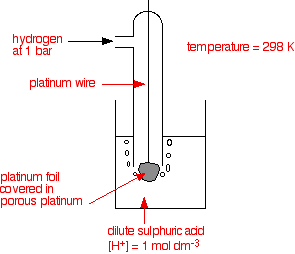
Note: The standard condition of this SHE is only attained at a particular temperature and pressure. The temperature of 298K and pressure of 1 bar is required for a Standard Hydrogen Electrode. This is also called as Standard temperature and pressure (STP) which is often used in various chemical reactions and processes to avoid errors in calculation due to external factors.
Complete step by step answer:
Standard Hydrogen Electrode also called as SHE in short is an electrode used for calculating potential value of different atoms/ions as it acts as a basis line in the electrochemical reactivity series.
Standard electrode potential(SHE) is set to be zero at a temperature of 298K. The pressure of the hydrogen gas present in this half-cell equals 1 bar. Platinum is generally used as an electrode in Standard Hydrogen Electrode.
The reaction takes place at redox half-cell of SHE is:
\[2{{H}^{+}}(aq)+2{{e}^{-}}\to {{H}_{2}}(g)\]
Let us now discuss the construction of the SHE.
For this, platinum electrode is generally used which is covered with finely powdered platinum black. A hydrogen blow is required for this.
A solution of acid having ${{\text{H}}^{\text{+}}}$molarity of 1 mole per cubic decimetre is taken in a beaker. The SHE should be properly sealed to prevent the interference of oxygen.
The other half cell of the entire Galvanic cell must be attached to the Standard Hydrogen Electrode through a reservoir in order to create an ionic conductive path.
This can be done through a direct connection, through a narrow tube, or even through the use of salt bridge.
Let us have a look at the diagram of SHE:
Note: The standard condition of this SHE is only attained at a particular temperature and pressure. The temperature of 298K and pressure of 1 bar is required for a Standard Hydrogen Electrode. This is also called as Standard temperature and pressure (STP) which is often used in various chemical reactions and processes to avoid errors in calculation due to external factors.
Recently Updated Pages
Master Class 12 Business Studies: Engaging Questions & Answers for Success

Master Class 12 Chemistry: Engaging Questions & Answers for Success
Master Class 12 Biology: Engaging Questions & Answers for Success
Class 12 Question and Answer - Your Ultimate Solutions Guide
Master Class 11 English: Engaging Questions & Answers for Success
Master Class 11 Social Science: Engaging Questions & Answers for Success
Trending doubts
Which are the Top 10 Largest Countries of the World?
Draw a labelled sketch of the human eye class 12 physics CBSE
The end of compass needle which points towards north class 12 physics CBSE
Differentiate between homogeneous and heterogeneous class 12 chemistry CBSE
Why is the cell called the structural and functional class 12 biology CBSE
When was the first election held in India a 194748 class 12 sst CBSE