




A stair–case of length l rests against a vertical wall and a floor of a room. Let P be a point on the stair-case, nearer to its end on the wall that divides its length in the ratio 1:2.If the stair-case begins to slide on the floor, then the locus of P is:
Answer
 Verified
648.3k+ views
Hint- The given terms will form a shape of triangle and
Formula used:
Section formula:
The coordinate of P(x,y) which divides the line segment joining the points A\[({x_1},{y_1})\] and B\[({x_2},{y_2})\]internally in the ratio m:n are
\[(\dfrac{{m{x_2} + n{x_1}}}{{m + n}},\dfrac{{m{y_2} + n{y_1}}}{{m + n}})\]
Complete step-by-step answer:
It is given that, a stair–case of length l rests against a vertical wall and a floor of a room.
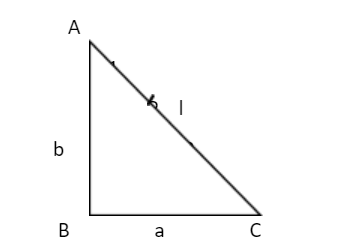
Let, “b” be the height and “a” be the length intercepted by the stair-case.
If we consider BC as x axis and BA as y axis and B as the origin (0,0) point ,then the coordinate of C is (a,0) and the coordinate of A is (0,b).
Now, P be a point on the stair-case, nearer to its end on the wall that divides its length in the ratio 1:2.
Then we can consider the section formula to calculate the coordinate of P.
The coordinate of P(x,y) which divides the line segment joining the points A\[(0,b)\] and C\[(a,0)\]internally in the ratio 1:2 are
\[\left( {\dfrac{{1 \times a + 2 \times 0}}{{1 + 2}},\dfrac{{1 \times 0 + 2 \times b}}{{1 + 2}}} \right)\]
By solving the above points we get,
\[\left( {\dfrac{a}{3},\dfrac{{2b}}{3}} \right)\]
Now, the length of the stair-case l is constant.
From the triangle ABC by Pythagoras theorem, we have
\[{a^2} + {b^2} = {l^2}\] …..(1)
Let us consider, the coordinate of P is (x,y)
Then,
\[x = \dfrac{a}{3}\& y = \dfrac{{2b}}{3}\]
Let us find a and b from the above equation we get,
\[a = 3x\& b = \dfrac{{3y}}{2}\]
Putting the values in (1) we get,
\[{(3x)^2} + {(\dfrac{{3y}}{2})^2} = {l^2}\]
On solving we get,
\[9{x^2} + \dfrac{{9{y^2}}}{4} = {l^2}\]
Let us rewrite the above equation as follows,
\[\dfrac{{{x^2}}}{{\dfrac{{{l^2}}}{9}}} + \dfrac{{{y^2}}}{{\dfrac{{4{l^2}}}{9}}} = 1\]
This represents the equation of an ellipse.
The general equation of ellipse is \[\dfrac{{{x^2}}}{{{a^2}}} + \dfrac{{{y^2}}}{{{b^2}}} = 1\] and the locus is given by \[1 - {e^2} = \dfrac{{{a^2}}}{{{b^2}}},{b^2} > {a^2}\]
So, locus of P is
\[e = \sqrt {1 - \dfrac{{\dfrac{{{l^2}}}{9}}}{{\dfrac{{4{l^2}}}{9}}}} \]
Let us solve the above equation as follows,
\[e = \sqrt {1 - \dfrac{{{l^2}}}{9} \times \dfrac{9}{{4{l^2}}}} \]
On final solving we get
\[e = \sqrt {\dfrac{{4 - 1}}{4}} = \dfrac{{\sqrt 3 }}{2}\]
Hence, locus of P is \[\dfrac{{\sqrt 3 }}{2}\]
Note: Pythagoras theorem used in the problem states that in a triangle the sum of the square of the opposite and adjacent sides are equal to the square of hypotenuse.
The locus of the ellipse \[\dfrac{{{x^2}}}{{{a^2}}} + \dfrac{{{y^2}}}{{{b^2}}} = 1\] is given by \[1 - {e^2} = \dfrac{{{a^2}}}{{{b^2}}},{b^2} > {a^2}\]
Formula used:
Section formula:
The coordinate of P(x,y) which divides the line segment joining the points A\[({x_1},{y_1})\] and B\[({x_2},{y_2})\]internally in the ratio m:n are
\[(\dfrac{{m{x_2} + n{x_1}}}{{m + n}},\dfrac{{m{y_2} + n{y_1}}}{{m + n}})\]
Complete step-by-step answer:
It is given that, a stair–case of length l rests against a vertical wall and a floor of a room.
Let, “b” be the height and “a” be the length intercepted by the stair-case.
If we consider BC as x axis and BA as y axis and B as the origin (0,0) point ,then the coordinate of C is (a,0) and the coordinate of A is (0,b).
Now, P be a point on the stair-case, nearer to its end on the wall that divides its length in the ratio 1:2.
Then we can consider the section formula to calculate the coordinate of P.
The coordinate of P(x,y) which divides the line segment joining the points A\[(0,b)\] and C\[(a,0)\]internally in the ratio 1:2 are
\[\left( {\dfrac{{1 \times a + 2 \times 0}}{{1 + 2}},\dfrac{{1 \times 0 + 2 \times b}}{{1 + 2}}} \right)\]
By solving the above points we get,
\[\left( {\dfrac{a}{3},\dfrac{{2b}}{3}} \right)\]
Now, the length of the stair-case l is constant.
From the triangle ABC by Pythagoras theorem, we have
\[{a^2} + {b^2} = {l^2}\] …..(1)
Let us consider, the coordinate of P is (x,y)
Then,
\[x = \dfrac{a}{3}\& y = \dfrac{{2b}}{3}\]
Let us find a and b from the above equation we get,
\[a = 3x\& b = \dfrac{{3y}}{2}\]
Putting the values in (1) we get,
\[{(3x)^2} + {(\dfrac{{3y}}{2})^2} = {l^2}\]
On solving we get,
\[9{x^2} + \dfrac{{9{y^2}}}{4} = {l^2}\]
Let us rewrite the above equation as follows,
\[\dfrac{{{x^2}}}{{\dfrac{{{l^2}}}{9}}} + \dfrac{{{y^2}}}{{\dfrac{{4{l^2}}}{9}}} = 1\]
This represents the equation of an ellipse.
The general equation of ellipse is \[\dfrac{{{x^2}}}{{{a^2}}} + \dfrac{{{y^2}}}{{{b^2}}} = 1\] and the locus is given by \[1 - {e^2} = \dfrac{{{a^2}}}{{{b^2}}},{b^2} > {a^2}\]
So, locus of P is
\[e = \sqrt {1 - \dfrac{{\dfrac{{{l^2}}}{9}}}{{\dfrac{{4{l^2}}}{9}}}} \]
Let us solve the above equation as follows,
\[e = \sqrt {1 - \dfrac{{{l^2}}}{9} \times \dfrac{9}{{4{l^2}}}} \]
On final solving we get
\[e = \sqrt {\dfrac{{4 - 1}}{4}} = \dfrac{{\sqrt 3 }}{2}\]
Hence, locus of P is \[\dfrac{{\sqrt 3 }}{2}\]
Note: Pythagoras theorem used in the problem states that in a triangle the sum of the square of the opposite and adjacent sides are equal to the square of hypotenuse.
The locus of the ellipse \[\dfrac{{{x^2}}}{{{a^2}}} + \dfrac{{{y^2}}}{{{b^2}}} = 1\] is given by \[1 - {e^2} = \dfrac{{{a^2}}}{{{b^2}}},{b^2} > {a^2}\]
Recently Updated Pages
Basicity of sulphurous acid and sulphuric acid are

Master Class 10 Computer Science: Engaging Questions & Answers for Success
Master Class 10 Social Science: Engaging Questions & Answers for Success
Master Class 10 Science: Engaging Questions & Answers for Success
Class 10 Question and Answer - Your Ultimate Solutions Guide
Master Class 10 Maths: Engaging Questions & Answers for Success
Trending doubts
What is the Total Duration of Football Match?
In football, which nation is called "La Roja"?
Why is there a time difference of about 5 hours between class 10 social science CBSE
What is the award for the best player at the FIFA World Cup?
Define Potential, Developed, Stock and Reserved resources
Draw the diagram of the sectional view of the human class 10 biology CBSE