



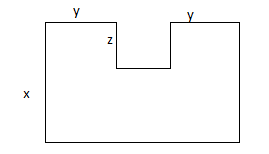
A square with side lengths \[z\] was cut from a rectangle to form the polygon as shown here.
Which expression represents the perimeter of the polygon?
A.\[2x + 4y + 2z\]
B.\[2x + 4y + 3z\]
C.\[2x + 4y + 4z\]
D.\[2x + 4y + 6z\]
Answer
 Verified
563.1k+ views
Hint: Here, we will use the properties of the rectangle and square to find all the lengths of the polygon. Then we will add all the lengths to find the perimeter. Perimeter is defined as the distance around a two-dimensional shape of all the sides.
Complete step-by-step answer:
We are given that a square with side lengths \[z\] was cut from a rectangle to form the polygon.
We will find the perimeter of the polygon. The perimeter of the polygon is found by adding the lengths of the sides of a polygon.
Let ABCDEFGH be a polygon. Draw a perpendicular line from CD and EF to the side AH at P and Q.
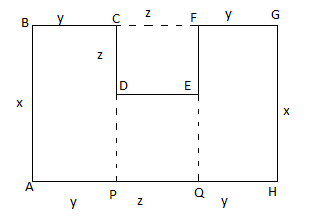
We know that \[AB = x\], \[BC = y\] and \[CD = z\] .
Since a square CDEF is cut from the rectangle, all the sides of a square are equal.
Thus, we get
\[CD = DE = EF = CF = z\].
Since ABGH is a rectangle, opposite sides of a rectangle are equal.
Thus, we get
\[AB = GH = x\]
Since ABCP is a rectangle, opposite sides of a rectangle are equal.
Thus, we get
\[BC = AP = y\]
Since FGHQ is a rectangle, opposite sides of a rectangle are equal.
Thus, we get
\[FG = HQ = y\]
Since DEPQ is a square, all the sides of a square are equal.
Thus, we get
\[DE = PQ = z\]
Now, the line
\[AH = AP + PQ + QH\]
Substituting the values of the length, we get
\[ \Rightarrow AH = y + z + y\]
Adding the like terms, we get
\[ \Rightarrow AH = 2y + z\]
Perimeter of the polygon is found by adding all the sides of a polygon.
Perimeter of a polygon \[ = AB + BC + CD + DE + EF + FG + GH + HA\]
Substituting the values of the length, we get
\[ \Rightarrow \] Perimeter of a polygon \[ = x + y + z + z + z + y + x + 2y + z\]
By adding all the variables, we get
\[ \Rightarrow \] Perimeter of a polygon \[ = 2x + 4y + 4z\]
Therefore, the expression for the perimeter of the polygon is \[2x + 4y + 4z\].
Thus Option(C) is the correct answer.
Note: We can also find the perimeter of the polygon by using the formula of the perimeter.
Perimeter of a polygon \[ = \] Perimeter of the rectangle \[ + \] Perimeter of a square \[ - \] common sides
\[ \Rightarrow \] Perimeter of a polygon\[ = 2\left( {x + 2y + z} \right) + 4z - 2z\]
Multiplying the terms, we get
\[ \Rightarrow \] Perimeter of a polygon\[ = 2x + 4y + 2z + 4z - 2z\]
Subtracting the like terms, we get
\[ \Rightarrow \] Perimeter of a polygon\[ = 2x + 4y + 4z\]
Complete step-by-step answer:
We are given that a square with side lengths \[z\] was cut from a rectangle to form the polygon.
We will find the perimeter of the polygon. The perimeter of the polygon is found by adding the lengths of the sides of a polygon.
Let ABCDEFGH be a polygon. Draw a perpendicular line from CD and EF to the side AH at P and Q.
We know that \[AB = x\], \[BC = y\] and \[CD = z\] .
Since a square CDEF is cut from the rectangle, all the sides of a square are equal.
Thus, we get
\[CD = DE = EF = CF = z\].
Since ABGH is a rectangle, opposite sides of a rectangle are equal.
Thus, we get
\[AB = GH = x\]
Since ABCP is a rectangle, opposite sides of a rectangle are equal.
Thus, we get
\[BC = AP = y\]
Since FGHQ is a rectangle, opposite sides of a rectangle are equal.
Thus, we get
\[FG = HQ = y\]
Since DEPQ is a square, all the sides of a square are equal.
Thus, we get
\[DE = PQ = z\]
Now, the line
\[AH = AP + PQ + QH\]
Substituting the values of the length, we get
\[ \Rightarrow AH = y + z + y\]
Adding the like terms, we get
\[ \Rightarrow AH = 2y + z\]
Perimeter of the polygon is found by adding all the sides of a polygon.
Perimeter of a polygon \[ = AB + BC + CD + DE + EF + FG + GH + HA\]
Substituting the values of the length, we get
\[ \Rightarrow \] Perimeter of a polygon \[ = x + y + z + z + z + y + x + 2y + z\]
By adding all the variables, we get
\[ \Rightarrow \] Perimeter of a polygon \[ = 2x + 4y + 4z\]
Therefore, the expression for the perimeter of the polygon is \[2x + 4y + 4z\].
Thus Option(C) is the correct answer.
Note: We can also find the perimeter of the polygon by using the formula of the perimeter.
Perimeter of a polygon \[ = \] Perimeter of the rectangle \[ + \] Perimeter of a square \[ - \] common sides
\[ \Rightarrow \] Perimeter of a polygon\[ = 2\left( {x + 2y + z} \right) + 4z - 2z\]
Multiplying the terms, we get
\[ \Rightarrow \] Perimeter of a polygon\[ = 2x + 4y + 2z + 4z - 2z\]
Subtracting the like terms, we get
\[ \Rightarrow \] Perimeter of a polygon\[ = 2x + 4y + 4z\]

Recently Updated Pages
Master Class 8 Social Science: Engaging Questions & Answers for Success

Master Class 8 English: Engaging Questions & Answers for Success
Class 8 Question and Answer - Your Ultimate Solutions Guide
Master Class 8 Maths: Engaging Questions & Answers for Success
Master Class 8 Science: Engaging Questions & Answers for Success
Master Class 7 English: Engaging Questions & Answers for Success
Trending doubts
Difference Between Plant Cell and Animal Cell
Fill the blanks with the suitable prepositions 1 The class 9 english CBSE
Who is eligible for RTE class 9 social science CBSE
Which places in India experience sunrise first and class 9 social science CBSE
What is pollution? How many types of pollution? Define it
Name 10 Living and Non living things class 9 biology CBSE