



A square planar complex is formed by hybridization of which atomic orbitals?
A. ${\text{s,}}{{\text{p}}_{\text{x}}}{\text{,}}{{\text{p}}_{\text{y}}}{\text{,}}{{\text{d}}_{{\text{yz}}}}$
B. ${\text{s,}}{{\text{p}}_{\text{x}}}{\text{,}}{{\text{p}}_{\text{y}}}{\text{,}}{{\text{d}}_{{{\text{x}}^{\text{2}}} - {{\text{y}}^{\text{2}}}}}$
C. ${\text{s,}}{{\text{p}}_{\text{x}}}{\text{,}}{{\text{p}}_{\text{y}}}{\text{,}}{{\text{d}}_{{{\text{z}}^2}}}$
D. ${\text{s,}}{{\text{p}}_{\text{x}}}{\text{,}}{{\text{p}}_{\text{y}}}{\text{,}}{{\text{d}}_{{\text{xy}}}}$
Answer
 Verified
608.7k+ views
Hint: The square planar complexes form when four ligands approach to the metal, so metal in a square planar complex requires four hybrid orbitals for the interaction with ligands. Hybrid orbitals are formed by the mixing of s, p and d orbitals.
Complete answer:
- When four ligands approach the metal from in between the two axis square planar complex forms.
- The metal requires the orbitals of the same energy to interact with all ligands approaching it. The concept that tells the formation of orbitals of the same energy is hybridization. Hybridization tells the mixing of metal orbitals to form the orbitals of the same energy.
- The orbitals s, p, d and f, all have a different energy. So, hybridization tells that some orbitals (as required) of the metal mix and form new orbitals in the same number. All newly formed orbitals have the same energy and are known as hybrid orbitals.
- In a square planar complex, metal requires four orbitals of the same energy.
- One d-orbital, one s and two p-orbital combine and form four hybrid orbits. The hybridization is known as ${\text{ds}}{{\text{p}}^2}$ hybridization.
- When one s-orbital, two p-orbital and one d-orbital combine and form six hybrid orbits. The hybridization is known as ${\text{s}}{{\text{p}}^{\text{3}}}{{\text{d}}^{\text{2}}}$ hybridization.
A general square planar complex is shown as follows:
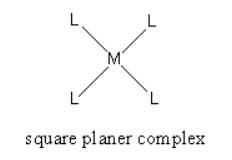
In a square planar complex, all ligands are in a plane. We consider xy plane then the ${{\text{p}}_{\text{x}}}{\text{,}}{{\text{p}}_{\text{y}}}$ orbital will be in plane and ${{\text{p}}_{\text{z}}}$ will be perpendicular to the plane. ${{\text{d}}_{{{\text{x}}^{\text{2}}} - {{\text{y}}^{\text{2}}}}}$ will be in plane and ${{\text{d}}_{{{\text{z}}^2}}}$ will be in perpendicular plane. Orbitals of ${{\text{d}}_{{\text{yz}}}}$ and ${{\text{d}}_{{\text{xy}}}}$ will be in between the yz and xy plane respectively.
So, s, ${{\text{p}}_{\text{x}}}{\text{,}}{{\text{p}}_{\text{y}}}$ and ${{\text{d}}_{{{\text{x}}^{\text{2}}} - {{\text{y}}^{\text{2}}}}}$ orbitals lies in the xy plane and on axis so, four ligand can approach. So, the square planar complex is formed by hybridization of ${\text{s,}}{{\text{p}}_{\text{x}}}{\text{,}}{{\text{p}}_{\text{y}}}{\text{,}}{{\text{d}}_{{{\text{x}}^{\text{2}}} - {{\text{y}}^{\text{2}}}}}$ atomic orbitals.
Therefore, option (B) ${\text{s,}}{{\text{p}}_{\text{x}}}{\text{,}}{{\text{p}}_{\text{y}}}{\text{,}}{{\text{d}}_{{{\text{x}}^{\text{2}}} - {{\text{y}}^{\text{2}}}}}$, is correct.
Note:
Hybrid orbitals form sigma bonds only. The name of the complex itself indicates the number of hybrid orbitals such as the complex with coordination number four has four hybrid orbitals so, the hybridization can be ${\text{s}}{{\text{p}}^{\text{3}}}$ or ${\text{ds}}{{\text{p}}^2}$. Square planar complex has hybridization ${\text{ds}}{{\text{p}}^{\text{2}}}$ and the tetrahedral complex has hybridization ${\text{s}}{{\text{p}}^{\text{3}}}$.
Complete answer:
- When four ligands approach the metal from in between the two axis square planar complex forms.
- The metal requires the orbitals of the same energy to interact with all ligands approaching it. The concept that tells the formation of orbitals of the same energy is hybridization. Hybridization tells the mixing of metal orbitals to form the orbitals of the same energy.
- The orbitals s, p, d and f, all have a different energy. So, hybridization tells that some orbitals (as required) of the metal mix and form new orbitals in the same number. All newly formed orbitals have the same energy and are known as hybrid orbitals.
- In a square planar complex, metal requires four orbitals of the same energy.
- One d-orbital, one s and two p-orbital combine and form four hybrid orbits. The hybridization is known as ${\text{ds}}{{\text{p}}^2}$ hybridization.
- When one s-orbital, two p-orbital and one d-orbital combine and form six hybrid orbits. The hybridization is known as ${\text{s}}{{\text{p}}^{\text{3}}}{{\text{d}}^{\text{2}}}$ hybridization.
A general square planar complex is shown as follows:
In a square planar complex, all ligands are in a plane. We consider xy plane then the ${{\text{p}}_{\text{x}}}{\text{,}}{{\text{p}}_{\text{y}}}$ orbital will be in plane and ${{\text{p}}_{\text{z}}}$ will be perpendicular to the plane. ${{\text{d}}_{{{\text{x}}^{\text{2}}} - {{\text{y}}^{\text{2}}}}}$ will be in plane and ${{\text{d}}_{{{\text{z}}^2}}}$ will be in perpendicular plane. Orbitals of ${{\text{d}}_{{\text{yz}}}}$ and ${{\text{d}}_{{\text{xy}}}}$ will be in between the yz and xy plane respectively.
So, s, ${{\text{p}}_{\text{x}}}{\text{,}}{{\text{p}}_{\text{y}}}$ and ${{\text{d}}_{{{\text{x}}^{\text{2}}} - {{\text{y}}^{\text{2}}}}}$ orbitals lies in the xy plane and on axis so, four ligand can approach. So, the square planar complex is formed by hybridization of ${\text{s,}}{{\text{p}}_{\text{x}}}{\text{,}}{{\text{p}}_{\text{y}}}{\text{,}}{{\text{d}}_{{{\text{x}}^{\text{2}}} - {{\text{y}}^{\text{2}}}}}$ atomic orbitals.
Therefore, option (B) ${\text{s,}}{{\text{p}}_{\text{x}}}{\text{,}}{{\text{p}}_{\text{y}}}{\text{,}}{{\text{d}}_{{{\text{x}}^{\text{2}}} - {{\text{y}}^{\text{2}}}}}$, is correct.
Note:
Hybrid orbitals form sigma bonds only. The name of the complex itself indicates the number of hybrid orbitals such as the complex with coordination number four has four hybrid orbitals so, the hybridization can be ${\text{s}}{{\text{p}}^{\text{3}}}$ or ${\text{ds}}{{\text{p}}^2}$. Square planar complex has hybridization ${\text{ds}}{{\text{p}}^{\text{2}}}$ and the tetrahedral complex has hybridization ${\text{s}}{{\text{p}}^{\text{3}}}$.
Recently Updated Pages
Master Class 12 Business Studies: Engaging Questions & Answers for Success

Master Class 12 Chemistry: Engaging Questions & Answers for Success
Master Class 12 Biology: Engaging Questions & Answers for Success
Class 12 Question and Answer - Your Ultimate Solutions Guide
Master Class 11 English: Engaging Questions & Answers for Success
Master Class 11 Social Science: Engaging Questions & Answers for Success
Trending doubts
Which are the Top 10 Largest Countries of the World?
Draw a labelled sketch of the human eye class 12 physics CBSE
The end of compass needle which points towards north class 12 physics CBSE
Differentiate between homogeneous and heterogeneous class 12 chemistry CBSE
Why is the cell called the structural and functional class 12 biology CBSE
When was the first election held in India a 194748 class 12 sst CBSE