




A square of side lies above the x-axis and has one vertex at the origin. The side passing through the origin makes an angle $\alpha \left( 0 < a < \dfrac{\pi }{4} \right)$ with the positive direction of x-axis. The equation of its diagonal not passing through the origin is
Answer
 Verified
560.4k+ views
Hint: From the question given that we have to find the equation of the diagonal not passing through the origin of a square whose side is a and lies above the x-axis and has one vertex at the origin. To find the equation of the diagonal to find its one of the points and the slope of that diagonal. From those we will get the equation.
Complete step-by-step solution:
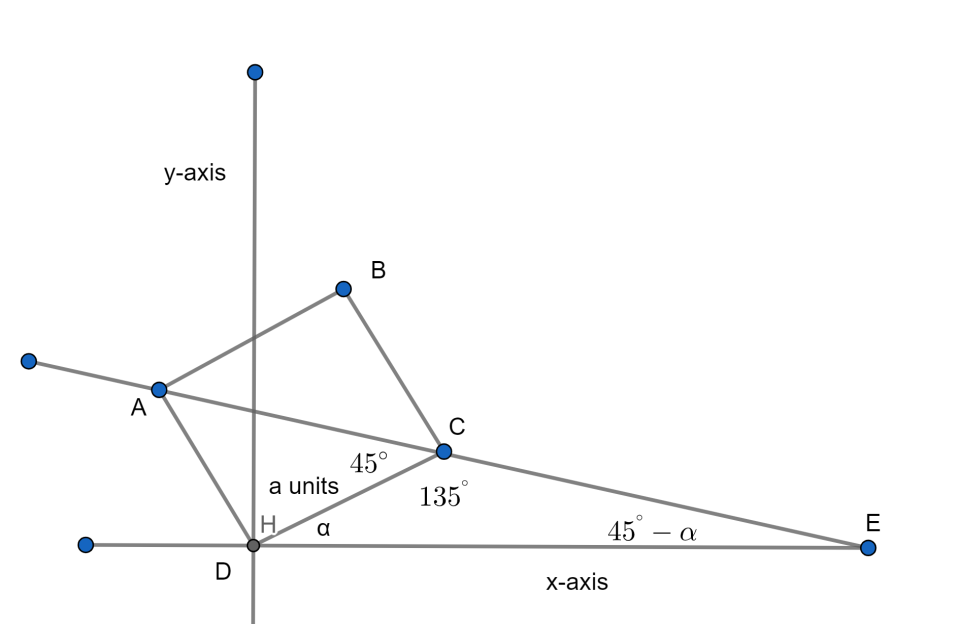
As we know that the diagonal of a square makes an angle of ${{45}^{\circ }}$ with its sides, hence
$\Rightarrow \angle DCA={{45}^{\circ }}$
Therefore, by linear pair we will get the,
$\Rightarrow \angle DCE={{135}^{\circ }}$
From the question given that the side of the square is “a”
Thus, from the co-ordinate geometry the coordinates of the vertex C will be
$\Rightarrow \left( a\cos \alpha ,a\sin \alpha \right)$
Applying sum property in the triangle DCE that is sum of all the angles in the triangle is equal to ${{180}^{\circ }}$
From this the $\angle CED$ will be,
$\Rightarrow \angle CED+\alpha +{{135}^{\circ }}={{180}^{\circ }}$
By further simplification we will get,
$\Rightarrow \angle CED={{45}^{\circ }}-\alpha $
Now the slope of the diagonal is
$\Rightarrow m=-\tan \left( \angle CED \right)$
$\Rightarrow m=-\tan \left( {{45}^{\circ }}-\alpha \right)$
As we know that
$\Rightarrow \tan \left( A-B \right)=\dfrac{\tan A-\tan B}{1+\tan A\times \tan B}$
From this the slope of the diagonal can be written as
$\Rightarrow -\tan \left( {{45}^{\circ }}-\alpha \right)=-\dfrac{1-\tan \alpha }{1+\tan \alpha }$
This can be written in terms of sin and cos we will get,
$\Rightarrow -\tan \left( {{45}^{\circ }}-\alpha \right)=-\dfrac{1-\tan \alpha }{1+\tan \alpha }=-\left( \dfrac{\cos \alpha -\sin \alpha }{\cos \alpha +\sin \alpha } \right)$
Since the diagonal passes through the vertex C, we have one point and the slope of the line the line equation will be
$\Rightarrow \dfrac{y-{{y}_{1}}}{x-{{x}_{1}}}=m$
Now substituting the values in their respective positions, we will get,
$\Rightarrow \dfrac{y-a\sin \alpha }{x-a\cos \alpha }=-\left( \dfrac{\cos \alpha -\sin \alpha }{\cos \alpha +\sin \alpha } \right)$
Now by further simplification we will get,
$\Rightarrow y\left( \cos \alpha +\sin \alpha \right)-a\sin \alpha \left( \cos \alpha +\sin \alpha \right)=-x\left( \cos \alpha -\sin \alpha \right)+a\cos \alpha \left( \cos \alpha -\sin \alpha \right)$
$\Rightarrow y\left( \cos \alpha +\sin \alpha \right)-a{{\sin }^{2}}\alpha -a\sin \alpha \cos \alpha =-x\left( \cos \alpha -\sin \alpha \right)+a{{\cos }^{2}}\alpha -a\cos \alpha \sin \alpha $
Now by further simplification we will get
$\Rightarrow y\left( \cos \alpha +\sin \alpha \right)+x\left( \cos \alpha -\sin \alpha \right)=a\left( {{\sin }^{2}}\alpha +{{\cos }^{2}}\alpha \right)$
As we know that the value of
$\Rightarrow {{\sin }^{2}}\alpha +{{\cos }^{2}}\alpha =1$
Therefore, from this we will get,
$\Rightarrow y\left( \cos \alpha +\sin \alpha \right)+x\left( \cos \alpha -\sin \alpha \right)=a$
Therefore, the required diagonal equation is $\Rightarrow y\left( \cos \alpha +\sin \alpha \right)+x\left( \cos \alpha -\sin \alpha \right)=a$
Note: Students any time solving like this problem first they have to convert the given question into a diagram then they can solve it easily. Students should recall all the formulas of trigonometry and coordinate geometry; this problem is a multi-conceptual. Students should be careful while doing the calculation.
Complete step-by-step solution:
As we know that the diagonal of a square makes an angle of ${{45}^{\circ }}$ with its sides, hence
$\Rightarrow \angle DCA={{45}^{\circ }}$
Therefore, by linear pair we will get the,
$\Rightarrow \angle DCE={{135}^{\circ }}$
From the question given that the side of the square is “a”
Thus, from the co-ordinate geometry the coordinates of the vertex C will be
$\Rightarrow \left( a\cos \alpha ,a\sin \alpha \right)$
Applying sum property in the triangle DCE that is sum of all the angles in the triangle is equal to ${{180}^{\circ }}$
From this the $\angle CED$ will be,
$\Rightarrow \angle CED+\alpha +{{135}^{\circ }}={{180}^{\circ }}$
By further simplification we will get,
$\Rightarrow \angle CED={{45}^{\circ }}-\alpha $
Now the slope of the diagonal is
$\Rightarrow m=-\tan \left( \angle CED \right)$
$\Rightarrow m=-\tan \left( {{45}^{\circ }}-\alpha \right)$
As we know that
$\Rightarrow \tan \left( A-B \right)=\dfrac{\tan A-\tan B}{1+\tan A\times \tan B}$
From this the slope of the diagonal can be written as
$\Rightarrow -\tan \left( {{45}^{\circ }}-\alpha \right)=-\dfrac{1-\tan \alpha }{1+\tan \alpha }$
This can be written in terms of sin and cos we will get,
$\Rightarrow -\tan \left( {{45}^{\circ }}-\alpha \right)=-\dfrac{1-\tan \alpha }{1+\tan \alpha }=-\left( \dfrac{\cos \alpha -\sin \alpha }{\cos \alpha +\sin \alpha } \right)$
Since the diagonal passes through the vertex C, we have one point and the slope of the line the line equation will be
$\Rightarrow \dfrac{y-{{y}_{1}}}{x-{{x}_{1}}}=m$
Now substituting the values in their respective positions, we will get,
$\Rightarrow \dfrac{y-a\sin \alpha }{x-a\cos \alpha }=-\left( \dfrac{\cos \alpha -\sin \alpha }{\cos \alpha +\sin \alpha } \right)$
Now by further simplification we will get,
$\Rightarrow y\left( \cos \alpha +\sin \alpha \right)-a\sin \alpha \left( \cos \alpha +\sin \alpha \right)=-x\left( \cos \alpha -\sin \alpha \right)+a\cos \alpha \left( \cos \alpha -\sin \alpha \right)$
$\Rightarrow y\left( \cos \alpha +\sin \alpha \right)-a{{\sin }^{2}}\alpha -a\sin \alpha \cos \alpha =-x\left( \cos \alpha -\sin \alpha \right)+a{{\cos }^{2}}\alpha -a\cos \alpha \sin \alpha $
Now by further simplification we will get
$\Rightarrow y\left( \cos \alpha +\sin \alpha \right)+x\left( \cos \alpha -\sin \alpha \right)=a\left( {{\sin }^{2}}\alpha +{{\cos }^{2}}\alpha \right)$
As we know that the value of
$\Rightarrow {{\sin }^{2}}\alpha +{{\cos }^{2}}\alpha =1$
Therefore, from this we will get,
$\Rightarrow y\left( \cos \alpha +\sin \alpha \right)+x\left( \cos \alpha -\sin \alpha \right)=a$
Therefore, the required diagonal equation is $\Rightarrow y\left( \cos \alpha +\sin \alpha \right)+x\left( \cos \alpha -\sin \alpha \right)=a$
Note: Students any time solving like this problem first they have to convert the given question into a diagram then they can solve it easily. Students should recall all the formulas of trigonometry and coordinate geometry; this problem is a multi-conceptual. Students should be careful while doing the calculation.
Recently Updated Pages
Master Class 11 Social Science: Engaging Questions & Answers for Success

Master Class 11 Chemistry: Engaging Questions & Answers for Success
Master Class 12 Business Studies: Engaging Questions & Answers for Success
Master Class 12 Chemistry: Engaging Questions & Answers for Success
Master Class 12 Biology: Engaging Questions & Answers for Success
Class 12 Question and Answer - Your Ultimate Solutions Guide
Trending doubts
One Metric ton is equal to kg A 10000 B 1000 C 100 class 11 physics CBSE
Difference Between Prokaryotic Cells and Eukaryotic Cells
Two of the body parts which do not appear in MRI are class 11 biology CBSE
Explain zero factorial class 11 maths CBSE
10 examples of friction in our daily life
Name the Largest and the Smallest Cell in the Human Body ?