




A square has two of its vertices on a circle and other two on a triangle to the circle. If the diameter of the circle is 10cm, then the side of the square is?
Answer
 Verified
594k+ views
Hint: In this question, we will first draw a diagram for better understanding. After that, we will suppose the side of the square as x. Using the following properties, we will evaluate our answer.
(i) Radius is the half of diameter i.e. $r=\dfrac{d}{2}$.
(ii) Pythagoras theorem: ${{\left( \text{hypotenuse} \right)}^{2}}={{\left( \text{base} \right)}^{2}}+{{\left( \text{perpendicular} \right)}^{2}}$.
Complete step by step answer:
According to our question, the square has two vertices on a circle and two vertices on a tangent to the circle. Let us assume that the square ACFE whose vertices A and C touch the circle and E and F touches the tangent to the circle at point of contact D. Let O be the center of the circle. Join OA, OD and OC. Our diagram looks like this,
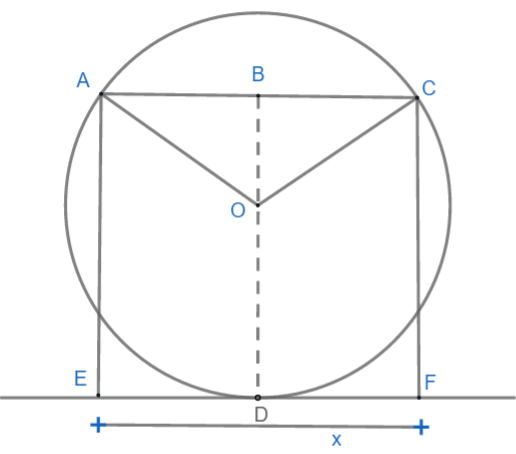
Let BD be a line in the center of the square such that it bisects AC and passes through the center.
This line BD will be perpendicular to AC (because AE and CF are perpendicular to AC as it is a square).
Now let us suppose that the side of the square is x cm.
As we are given that, the diameter of the circle is 10cm, therefore, the radius of the circle will be half of the diameter. Hence radius $\Rightarrow \dfrac{10}{2}=5cm$.
From the diagram we can see that OA, OC and OD are the radius of the circle.
So, OA = 5cm, OC = 5cm and OD = 5cm.
Since the side of the square is x cm, so AC = x cm.
Half of AC is AB, so $AB=\dfrac{x}{2}cm$.
Since BD is equal to CF, which is the side of square. So BD = x cm.
Now, BD = OB + OD but BD = x cm and OD = 5cm, so we get,
$x=OB+5\Rightarrow OB=\left( x-5 \right)cm$.
Hence in $\Delta AOB$ we see that,
$\angle ABO={{90}^{\circ }}$ (BD parallel to CF), OA = 5cm, OB = (x-5)cm and $AB=\dfrac{x}{2}cm$. As $\Delta AOB$ is a right angled triangle so we can apply Pythagoras theorem.
According to Pythagoras theorem,
${{\left( \text{hypotenuse} \right)}^{2}}={{\left( \text{base} \right)}^{2}}+{{\left( \text{perpendicular} \right)}^{2}}$.
In $\Delta AOB$.
\[\begin{align}
& {{\left( AO \right)}^{2}}={{\left( AB \right)}^{2}}+{{\left( OB \right)}^{2}} \\
& \Rightarrow {{\left( 5 \right)}^{2}}={{\left( \dfrac{x}{2} \right)}^{2}}+{{\left( x-5 \right)}^{2}} \\
& \Rightarrow 25=\dfrac{{{x}^{2}}}{4}+{{\left( x-5 \right)}^{2}} \\
\end{align}\]
Applying ${{\left( a-b \right)}^{2}}={{a}^{2}}+{{b}^{2}}-2ab$ we get,
\[\begin{align}
& \Rightarrow 25=\dfrac{{{x}^{2}}}{4}+{{x}^{2}}+{{5}^{2}}-2\left( x \right)\left( 5 \right) \\
& \Rightarrow 25=\dfrac{{{x}^{2}}}{4}+{{x}^{2}}+25-10x \\
& \Rightarrow \dfrac{{{x}^{2}}}{4}+{{x}^{2}}-10x=0 \\
\end{align}\]
Taking LCM as 4 we get,
\[\Rightarrow \dfrac{{{x}^{2}}+4{{x}^{2}}-40x}{4}=0\]
Taking 4 to the other side we get,
\[\begin{align}
& \Rightarrow {{x}^{2}}+4{{x}^{2}}-40x=0 \\
& \Rightarrow 5{{x}^{2}}-40x=0 \\
& \Rightarrow x\left( 5x-40 \right)=0 \\
\end{align}\]
This means either x = 0 or (5x-40)=0.
Since the side of the square cannot be 0. So,
\[\begin{align}
& \Rightarrow 5x-40=0 \\
& \Rightarrow 5x=40 \\
\end{align}\]
Dividing by 5 on both sides we get,
$\begin{align}
& \Rightarrow x=\dfrac{40}{5} \\
& \Rightarrow x=8cm \\
\end{align}$
Since x was supposed to be the side of the square therefore, side of the square is 8cm.
Note: Students should note that diagrams are must for this question, otherwise students can easily make mistakes. For the proof of OB being the perpendicular bisector of AC we can use following proof: since OA and OC are equal so $\Delta AOC$ is an isosceles triangle and we know that line drawn from vertex common to equal sides in an isosceles triangle to the third side is perpendicular bisector to the third side. Hence BD is at ${{90}^{\circ }}$ to AC and thus parallel to AE and CF.
(i) Radius is the half of diameter i.e. $r=\dfrac{d}{2}$.
(ii) Pythagoras theorem: ${{\left( \text{hypotenuse} \right)}^{2}}={{\left( \text{base} \right)}^{2}}+{{\left( \text{perpendicular} \right)}^{2}}$.
Complete step by step answer:
According to our question, the square has two vertices on a circle and two vertices on a tangent to the circle. Let us assume that the square ACFE whose vertices A and C touch the circle and E and F touches the tangent to the circle at point of contact D. Let O be the center of the circle. Join OA, OD and OC. Our diagram looks like this,
Let BD be a line in the center of the square such that it bisects AC and passes through the center.
This line BD will be perpendicular to AC (because AE and CF are perpendicular to AC as it is a square).
Now let us suppose that the side of the square is x cm.
As we are given that, the diameter of the circle is 10cm, therefore, the radius of the circle will be half of the diameter. Hence radius $\Rightarrow \dfrac{10}{2}=5cm$.
From the diagram we can see that OA, OC and OD are the radius of the circle.
So, OA = 5cm, OC = 5cm and OD = 5cm.
Since the side of the square is x cm, so AC = x cm.
Half of AC is AB, so $AB=\dfrac{x}{2}cm$.
Since BD is equal to CF, which is the side of square. So BD = x cm.
Now, BD = OB + OD but BD = x cm and OD = 5cm, so we get,
$x=OB+5\Rightarrow OB=\left( x-5 \right)cm$.
Hence in $\Delta AOB$ we see that,
$\angle ABO={{90}^{\circ }}$ (BD parallel to CF), OA = 5cm, OB = (x-5)cm and $AB=\dfrac{x}{2}cm$. As $\Delta AOB$ is a right angled triangle so we can apply Pythagoras theorem.
According to Pythagoras theorem,
${{\left( \text{hypotenuse} \right)}^{2}}={{\left( \text{base} \right)}^{2}}+{{\left( \text{perpendicular} \right)}^{2}}$.
In $\Delta AOB$.
\[\begin{align}
& {{\left( AO \right)}^{2}}={{\left( AB \right)}^{2}}+{{\left( OB \right)}^{2}} \\
& \Rightarrow {{\left( 5 \right)}^{2}}={{\left( \dfrac{x}{2} \right)}^{2}}+{{\left( x-5 \right)}^{2}} \\
& \Rightarrow 25=\dfrac{{{x}^{2}}}{4}+{{\left( x-5 \right)}^{2}} \\
\end{align}\]
Applying ${{\left( a-b \right)}^{2}}={{a}^{2}}+{{b}^{2}}-2ab$ we get,
\[\begin{align}
& \Rightarrow 25=\dfrac{{{x}^{2}}}{4}+{{x}^{2}}+{{5}^{2}}-2\left( x \right)\left( 5 \right) \\
& \Rightarrow 25=\dfrac{{{x}^{2}}}{4}+{{x}^{2}}+25-10x \\
& \Rightarrow \dfrac{{{x}^{2}}}{4}+{{x}^{2}}-10x=0 \\
\end{align}\]
Taking LCM as 4 we get,
\[\Rightarrow \dfrac{{{x}^{2}}+4{{x}^{2}}-40x}{4}=0\]
Taking 4 to the other side we get,
\[\begin{align}
& \Rightarrow {{x}^{2}}+4{{x}^{2}}-40x=0 \\
& \Rightarrow 5{{x}^{2}}-40x=0 \\
& \Rightarrow x\left( 5x-40 \right)=0 \\
\end{align}\]
This means either x = 0 or (5x-40)=0.
Since the side of the square cannot be 0. So,
\[\begin{align}
& \Rightarrow 5x-40=0 \\
& \Rightarrow 5x=40 \\
\end{align}\]
Dividing by 5 on both sides we get,
$\begin{align}
& \Rightarrow x=\dfrac{40}{5} \\
& \Rightarrow x=8cm \\
\end{align}$
Since x was supposed to be the side of the square therefore, side of the square is 8cm.
Note: Students should note that diagrams are must for this question, otherwise students can easily make mistakes. For the proof of OB being the perpendicular bisector of AC we can use following proof: since OA and OC are equal so $\Delta AOC$ is an isosceles triangle and we know that line drawn from vertex common to equal sides in an isosceles triangle to the third side is perpendicular bisector to the third side. Hence BD is at ${{90}^{\circ }}$ to AC and thus parallel to AE and CF.
Recently Updated Pages
Master Class 12 Business Studies: Engaging Questions & Answers for Success

Master Class 12 Biology: Engaging Questions & Answers for Success
Master Class 12 Chemistry: Engaging Questions & Answers for Success
Class 12 Question and Answer - Your Ultimate Solutions Guide
Master Class 11 Social Science: Engaging Questions & Answers for Success
Master Class 11 English: Engaging Questions & Answers for Success
Trending doubts
Explain the Treaty of Vienna of 1815 class 10 social science CBSE
Which Indian city is known as the "City of Victory"?
Which instrument is used to measure the Blood Pressure?
Who Won 36 Oscar Awards? Record Holder Revealed
What is the median of the first 10 natural numbers class 10 maths CBSE
Why is it 530 pm in india when it is 1200 afternoon class 10 social science CBSE