




A square current carrying loop is suspended in a uniform magnetic field acting in the plane of the loop. If the force on one arm of the loop is$\overrightarrow{F}$, the net force on the remaining three arms of the loop is
A. $3\overrightarrow{F}$
B. $-\overrightarrow{F}$
C. $-3\overrightarrow{F}$
D. $\overrightarrow{F}$
Answer
 Verified
589.2k+ views
Hint: You could make a rough sketch of the given situation so as to have better clarity. Then, you could use the formula as per requirement. You may recall that the force for a closed loop will be zero. We are given force on one of the four arms. We could easily find the net force due to the other three arms.
Formula used:
Magnetic force,
$\overrightarrow{F}=i\left( \oint{\overrightarrow{dl}\times \overrightarrow{B}} \right)$
Complete answer:
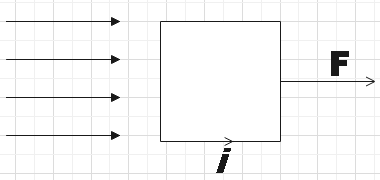
In the question, we are given a square current carrying loop that is suspended in a uniform magnetic field that is acting in the plane of the loop. The following figure will give you a clear picture of the situation.
Let us recall that magnetic force could be given by,
$\overrightarrow{dF}=i\left( \overrightarrow{dl}\times \overrightarrow{B} \right)$
This expression is for a small element. Now for the whole loop it would be given by,
$\overrightarrow{F}=i\left( \oint{\overrightarrow{dl}\times \overrightarrow{B}} \right)$
We also know that, for a closed loop,
$\oint{\overrightarrow{dl}}=0$
Therefore, we could conclude that the net magnetic force would be zero for the given closed loop. We are told that the magnetic force on one of the arms is $\overrightarrow{F}$ and the net force due to the other three arms should be $-\overrightarrow{F}$ for the net force due to the loop to be zero.
Hence, option B is the correct answer.
Note:
We could define magnetic force as the attraction or repulsion that is caused by flow of current or the electrically charged particles. So, basically magnetic force is indeed a consequence of electromagnetic force. Another way to find this magnetic force is by using the magnetic Lorentz force.
$\overrightarrow{F}=q\overrightarrow{v}\times \overrightarrow{B}$
Formula used:
Magnetic force,
$\overrightarrow{F}=i\left( \oint{\overrightarrow{dl}\times \overrightarrow{B}} \right)$
Complete answer:
In the question, we are given a square current carrying loop that is suspended in a uniform magnetic field that is acting in the plane of the loop. The following figure will give you a clear picture of the situation.
Let us recall that magnetic force could be given by,
$\overrightarrow{dF}=i\left( \overrightarrow{dl}\times \overrightarrow{B} \right)$
This expression is for a small element. Now for the whole loop it would be given by,
$\overrightarrow{F}=i\left( \oint{\overrightarrow{dl}\times \overrightarrow{B}} \right)$
We also know that, for a closed loop,
$\oint{\overrightarrow{dl}}=0$
Therefore, we could conclude that the net magnetic force would be zero for the given closed loop. We are told that the magnetic force on one of the arms is $\overrightarrow{F}$ and the net force due to the other three arms should be $-\overrightarrow{F}$ for the net force due to the loop to be zero.
Hence, option B is the correct answer.
Note:
We could define magnetic force as the attraction or repulsion that is caused by flow of current or the electrically charged particles. So, basically magnetic force is indeed a consequence of electromagnetic force. Another way to find this magnetic force is by using the magnetic Lorentz force.
$\overrightarrow{F}=q\overrightarrow{v}\times \overrightarrow{B}$
Recently Updated Pages
Master Class 11 English: Engaging Questions & Answers for Success

Master Class 11 Physics: Engaging Questions & Answers for Success
Master Class 11 Computer Science: Engaging Questions & Answers for Success
Master Class 11 Chemistry: Engaging Questions & Answers for Success
Master Class 11 Social Science: Engaging Questions & Answers for Success
Master Class 11 Accountancy: Engaging Questions & Answers for Success
Trending doubts
Difference Between Prokaryotic Cells and Eukaryotic Cells
Two of the body parts which do not appear in MRI are class 11 biology CBSE
One Metric ton is equal to kg A 10000 B 1000 C 100 class 11 physics CBSE
10 examples of friction in our daily life
Draw a diagram of nephron and explain its structur class 11 biology CBSE
Draw a diagram of a plant cell and label at least eight class 11 biology CBSE