




A spring of force constant 800 N/m has an extension of 5 cm. Find work done in extending it from 5 cm to 15 cm?
Answer
 Verified
621.9k+ views
Hint: When a force is by a spring on an object attached to its ends is directly proportional to the change in length of spring away from its equilibrium length, and the force is always directed towards its equilibrium position given as $F = - kx$ where constant $k$ is called spring constant and $x$ is the elongation/compression of the spring from its normal state. Spring constant is the measure of the stiffness of the spring.
In this question, a force is applied to stretch the spring from its equilibrium position; hence Elastic potential energy is stored. Elastic potential energy is the potential energy stored as a result of deformation of an elastic object which is equal to work done.
Complete step by step answer:
Given that the spring is extended with a constant force \[k = 800N/m\]
Hence the work done is stored as elastic potential energy in the spring,
The spring is extended from 5cm to 15cm which is given as
\[{x_1} = 5cm\]
\[{x_2} = 15cm\]
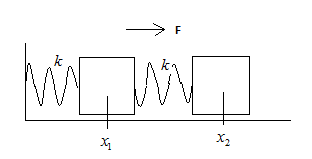
Force constant \[k = 800N/m = \dfrac{{800}}{{100}}N/cm = 8N/cm\]
Hence the total work done in the deformation of the spring is
\[
W = \dfrac{1}{2}k\left( {x_2^2 - x_1^2} \right) \\
= \dfrac{1}{2} \times 8 \times \left( {{{\left( {15} \right)}^2} - {5^2}} \right) \\
= \dfrac{1}{2} \times 8 \times \left( {225 - 25} \right) \\
= \dfrac{1}{2} \times 8 \times 200 \\
= 800N/cm \\
\]
This can be written as:
\[W = 800N/cm = 8N/m = 8J\]
Hence the total work done in the extension of the spring from 5cm to 15cm is equal to \[8J\]
Note:
When a spring is stretched or compressed, its length changes by an amount $x$ from its equilibrium length, then it exerts a force \[F = - kx\] in the direction towards the equilibrium.
In this question, a force is applied to stretch the spring from its equilibrium position; hence Elastic potential energy is stored. Elastic potential energy is the potential energy stored as a result of deformation of an elastic object which is equal to work done.
Complete step by step answer:
Given that the spring is extended with a constant force \[k = 800N/m\]
Hence the work done is stored as elastic potential energy in the spring,
The spring is extended from 5cm to 15cm which is given as
\[{x_1} = 5cm\]
\[{x_2} = 15cm\]
Force constant \[k = 800N/m = \dfrac{{800}}{{100}}N/cm = 8N/cm\]
Hence the total work done in the deformation of the spring is
\[
W = \dfrac{1}{2}k\left( {x_2^2 - x_1^2} \right) \\
= \dfrac{1}{2} \times 8 \times \left( {{{\left( {15} \right)}^2} - {5^2}} \right) \\
= \dfrac{1}{2} \times 8 \times \left( {225 - 25} \right) \\
= \dfrac{1}{2} \times 8 \times 200 \\
= 800N/cm \\
\]
This can be written as:
\[W = 800N/cm = 8N/m = 8J\]
Hence the total work done in the extension of the spring from 5cm to 15cm is equal to \[8J\]
Note:
When a spring is stretched or compressed, its length changes by an amount $x$ from its equilibrium length, then it exerts a force \[F = - kx\] in the direction towards the equilibrium.
Recently Updated Pages
Master Class 11 English: Engaging Questions & Answers for Success

Master Class 11 Social Science: Engaging Questions & Answers for Success
Master Class 11 Maths: Engaging Questions & Answers for Success
Master Class 11 Biology: Engaging Questions & Answers for Success
Master Class 11 Physics: Engaging Questions & Answers for Success
Master Class 11 Chemistry: Engaging Questions & Answers for Success
Trending doubts
One Metric ton is equal to kg A 10000 B 1000 C 100 class 11 physics CBSE
Difference Between Prokaryotic Cells and Eukaryotic Cells
1 ton equals to A 100 kg B 1000 kg C 10 kg D 10000 class 11 physics CBSE
Find the value of the expression given below sin 30circ class 11 maths CBSE
Two of the body parts which do not appear in MRI are class 11 biology CBSE
What are hard magnetic materials class 11 physics CBSE