




A spring mass system is held at rest with the spring relaxed of a height h above the ground. The minimum value of h for which the system has a tendency to rebound after hitting the ground is (assume zero coefficient of restitution for tower block and ground).
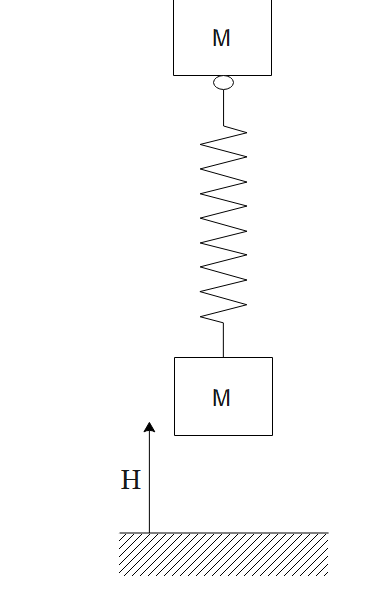
$\begin{align}
& a)\dfrac{2mg}{k} \\
& b)\dfrac{3mg}{k} \\
& c)\dfrac{3mg}{2k} \\
& d)\dfrac{6mg}{k} \\
\end{align}$
Answer
 Verified
584.1k+ views
Hint: Let us first find out the velocity of the block when it hits the ground using the conservation of energy. Also, the compression must be such that it must lift the block again. Apply this condition and find out the minimum compression. Finally, apply conservation of energy to find the value of h at initial and final points.
Formula used:
$\begin{align}
& \dfrac{1}{2}m{{v}^{2}}=mgh \\
& \Rightarrow kx=mg \\
\end{align}$
Complete answer:
Let’s find the velocity of the block just before it hits the ground,
$\begin{align}
& \dfrac{1}{2}m{{v}^{2}}=mgh \\
& \Rightarrow v=\sqrt{2gh}...(1) \\
\end{align}$
Next, for minimum compression,
$\begin{align}
& kx=mg \\
& \Rightarrow x=\dfrac{mg}{k} \\
\end{align}$
Next, applying work energy theorem for final conditions,
$\begin{align}
& \dfrac{1}{2}m{{v}^{2}}+0=\dfrac{1}{2}k{{x}^{2}}+mgx \\
& \Rightarrow \dfrac{1}{2}m(2gh)=\dfrac{mg\times mg}{2k}+\dfrac{mg\times mg}{k} \\
& \Rightarrow 2mgh=\dfrac{3{{m}^{2}}{{g}^{2}}}{k} \\
& \Rightarrow h=\dfrac{3mg}{2k} \\
\end{align}$
So, the correct answer is “Option C”.
Additional Information:
In a spring mass system, there will not be any external forces acting on them. A system of masses connected by springs is a classical system with several degrees of freedom. A system consisting of two masses and three springs has two degrees of freedom. As the energy is conserved in any spring mass system, the velocity of the block at any point can be easily calculated using the energy conservation system. The motion of a mass on a spring can be described as simple harmonic motion, an oscillatory motion that follows hooke's law. The natural frequency is also known as eigen frequency, is the frequency at which a system tends to oscillate in the absence of any driving or damping force. The motion pattern of a system oscillating at natural frequency is called normal mode.
Note:
In the above question, the force due to spring or during force must be greater than the weight of the block for the block to rebound. And the minimum compression requires the spring to be equal to the weight exactly. Therefore, the force is equal to the weight of the block for minimum compression.
Formula used:
$\begin{align}
& \dfrac{1}{2}m{{v}^{2}}=mgh \\
& \Rightarrow kx=mg \\
\end{align}$
Complete answer:
Let’s find the velocity of the block just before it hits the ground,
$\begin{align}
& \dfrac{1}{2}m{{v}^{2}}=mgh \\
& \Rightarrow v=\sqrt{2gh}...(1) \\
\end{align}$
Next, for minimum compression,
$\begin{align}
& kx=mg \\
& \Rightarrow x=\dfrac{mg}{k} \\
\end{align}$
Next, applying work energy theorem for final conditions,
$\begin{align}
& \dfrac{1}{2}m{{v}^{2}}+0=\dfrac{1}{2}k{{x}^{2}}+mgx \\
& \Rightarrow \dfrac{1}{2}m(2gh)=\dfrac{mg\times mg}{2k}+\dfrac{mg\times mg}{k} \\
& \Rightarrow 2mgh=\dfrac{3{{m}^{2}}{{g}^{2}}}{k} \\
& \Rightarrow h=\dfrac{3mg}{2k} \\
\end{align}$
So, the correct answer is “Option C”.
Additional Information:
In a spring mass system, there will not be any external forces acting on them. A system of masses connected by springs is a classical system with several degrees of freedom. A system consisting of two masses and three springs has two degrees of freedom. As the energy is conserved in any spring mass system, the velocity of the block at any point can be easily calculated using the energy conservation system. The motion of a mass on a spring can be described as simple harmonic motion, an oscillatory motion that follows hooke's law. The natural frequency is also known as eigen frequency, is the frequency at which a system tends to oscillate in the absence of any driving or damping force. The motion pattern of a system oscillating at natural frequency is called normal mode.
Note:
In the above question, the force due to spring or during force must be greater than the weight of the block for the block to rebound. And the minimum compression requires the spring to be equal to the weight exactly. Therefore, the force is equal to the weight of the block for minimum compression.
Recently Updated Pages
Master Class 11 Computer Science: Engaging Questions & Answers for Success

Master Class 11 Business Studies: Engaging Questions & Answers for Success
Master Class 11 Economics: Engaging Questions & Answers for Success
Master Class 11 English: Engaging Questions & Answers for Success
Master Class 11 Maths: Engaging Questions & Answers for Success
Master Class 11 Biology: Engaging Questions & Answers for Success
Trending doubts
One Metric ton is equal to kg A 10000 B 1000 C 100 class 11 physics CBSE
There are 720 permutations of the digits 1 2 3 4 5 class 11 maths CBSE
Discuss the various forms of bacteria class 11 biology CBSE
Draw a diagram of a plant cell and label at least eight class 11 biology CBSE
State the laws of reflection of light
Explain zero factorial class 11 maths CBSE