




A spring block system is placed on a horizontal surface so as to just fit within the vertical walls. The spring is initially unstretched. The coefficient of restitution for collision is $e = \dfrac{1}{2}$ . The block is pulled to the left by a distance \[x = 1\,cm\] and released from rest. The time between second and third collision of the block with the wall is
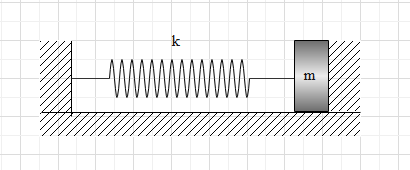
A. $2\pi \sqrt {\dfrac{m}{k}} $
B. $\pi \sqrt {\dfrac{m}{k}} $
C. $\dfrac{\pi }{2}\sqrt {\dfrac{m}{k}} $
D. $\dfrac{\pi }{4}\sqrt {\dfrac{m}{k}} $
Answer
 Verified
601.2k+ views
Hint-
Coefficient of restitution for an object colliding with a perfectly rigid wall is defined as the ratio of final velocity to initial velocity or the speed of separation to speed of approach
Therefore,
$e = \dfrac{{{v_s}}}{{{v_a}}} = \dfrac{1}{2}$
Where,${v_s}$ is the velocity of separation,${v_a}$ is the velocity of approach
Time period in simple harmonic motion is independent of the amplitude. It is given by the equation,
$T = 2\pi \sqrt {\dfrac{m}{k}} $
Where, $m$ is the mass and $k$ is the spring constant.
Coefficient of restitution is given as$\dfrac{1}{2}$ . It means that velocity becomes twice in second collision
Since velocity and time are inversely related. The time becomes $\dfrac{1}{2}$
That is, time for second oscillation
$t = \dfrac{T}{2}$
Complete step-by-step answer:
Given,
Coefficient of restitution for collision is , $e = \dfrac{1}{2}$
Coefficient of restitution for an object colliding with a perfectly rigid wall is defined as the ratio of final velocity to initial velocity or the speed of separation to speed of approach
Therefore,
$e = \dfrac{{{v_s}}}{{{v_a}}} = \dfrac{1}{2}$
Where, ${v_s}$ is the velocity of separation, ${v_a}$ is the velocity of approach.
When the block strikes the wall, it bounces back because of the normal reaction exerted by the wall
The motion here is simple harmonic motion.
A simple harmonic motion is a periodic motion in which the restoring force is directly proportional to the displacement and acting towards the equilibrium position
Time period in simple harmonic motion is independent of the amplitude. It is given by the equation,
$T = 2\pi \sqrt {\dfrac{m}{k}} $
Where, $m$ is the mass and $k$ is the spring constant.
Since, the coefficient of restitution is given as $\dfrac{1}{2}$. It means that velocity becomes twice in a second collision.
Since velocity and time are inversely related. The time becomes $\dfrac{1}{2}$
That is, time for second oscillation,
$t = \dfrac{T}{2}$
Therefore,
\[
t = \dfrac{{2\pi \sqrt {\dfrac{m}{k}} }}{2} \\
= \pi \sqrt {\dfrac{m}{k}} \\
\]
So, the correct answer is option B.
Note:
Formulas to remember-
$T = 2\pi \sqrt {\dfrac{m}{k}} $
Where, $T$ is the time period in simple harmonic motion, $m$ is the mass and $k$ is the spring constant.
Coefficient of restitution for collision,
$e = \dfrac{{{v_s}}}{{{v_a}}}$
Where, ${v_s}$ is the velocity of separation, ${v_a}$ is the velocity of approach.
Coefficient of restitution for an object colliding with a perfectly rigid wall is defined as the ratio of final velocity to initial velocity or the speed of separation to speed of approach
Therefore,
$e = \dfrac{{{v_s}}}{{{v_a}}} = \dfrac{1}{2}$
Where,${v_s}$ is the velocity of separation,${v_a}$ is the velocity of approach
Time period in simple harmonic motion is independent of the amplitude. It is given by the equation,
$T = 2\pi \sqrt {\dfrac{m}{k}} $
Where, $m$ is the mass and $k$ is the spring constant.
Coefficient of restitution is given as$\dfrac{1}{2}$ . It means that velocity becomes twice in second collision
Since velocity and time are inversely related. The time becomes $\dfrac{1}{2}$
That is, time for second oscillation
$t = \dfrac{T}{2}$
Complete step-by-step answer:
Given,
Coefficient of restitution for collision is , $e = \dfrac{1}{2}$
Coefficient of restitution for an object colliding with a perfectly rigid wall is defined as the ratio of final velocity to initial velocity or the speed of separation to speed of approach
Therefore,
$e = \dfrac{{{v_s}}}{{{v_a}}} = \dfrac{1}{2}$
Where, ${v_s}$ is the velocity of separation, ${v_a}$ is the velocity of approach.
When the block strikes the wall, it bounces back because of the normal reaction exerted by the wall
The motion here is simple harmonic motion.
A simple harmonic motion is a periodic motion in which the restoring force is directly proportional to the displacement and acting towards the equilibrium position
Time period in simple harmonic motion is independent of the amplitude. It is given by the equation,
$T = 2\pi \sqrt {\dfrac{m}{k}} $
Where, $m$ is the mass and $k$ is the spring constant.
Since, the coefficient of restitution is given as $\dfrac{1}{2}$. It means that velocity becomes twice in a second collision.
Since velocity and time are inversely related. The time becomes $\dfrac{1}{2}$
That is, time for second oscillation,
$t = \dfrac{T}{2}$
Therefore,
\[
t = \dfrac{{2\pi \sqrt {\dfrac{m}{k}} }}{2} \\
= \pi \sqrt {\dfrac{m}{k}} \\
\]
So, the correct answer is option B.
Note:
Formulas to remember-
$T = 2\pi \sqrt {\dfrac{m}{k}} $
Where, $T$ is the time period in simple harmonic motion, $m$ is the mass and $k$ is the spring constant.
Coefficient of restitution for collision,
$e = \dfrac{{{v_s}}}{{{v_a}}}$
Where, ${v_s}$ is the velocity of separation, ${v_a}$ is the velocity of approach.
Recently Updated Pages
Three beakers labelled as A B and C each containing 25 mL of water were taken A small amount of NaOH anhydrous CuSO4 and NaCl were added to the beakers A B and C respectively It was observed that there was an increase in the temperature of the solutions contained in beakers A and B whereas in case of beaker C the temperature of the solution falls Which one of the following statements isarecorrect i In beakers A and B exothermic process has occurred ii In beakers A and B endothermic process has occurred iii In beaker C exothermic process has occurred iv In beaker C endothermic process has occurred

Master Class 11 Social Science: Engaging Questions & Answers for Success
Master Class 11 Physics: Engaging Questions & Answers for Success
Master Class 11 Maths: Engaging Questions & Answers for Success
Master Class 11 Economics: Engaging Questions & Answers for Success
Master Class 11 Computer Science: Engaging Questions & Answers for Success
Three beakers labelled as A B and C each containing 25 mL of water were taken A small amount of NaOH anhydrous CuSO4 and NaCl were added to the beakers A B and C respectively It was observed that there was an increase in the temperature of the solutions contained in beakers A and B whereas in case of beaker C the temperature of the solution falls Which one of the following statements isarecorrect i In beakers A and B exothermic process has occurred ii In beakers A and B endothermic process has occurred iii In beaker C exothermic process has occurred iv In beaker C endothermic process has occurred
Master Class 11 Social Science: Engaging Questions & Answers for Success
Master Class 11 Physics: Engaging Questions & Answers for Success
Trending doubts
One Metric ton is equal to kg A 10000 B 1000 C 100 class 11 physics CBSE
There are 720 permutations of the digits 1 2 3 4 5 class 11 maths CBSE
State and prove Bernoullis theorem class 11 physics CBSE
Draw a diagram of a plant cell and label at least eight class 11 biology CBSE
Difference Between Prokaryotic Cells and Eukaryotic Cells
1 Quintal is equal to a 110 kg b 10 kg c 100kg d 1000 class 11 physics CBSE