




A spectrum is obtained by passing white light from a torch through a glass prism
a.Write down the steps of this experiment.
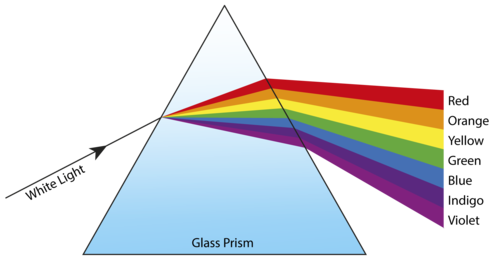
b.Draw a figure that represents the experiment.
Answer
 Verified
494.7k+ views
Hint: White light may be broken up into its constituent spectral hues using a dispersive prism (the colors of the rainbow). Prisms can also be used to split light into components with different polarizations or to reflect light.
Dispersion is a phenomenon in which the refractive index of numerous materials (such as glass) fluctuates with the wavelength or color of the light employed.
As a result, the light of different hues is refracted differently and exits the prism at different angles, giving a rainbow effect.
Complete answer:
a.The experiment has the following steps:
You have to take a transparent prism and a torch.
Cut a hole in a piece of cardboard so that a beam of light traveling through it can be focused.
Attach it to the torch.
Allow the light beam to travel through the prism now.
When white light passes through a prism, it splits into its constituent colors, which are red, orange, yellow, green, blue, indigo, and violet.
This means white light is made up of seven different colors.
b.
Note:
Because the refractive index of light varies with frequency, dispersive prisms are used to separate light into its constituent spectral colors. White light entering the prism is a mixture of several frequencies, each of which bends somewhat differently. Because blue light is slower than red light, it will bend more.
Instead of dispersion, prisms are sometimes employed for internal reflection at surfaces. Total internal reflection occurs when the light inside the prism strikes one of the surfaces at a sufficiently steep angle, and all of the light is reflected. In some cases, this makes a prism a good substitute for a mirror.
The angle of deviation is a term used to describe the amount of overall refraction induced by a light ray passing through a prism.
Dispersion is a phenomenon in which the refractive index of numerous materials (such as glass) fluctuates with the wavelength or color of the light employed.
As a result, the light of different hues is refracted differently and exits the prism at different angles, giving a rainbow effect.
Complete answer:
a.The experiment has the following steps:
You have to take a transparent prism and a torch.
Cut a hole in a piece of cardboard so that a beam of light traveling through it can be focused.
Attach it to the torch.
Allow the light beam to travel through the prism now.
When white light passes through a prism, it splits into its constituent colors, which are red, orange, yellow, green, blue, indigo, and violet.
This means white light is made up of seven different colors.
b.
Note:
Because the refractive index of light varies with frequency, dispersive prisms are used to separate light into its constituent spectral colors. White light entering the prism is a mixture of several frequencies, each of which bends somewhat differently. Because blue light is slower than red light, it will bend more.
Instead of dispersion, prisms are sometimes employed for internal reflection at surfaces. Total internal reflection occurs when the light inside the prism strikes one of the surfaces at a sufficiently steep angle, and all of the light is reflected. In some cases, this makes a prism a good substitute for a mirror.
The angle of deviation is a term used to describe the amount of overall refraction induced by a light ray passing through a prism.
Recently Updated Pages
Master Class 11 Social Science: Engaging Questions & Answers for Success

Master Class 11 English: Engaging Questions & Answers for Success
Master Class 11 Maths: Engaging Questions & Answers for Success
Master Class 11 Chemistry: Engaging Questions & Answers for Success
Master Class 11 Biology: Engaging Questions & Answers for Success
Master Class 11 Physics: Engaging Questions & Answers for Success
Trending doubts
One Metric ton is equal to kg A 10000 B 1000 C 100 class 11 physics CBSE
Difference Between Prokaryotic Cells and Eukaryotic Cells
Draw a diagram of a plant cell and label at least eight class 11 biology CBSE
Two of the body parts which do not appear in MRI are class 11 biology CBSE
Which gas is abundant in air class 11 chemistry CBSE
10 examples of friction in our daily life