




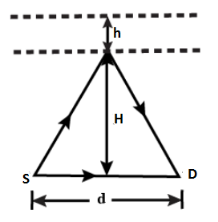
A source $ S $ and a detector $ D $ of high frequency waves are a distance $ d $ apart on the ground. The direct wave from $ S $ is found to be in phase at $ D $ with the wave from $ S $ that is reflected rays making the same angle with the reflecting layer. When the layer rises a distance $ h $ , no signal is detected at $ D $ . Neglect absorption in the atmosphere and find the relation between $ d $ , $ h $ , $ H $ and the wavelength $ \lambda $ of the waves.
Answer
 Verified
531.9k+ views
Hint :In order to solve this question, we are going to consider the two rays that are approaching the point $ D $ first from the height $ H $ and then from the height $ \left( {H + h} \right) $ . The first one will form constructive interference and the latter will be destructive. Thus, respective path differences are subtracted.
The path difference for constructive interference is given by
$ \Delta x = n\lambda $
The path difference for destructive interference is given by
$ \Delta x = \left( {n + \dfrac{1}{2}} \right)\lambda $ .
Complete Step By Step Answer:
If we observe the situation as given in the question, we see that when a ray is reflected from a height $ H $ , and the other one comes to $ D $ in a direct way, then, the interference that occurs is a constructive one.
We know that the path difference for constructive interference is given by
$ \Delta x = n\lambda $
Where,
$ n = 0,1,2,3,.... $
Let us consider a point P at the height $ H $
Thus, $ SD = d $
$ SP = \sqrt {{H^2} + {{\left( {\dfrac{d}{2}} \right)}^2}} $
And, $ PD = \sqrt {{H^2} + {{\left( {\dfrac{d}{2}} \right)}^2}} $
Hence, $ SP + PD = 2\sqrt {{H^2} + {{\left( {\dfrac{d}{2}} \right)}^2}} = \sqrt {4{H^2} + {d^2}} $
Hence, the path difference is given by
$ \Delta x = SP - SD = \sqrt {4{H^2} + {d^2}} - d \\
\Rightarrow n\lambda = \sqrt {4{H^2} + {d^2}} - d - - - - \left( 1 \right) \\ $
When ray comes from height $ H + h $ , there is no direct ray coming to $ D $ , then the destructive interference occurs at $ D $
Now, path difference for destructive interference is given by
$ \Delta x = \left( {n + \dfrac{1}{2}} \right)\lambda $
Where, $ n = 0,1,2,3,.... $
Let us consider a point Q at the height $ H + h $
$ SD = d $
And
$ SQ = \sqrt {{{\left( {H + h} \right)}^2} + {{\left( {\dfrac{d}{2}} \right)}^2}} \\
QD = \sqrt {{{\left( {H + h} \right)}^2} + {{\left( {\dfrac{d}{2}} \right)}^2}} \\ $
Thus, $ SQ + QD = 2\sqrt {{{\left( {H + h} \right)}^2} + {{\left( {\dfrac{d}{2}} \right)}^2}} = \sqrt {4{{\left( {H + h} \right)}^2} + {d^2}} $
Hence, the path difference is given by
$ SQ - SD = \sqrt {4{{\left( {H + h} \right)}^2} + {d^2}} - d \\
\Rightarrow \left( {n + \dfrac{1}{2}} \right)\lambda = \sqrt {4{{\left( {H + h} \right)}^2} + {d^2}} - d - - - - \left( 2 \right) \\ $
Subtracting equation $ \left( 1 \right) $ from equation $ \left( 2 \right) $
$ \lambda = 2\sqrt {4{{\left( {H + h} \right)}^2} + {d^2}} - 2\sqrt {4{H^2} + {d^2}} $
Note :
For both the constructive and the destructive interference, two factors that remain common are the variable $ n $ and the wavelength, the respective relations for both the types are different which gives two different equations and thus, helps to solve for the value of the wavelength.
The path difference for constructive interference is given by
$ \Delta x = n\lambda $
The path difference for destructive interference is given by
$ \Delta x = \left( {n + \dfrac{1}{2}} \right)\lambda $ .
Complete Step By Step Answer:
If we observe the situation as given in the question, we see that when a ray is reflected from a height $ H $ , and the other one comes to $ D $ in a direct way, then, the interference that occurs is a constructive one.
We know that the path difference for constructive interference is given by
$ \Delta x = n\lambda $
Where,
$ n = 0,1,2,3,.... $
Let us consider a point P at the height $ H $
Thus, $ SD = d $
$ SP = \sqrt {{H^2} + {{\left( {\dfrac{d}{2}} \right)}^2}} $
And, $ PD = \sqrt {{H^2} + {{\left( {\dfrac{d}{2}} \right)}^2}} $
Hence, $ SP + PD = 2\sqrt {{H^2} + {{\left( {\dfrac{d}{2}} \right)}^2}} = \sqrt {4{H^2} + {d^2}} $
Hence, the path difference is given by
$ \Delta x = SP - SD = \sqrt {4{H^2} + {d^2}} - d \\
\Rightarrow n\lambda = \sqrt {4{H^2} + {d^2}} - d - - - - \left( 1 \right) \\ $
When ray comes from height $ H + h $ , there is no direct ray coming to $ D $ , then the destructive interference occurs at $ D $
Now, path difference for destructive interference is given by
$ \Delta x = \left( {n + \dfrac{1}{2}} \right)\lambda $
Where, $ n = 0,1,2,3,.... $
Let us consider a point Q at the height $ H + h $
$ SD = d $
And
$ SQ = \sqrt {{{\left( {H + h} \right)}^2} + {{\left( {\dfrac{d}{2}} \right)}^2}} \\
QD = \sqrt {{{\left( {H + h} \right)}^2} + {{\left( {\dfrac{d}{2}} \right)}^2}} \\ $
Thus, $ SQ + QD = 2\sqrt {{{\left( {H + h} \right)}^2} + {{\left( {\dfrac{d}{2}} \right)}^2}} = \sqrt {4{{\left( {H + h} \right)}^2} + {d^2}} $
Hence, the path difference is given by
$ SQ - SD = \sqrt {4{{\left( {H + h} \right)}^2} + {d^2}} - d \\
\Rightarrow \left( {n + \dfrac{1}{2}} \right)\lambda = \sqrt {4{{\left( {H + h} \right)}^2} + {d^2}} - d - - - - \left( 2 \right) \\ $
Subtracting equation $ \left( 1 \right) $ from equation $ \left( 2 \right) $
$ \lambda = 2\sqrt {4{{\left( {H + h} \right)}^2} + {d^2}} - 2\sqrt {4{H^2} + {d^2}} $
Note :
For both the constructive and the destructive interference, two factors that remain common are the variable $ n $ and the wavelength, the respective relations for both the types are different which gives two different equations and thus, helps to solve for the value of the wavelength.
Recently Updated Pages
Master Class 11 Computer Science: Engaging Questions & Answers for Success

Master Class 11 Business Studies: Engaging Questions & Answers for Success
Master Class 11 Economics: Engaging Questions & Answers for Success
Master Class 11 English: Engaging Questions & Answers for Success
Master Class 11 Maths: Engaging Questions & Answers for Success
Master Class 11 Biology: Engaging Questions & Answers for Success
Trending doubts
One Metric ton is equal to kg A 10000 B 1000 C 100 class 11 physics CBSE
There are 720 permutations of the digits 1 2 3 4 5 class 11 maths CBSE
Discuss the various forms of bacteria class 11 biology CBSE
Draw a diagram of a plant cell and label at least eight class 11 biology CBSE
State the laws of reflection of light
10 examples of friction in our daily life