




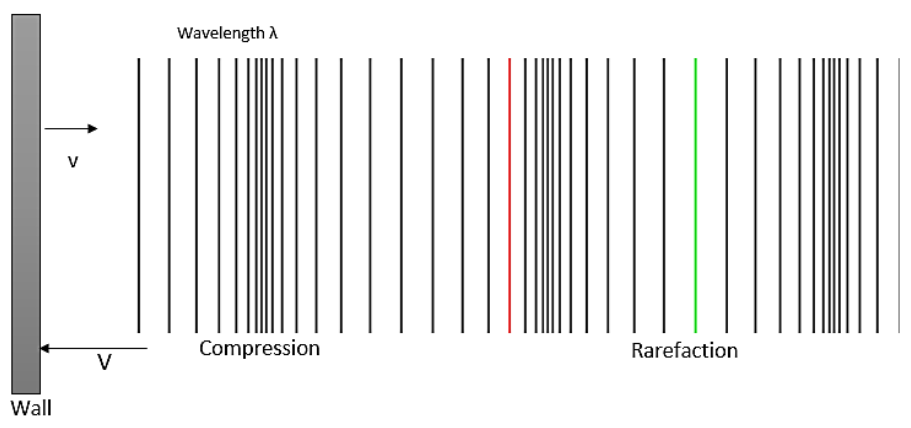
A sound wave of wavelength $\lambda $ travels horizontally towards the right with a velocity of $V$. It strikes and reflects from a vertical plane surface traveling at a speed $v$ towards the left. Then the number of positive crests striking in a time interval of $3s$ on the wall is
Answer
 Verified
596.4k+ views
Hint: The relative velocity should be found first. Using this the apparent frequency also should be found out. The number of crests per second is obtained using the apparent frequency. For the required time interval mentioned in the question, multiply the apparent frequency with this time interval. These all may help you to solve this question.
Complete step-by-step solution:
First of all, let us take a look at those terms mentioned in the question. The wavelength of the sound wave traveling is given as $\lambda $. The velocity of the wave towards the right is given as $V$, and the velocity when it reflects back towards left is given as $v$. The time taken for the process to happen is,
$t=3s$
The relative velocity of sound waves with respect to the wall is given by the equation,
$V+v$
Let us calculate the apparent frequency of striking.
The frequency is found by the equation,
$f=\dfrac{v}{\lambda }$
Using this relation, here we can write that,
$f=\dfrac{V+v}{\lambda }$
The number of crests striking per second will be the same as frequency. As there is $3s$ in total, the total number of crest striking per second will be given as,
$n=\dfrac{3\left( V+v \right)}{\lambda }$
Therefore the correct answer has been obtained.
Note: Sound waves are considered as longitudinal waves. This is because the particles in the medium through which the wave passes will be vibrating in parallel to the direction of propagation of the wave. Sound requires a medium to travel.
Complete step-by-step solution:
First of all, let us take a look at those terms mentioned in the question. The wavelength of the sound wave traveling is given as $\lambda $. The velocity of the wave towards the right is given as $V$, and the velocity when it reflects back towards left is given as $v$. The time taken for the process to happen is,
$t=3s$
The relative velocity of sound waves with respect to the wall is given by the equation,
$V+v$
Let us calculate the apparent frequency of striking.
The frequency is found by the equation,
$f=\dfrac{v}{\lambda }$
Using this relation, here we can write that,
$f=\dfrac{V+v}{\lambda }$
The number of crests striking per second will be the same as frequency. As there is $3s$ in total, the total number of crest striking per second will be given as,
$n=\dfrac{3\left( V+v \right)}{\lambda }$
Therefore the correct answer has been obtained.
Note: Sound waves are considered as longitudinal waves. This is because the particles in the medium through which the wave passes will be vibrating in parallel to the direction of propagation of the wave. Sound requires a medium to travel.
Recently Updated Pages
Master Class 11 Social Science: Engaging Questions & Answers for Success

Master Class 11 Physics: Engaging Questions & Answers for Success
Master Class 11 Maths: Engaging Questions & Answers for Success
Master Class 11 Economics: Engaging Questions & Answers for Success
Master Class 11 Computer Science: Engaging Questions & Answers for Success
Master Class 11 Chemistry: Engaging Questions & Answers for Success
Trending doubts
One Metric ton is equal to kg A 10000 B 1000 C 100 class 11 physics CBSE
There are 720 permutations of the digits 1 2 3 4 5 class 11 maths CBSE
1 Quintal is equal to a 110 kg b 10 kg c 100kg d 1000 class 11 physics CBSE
State and prove Bernoullis theorem class 11 physics CBSE
Difference Between Prokaryotic Cells and Eukaryotic Cells
Discuss the various forms of bacteria class 11 biology CBSE