




A solution of $\mathbf{2M}$ formic acid $(HCOOH)$ is $0.95\%$ ionized. What is the $\mathbf{K}\alpha $ of formic acid?
A.$1.9\times {{10}^{-2}}$
B.$1.8\times {{10}^{-4}}$
C.$9\times {{10}^{-5}}$
D.$4.5\times {{10}^{-5}}$
Answer
 Verified
599.1k+ views
Hint:The dissociation constant $\text{(Ka)}$ is a quantitative measurement of the strength of acid in a solution. It is the equilibrium constant for a chemical reaction known as dissociation in the context of acid-base reactions. The dissociation constant ‘$\text{Ka}$’ for a degree of dissociation $(\alpha )$ is given as.
$\text{K}\alpha ={{\alpha }^{2}}\text{C}$
Complete step by step answer:
We know that, the formula for degree of dissociation $(\alpha )$ in terms of dissociation constant $\text{K}\alpha $ is,
$\text{K}\alpha ={{\alpha }^{2}}\text{C}$
$\therefore $ $\alpha =\sqrt{\dfrac{\text{K}\alpha }{\text{C}}}$
Squaring both the sides
$\therefore $ ${{\alpha }^{2}}=\dfrac{\text{K}\alpha }{\text{C}}$
Where $\alpha $ is degree of dissociation and C is the concentration
$\therefore $ $\text{K}\alpha ={{\alpha }^{2}}\text{C}$
Given degree of dissociation is
$\alpha =\text{0}\text{.95 }\!\!%\!\!\text{ }=\dfrac{0.95}{100}$
And concentration is
$\text{C}=\text{2M}$
Therefore, on putting the above values in the formula we have derived above, we get
$\text{K}\alpha ={{\left( \dfrac{0.95}{100} \right)}^{2}}\times 2$
$=1.84\times {{10}^{-4}}$
So, B is the correct option.
Additional Information:
-Formic acid is also known as mechanic acid. The word ‘Formic’ is a Latin word used for ‘ant’, ‘’formica’’.
-It’s chemical formula is $\text{HCOOH}\text{.}$
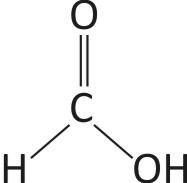
-Formic acid is the simplest carboxylic acid, which contains a single carbon atom.
-It occurs naturally in various sources like venom of bee and ant stings, pine needles.
-It is used to produce insecticides, used as a preservative also.
-It is a colourless liquid, highly flammable, and pungent.
Note:
As we know the formic acid is corrosive, it can cause acid is corrosive, it can cause burns to any part of the body which comes in contact with.
Any by mistake intake of formic acid can lead to burns of the mouth, throat and stomach.
While performing reactions of formic acid, do not breathe vapors and use a respirator.
$\text{K}\alpha ={{\alpha }^{2}}\text{C}$
Complete step by step answer:
We know that, the formula for degree of dissociation $(\alpha )$ in terms of dissociation constant $\text{K}\alpha $ is,
$\text{K}\alpha ={{\alpha }^{2}}\text{C}$
$\therefore $ $\alpha =\sqrt{\dfrac{\text{K}\alpha }{\text{C}}}$
Squaring both the sides
$\therefore $ ${{\alpha }^{2}}=\dfrac{\text{K}\alpha }{\text{C}}$
Where $\alpha $ is degree of dissociation and C is the concentration
$\therefore $ $\text{K}\alpha ={{\alpha }^{2}}\text{C}$
Given degree of dissociation is
$\alpha =\text{0}\text{.95 }\!\!%\!\!\text{ }=\dfrac{0.95}{100}$
And concentration is
$\text{C}=\text{2M}$
Therefore, on putting the above values in the formula we have derived above, we get
$\text{K}\alpha ={{\left( \dfrac{0.95}{100} \right)}^{2}}\times 2$
$=1.84\times {{10}^{-4}}$
So, B is the correct option.
Additional Information:
-Formic acid is also known as mechanic acid. The word ‘Formic’ is a Latin word used for ‘ant’, ‘’formica’’.
-It’s chemical formula is $\text{HCOOH}\text{.}$
-Formic acid is the simplest carboxylic acid, which contains a single carbon atom.
-It occurs naturally in various sources like venom of bee and ant stings, pine needles.
-It is used to produce insecticides, used as a preservative also.
-It is a colourless liquid, highly flammable, and pungent.
Note:
As we know the formic acid is corrosive, it can cause acid is corrosive, it can cause burns to any part of the body which comes in contact with.
Any by mistake intake of formic acid can lead to burns of the mouth, throat and stomach.
While performing reactions of formic acid, do not breathe vapors and use a respirator.
Recently Updated Pages
Master Class 11 English: Engaging Questions & Answers for Success

Master Class 11 Physics: Engaging Questions & Answers for Success
Master Class 11 Computer Science: Engaging Questions & Answers for Success
Master Class 11 Chemistry: Engaging Questions & Answers for Success
Master Class 11 Social Science: Engaging Questions & Answers for Success
Master Class 11 Accountancy: Engaging Questions & Answers for Success
Trending doubts
Difference Between Prokaryotic Cells and Eukaryotic Cells
Two of the body parts which do not appear in MRI are class 11 biology CBSE
One Metric ton is equal to kg A 10000 B 1000 C 100 class 11 physics CBSE
10 examples of friction in our daily life
Draw a diagram of nephron and explain its structur class 11 biology CBSE
Draw a diagram of a plant cell and label at least eight class 11 biology CBSE