




A solution contains 1 millicurie of L-phenylalanine \[^{{\mathbf{14}}}{\mathbf{C}}\](uniformly labelled) in $2.0$ mL solution. The specific activity of the labelled sample is given as 150 millicuries/mmol. The activity of the solution in terms of counting per minute/mL at a counting efficiency of 80% is :
A. \[88.8 \times {10^7}{\text{cpm/L}}\]
B. \[88.8 \times {10^6}{\text{cpm/mL}}\]
C. \[88.8 \times {10^5}{\text{cpm/mL}}\]
D. \[88.8 \times {10^7}{\text{cpm/mL}}\]
Answer
 Verified
618.6k+ views
Hint: To answer this question, you should recall the concept of the specific activity of a labelled sample. The specific activity can be defined as the activity per quantity of a radionuclide and it is a physical property of that radionuclide.
Formula used: \[{\text{molarity}} = \dfrac{{{\text{moles (in mmol)}}}}{{{\text{V (in mL)}}}}\]
Complete Step by step solution:
To answer this question let us first calculate the concentration of the given labelled sample.
(a) 1 mmole = 150 millicurie, using unitary method
1 millicurie=$\dfrac{1}{{150}}$ mmol
Now, concentration can be calculated by dividing the moles with the given volume
\[{\text{molarity}} = \dfrac{{{\text{moles (in mmol)}}}}{{{\text{V (in mL)}}}} = \dfrac{1}{{150 \times 2}} = 3.33 \times {10^{ - 3}}{\text{M}}\]
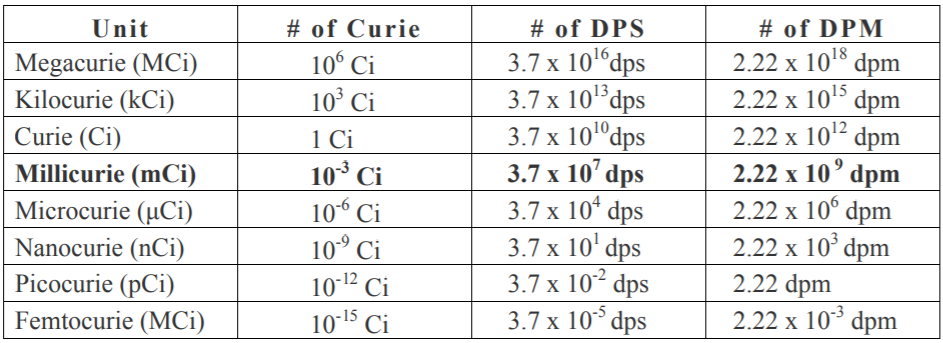
b) We know that 1 curie = \[3.7 \times {10^{10}}{\text{dps}}\]= \[3.7 \times {10^{10}} \times 60{\text{ dpm}}\] . This can be converted to counting per minute:
\[ \Rightarrow 3.7 \times {10^{10}} \times 60 \times \dfrac{{80}}{{100}}\] counting per minute
$\therefore $ 1 millicurie = \[3.7 \times {10^{10}} \times 60 \times \dfrac{{80}}{{100}} \times {10^{ - 3}}{\text{cpm}}\].
To achieve the final answer we need to divide this value with volume.
\[ \Rightarrow 3.7 \times {10^{10}} \times 60 \times \dfrac{{80}}{{100}} \times {10^{ - 3}} \times \dfrac{1}{2}\]
\[ \Rightarrow 88.8 \times {10^7}{\text{cpm/mL}}\]
Therefore, we can conclude that the correct answer to this question is option D.
Additional information: The emissions in most of the spontaneous radioactive decays involve alpha $(\alpha )$particle, the beta $(\beta )$ particle, the gamma-ray, and the neutrino. The alpha particle is the nucleus of doubly charged ${\text{He}}_2^4$. Beta particles can be beta minus beta plus. Beta minus is an electron created in the nucleus during beta decay. Beta plus particle is also known as a positron, is the antiparticle of the electron; when brought together, two such particles will mutually annihilate each other.
Note: To answer the questions related to radioactivity you need to know the important conversion units regarding the disintegration of a radioactive compound.
Formula used: \[{\text{molarity}} = \dfrac{{{\text{moles (in mmol)}}}}{{{\text{V (in mL)}}}}\]
Complete Step by step solution:
To answer this question let us first calculate the concentration of the given labelled sample.
(a) 1 mmole = 150 millicurie, using unitary method
1 millicurie=$\dfrac{1}{{150}}$ mmol
Now, concentration can be calculated by dividing the moles with the given volume
\[{\text{molarity}} = \dfrac{{{\text{moles (in mmol)}}}}{{{\text{V (in mL)}}}} = \dfrac{1}{{150 \times 2}} = 3.33 \times {10^{ - 3}}{\text{M}}\]
b) We know that 1 curie = \[3.7 \times {10^{10}}{\text{dps}}\]= \[3.7 \times {10^{10}} \times 60{\text{ dpm}}\] . This can be converted to counting per minute:
\[ \Rightarrow 3.7 \times {10^{10}} \times 60 \times \dfrac{{80}}{{100}}\] counting per minute
$\therefore $ 1 millicurie = \[3.7 \times {10^{10}} \times 60 \times \dfrac{{80}}{{100}} \times {10^{ - 3}}{\text{cpm}}\].
To achieve the final answer we need to divide this value with volume.
\[ \Rightarrow 3.7 \times {10^{10}} \times 60 \times \dfrac{{80}}{{100}} \times {10^{ - 3}} \times \dfrac{1}{2}\]
\[ \Rightarrow 88.8 \times {10^7}{\text{cpm/mL}}\]
Therefore, we can conclude that the correct answer to this question is option D.
Additional information: The emissions in most of the spontaneous radioactive decays involve alpha $(\alpha )$particle, the beta $(\beta )$ particle, the gamma-ray, and the neutrino. The alpha particle is the nucleus of doubly charged ${\text{He}}_2^4$. Beta particles can be beta minus beta plus. Beta minus is an electron created in the nucleus during beta decay. Beta plus particle is also known as a positron, is the antiparticle of the electron; when brought together, two such particles will mutually annihilate each other.
Note: To answer the questions related to radioactivity you need to know the important conversion units regarding the disintegration of a radioactive compound.
Recently Updated Pages
Master Class 12 Economics: Engaging Questions & Answers for Success

Master Class 12 English: Engaging Questions & Answers for Success
Master Class 12 Social Science: Engaging Questions & Answers for Success
Master Class 12 Maths: Engaging Questions & Answers for Success
Master Class 12 Physics: Engaging Questions & Answers for Success
Master Class 9 General Knowledge: Engaging Questions & Answers for Success
Trending doubts
One Metric ton is equal to kg A 10000 B 1000 C 100 class 11 physics CBSE
Difference Between Prokaryotic Cells and Eukaryotic Cells
Find the value of the expression given below sin 30circ class 11 maths CBSE
Two of the body parts which do not appear in MRI are class 11 biology CBSE
1 ton equals to A 100 kg B 1000 kg C 10 kg D 10000 class 11 physics CBSE
Draw a diagram of nephron and explain its structur class 11 biology CBSE