




A solid sphere rolls down without slipping from rest on a $30^\circ $ include. Its linear acceleration is
$\left( A \right)\dfrac{{5g}}{7}$
$\left( B \right)\dfrac{{5g}}{{14}}$
$\left( C \right)\dfrac{{2g}}{3}$
$\left( D \right)\dfrac{g}{3}$
Answer
 Verified
506.4k+ views
Hint:First of all in this problem we have to make a rough diagram to solve this by representing all the parameters. Now using the acceleration formula for the rolling object as shown by the figure. The acceleration gives us the formula that has a relationship between the angles, radius of gyration, acceleration, and acceleration due to gravity. On putting the values we will find our solution.
Complete step by step answer:
As per the problem we have a solid sphere that rolls down without slipping from rest on a $30^\circ $ include.
Now we need to calculate the linear acceleration.
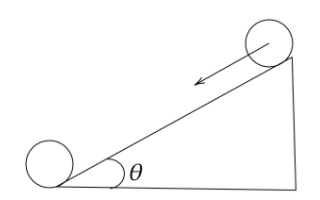
We know that linear acceleration of a rolling sphere in incline plane will be given as,
$a = \dfrac{{g\sin \theta }}{{1 + \dfrac{{{K^2}}}{{{R^2}}}}} \ldots \ldots \left( 1 \right)$
Where,
$g$ is equal to acceleration due to gravity in meters per second.
$\theta $ is the angle incline.
$K$ is the radius of gyration.
$R$ is the radius of the sphere.
$a$ is the linear acceleration.
We know the moment of inertia of a sphere is represented as,
$\dfrac{2}{5}M{R^2} = M{K^2}$
Cancelling the common terms we will get,
$\dfrac{2}{5}{R^2} = {K^2}$
$\theta = 30^\circ $
Now putting the known values in the equation $\left( 1 \right)$ we will get,
$a = \dfrac{{g\sin 30^\circ }}{{1 + \dfrac{{\dfrac{2}{5}{R^2}}}{{{R^2}}}}}$
Cancelling the common term we will get,
$a = \dfrac{{g\sin 30^\circ }}{{1 + \dfrac{2}{5}}}$
On further solving we will get,
$a = \dfrac{{g\dfrac{1}{2}}}{{\dfrac{7}{5}}}$
$ \Rightarrow a = \dfrac{{5g}}{{14}}$
Therefore the correct option is $\left( B \right)$.
Note:Remember that the radius of gyration is defined as the radial distance to a point that would have a moment of inertia the same as that of the actual distribution of mass if the total mass of the body were concentrated there about the axis of rotation.
Complete step by step answer:
As per the problem we have a solid sphere that rolls down without slipping from rest on a $30^\circ $ include.
Now we need to calculate the linear acceleration.
We know that linear acceleration of a rolling sphere in incline plane will be given as,
$a = \dfrac{{g\sin \theta }}{{1 + \dfrac{{{K^2}}}{{{R^2}}}}} \ldots \ldots \left( 1 \right)$
Where,
$g$ is equal to acceleration due to gravity in meters per second.
$\theta $ is the angle incline.
$K$ is the radius of gyration.
$R$ is the radius of the sphere.
$a$ is the linear acceleration.
We know the moment of inertia of a sphere is represented as,
$\dfrac{2}{5}M{R^2} = M{K^2}$
Cancelling the common terms we will get,
$\dfrac{2}{5}{R^2} = {K^2}$
$\theta = 30^\circ $
Now putting the known values in the equation $\left( 1 \right)$ we will get,
$a = \dfrac{{g\sin 30^\circ }}{{1 + \dfrac{{\dfrac{2}{5}{R^2}}}{{{R^2}}}}}$
Cancelling the common term we will get,
$a = \dfrac{{g\sin 30^\circ }}{{1 + \dfrac{2}{5}}}$
On further solving we will get,
$a = \dfrac{{g\dfrac{1}{2}}}{{\dfrac{7}{5}}}$
$ \Rightarrow a = \dfrac{{5g}}{{14}}$
Therefore the correct option is $\left( B \right)$.
Note:Remember that the radius of gyration is defined as the radial distance to a point that would have a moment of inertia the same as that of the actual distribution of mass if the total mass of the body were concentrated there about the axis of rotation.
Recently Updated Pages
Master Class 11 Social Science: Engaging Questions & Answers for Success

Master Class 11 Physics: Engaging Questions & Answers for Success
Master Class 11 Maths: Engaging Questions & Answers for Success
Master Class 11 Economics: Engaging Questions & Answers for Success
Master Class 11 Computer Science: Engaging Questions & Answers for Success
Master Class 11 Chemistry: Engaging Questions & Answers for Success
Trending doubts
One Metric ton is equal to kg A 10000 B 1000 C 100 class 11 physics CBSE
There are 720 permutations of the digits 1 2 3 4 5 class 11 maths CBSE
1 Quintal is equal to a 110 kg b 10 kg c 100kg d 1000 class 11 physics CBSE
State and prove Bernoullis theorem class 11 physics CBSE
Difference Between Prokaryotic Cells and Eukaryotic Cells
Discuss the various forms of bacteria class 11 biology CBSE