




A solid sphere rolls down on two inclined planes of the same heights but different angles of inclination. (a) Will it reach the bottom with the same speed in each case? (b) Will it take longer to roll down one plane than the other? (c) If so, which one and why?
Answer
 Verified
590.7k+ views
Hint: This problem uses the concept of circular motion along an inclined plane, which is a combination of both translational and rotational motions for the rolling case. Hence, the total energy of the sphere when it rolls down an inclined plane is $\dfrac{1}{2}m{{v}^{2}}+\dfrac{1}{2}I{{\omega }^{2}}$. This energy will be equal to the potential energy, mgh. Further, equating the forces using \[mg\sin \theta -f=ma\] and \[I\alpha =fr\], we can find the acceleration (a) value for each case of different angles of inclination $(\theta )$. Then, we will use Newton's law of motion formula of: $s=ut+\dfrac{1}{2}a{{t}^{2}}$ to find the time of travel (t).
Step by step solution:
Let’s start by making a diagram of the problem.
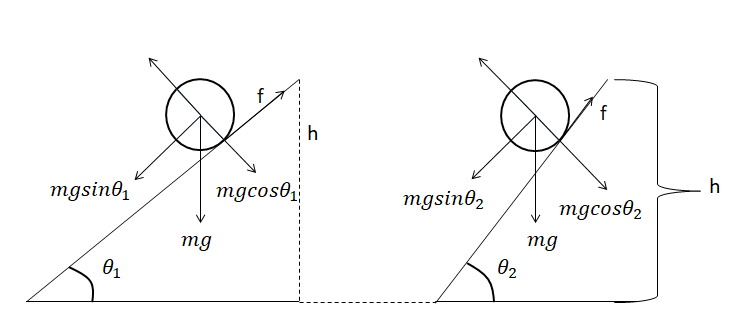
We have two different inclined planes having angles of inclination ${{\theta }_{1}}$ and ${{\theta }_{2}}$. Consider the sphere of mass (m) and radius (r) to be released from height (h). Hence, the potential energy of the sphere is given by $PE=mgh$. As the sphere rolls down the inclined plane, hence the potential energy of the sphere gets converted into both translational and rotational motion. Therefore, the total potential energy of the sphere gets completely converted into the translational and rotational motion$\dfrac{1}{2}m{{v}^{2}}+\dfrac{1}{2}I{{\omega }^{2}}$. Using this relation we get, $mgh=\dfrac{1}{2}m{{v}^{2}}+\dfrac{1}{2}I{{\omega }^{2}}.$ Using the relation of $v=\omega r\Rightarrow \omega =\dfrac{v}{r}$ and substituting the value of moment of Inertia of a sphere, which is $I=\dfrac{2}{5}m{{r}^{2}}$ into the above equation: $mgh=\dfrac{1}{2}m{{v}^{2}}+\dfrac{1}{2}I{{\omega }^{2}}\Rightarrow mgh=\dfrac{1}{2}m{{v}^{2}}+\dfrac{1}{2}(\dfrac{2}{5}m{{r}^{2}}){{(\dfrac{v}{r})}^{2}}\Rightarrow gh=\dfrac{1}{2}{{v}^{2}}+\dfrac{1}{5}{{v}^{2}}\Rightarrow gh=\dfrac{7}{10}{{v}^{2}}$.
Therefore, the velocity of the sphere will be: $v=\sqrt{\dfrac{10gh}{7}}$. Since, the value of velocity is independent of the angle of inclination$(\theta )$, hence both the spheres will reach the bottom of the plane with same speed.
For case (b), we will consider the free body diagram made above. We will solve the problem for one angle of inclination as the solution will be the same for the other angle of inclination.
We will solve for the angle of inclination $({{\theta }_{1}})$. Here, we will consider the net tangential acceleration for this system given by $({{a}_{1}})$. Hence the two equations of force we will get are:
\[mg\sin {{\theta }_{1}}-f=m{{a}_{1}}\to (1)\], where f is the frictional force acting at the point of contact in between the sphere and the plane.
\[I\alpha =fr\to (2)\], where the angular acceleration is given by: \[\alpha =\dfrac{{{a}_{1}}}{r}\]. We also know that the moment of Inertia of the sphere is: $I=\dfrac{2}{5}m{{r}^{2}}$. Hence, the equation (2) becomes, $\dfrac{2}{5}m{{r}^{2}}(\dfrac{{{a}_{1}}}{r})=fr\Rightarrow \dfrac{2}{5}m{{a}_{1}}r=fr\Rightarrow \dfrac{2}{5}m{{a}_{1}}=f$. Substituting in the value of the frictional force into equation (1), we get: \[mg\sin {{\theta }_{1}}-\dfrac{2}{5}m{{a}_{1}}=m{{a}_{1}}\Rightarrow mg\sin {{\theta }_{1}}=\dfrac{7}{5}m{{a}_{1}}\Rightarrow \dfrac{5g\sin {{\theta }_{1}}}{7}={{a}_{1}}\].
Similarly, the tangential acceleration $({{a}_{2}})$ will be: \[\dfrac{5g\sin {{\theta }_{2}}}{7}={{a}_{2}}\].
The incline distance travelled by the sphere in each case is given by: $s=\dfrac{h}{\sin \theta }$. Hence, the amount of inclined distance travelled in each case is:${{s}_{1}}=\dfrac{h}{\sin {{\theta }_{1}}}$ and ${{s}_{2}}=\dfrac{h}{\sin {{\theta }_{2}}}$.
Using the newton’s law of motion of $s=ut+\dfrac{1}{2}a{{t}^{2}}$ and putting in the values of (s) and (a) for each case, we will find the value of t. u=0, since the sphere is initially at rest.
Therefore,${{s}_{1}}=\dfrac{h}{\sin {{\theta }_{1}}}=\dfrac{1}{2}{{a}_{1}}t_{1}^{2}\Rightarrow \dfrac{h}{\sin {{\theta }_{1}}}=\dfrac{1}{2}(\dfrac{5g\sin {{\theta }_{1}}}{7})t_{1}^{2}\Rightarrow t_{1}^{2}=\dfrac{14h}{5g}(\dfrac{1}{{{\sin }^{2}}{{\theta }_{1}}})\Rightarrow {{t}_{1}}=\dfrac{1}{\sin {{\theta }_{1}}}\sqrt{\dfrac{14h}{5g}}$.
Similarly, ${{t}_{2}}=\dfrac{1}{\sin {{\theta }_{2}}}\sqrt{\dfrac{14h}{5g}}$.
Therefore, the time taken by the sphere in each case is different. We know that in the interval of ${{0}^{0}}$ to ${{90}^{0}}$, sine function is increasing and from the figure ${{\theta }_{1}} < {{\theta }_{2}}$. Since $t\propto \dfrac{1}{\sin \theta }$, therefore the time taken by the sphere to roll down the inclined plane having inclination angle ${{\theta }_{1}}$ is larger than the time taken by the sphere to roll down the inclined plane by the sphere having an inclination angle of ${{\theta }_{2}}$ for ${{\theta }_{1}} < {{\theta }_{2}}$.
Note: A shortcut to solving this problem is by taking the values of the tangential accelerations: \[{{a}_{1}}=\dfrac{5g\sin {{\theta }_{1}}}{7}\] and \[{{a}_{2}}=\dfrac{5g\sin {{\theta }_{2}}}{7}\]. Hence, $a\propto \sin \theta $and since no external force is applied the sphere having higher acceleration will roll down faster. Since, ${{\theta }_{1}} < {{\theta }_{2}}$, therefore ${{a}_{1}} < {{a}_{2}}$. Hence, the sphere having an inclination angle ${{\theta }_{1}}$ is roll down slower than the one rolling down the inclined plane having an inclination angle of ${{\theta }_{2}}$.
Step by step solution:
Let’s start by making a diagram of the problem.
We have two different inclined planes having angles of inclination ${{\theta }_{1}}$ and ${{\theta }_{2}}$. Consider the sphere of mass (m) and radius (r) to be released from height (h). Hence, the potential energy of the sphere is given by $PE=mgh$. As the sphere rolls down the inclined plane, hence the potential energy of the sphere gets converted into both translational and rotational motion. Therefore, the total potential energy of the sphere gets completely converted into the translational and rotational motion$\dfrac{1}{2}m{{v}^{2}}+\dfrac{1}{2}I{{\omega }^{2}}$. Using this relation we get, $mgh=\dfrac{1}{2}m{{v}^{2}}+\dfrac{1}{2}I{{\omega }^{2}}.$ Using the relation of $v=\omega r\Rightarrow \omega =\dfrac{v}{r}$ and substituting the value of moment of Inertia of a sphere, which is $I=\dfrac{2}{5}m{{r}^{2}}$ into the above equation: $mgh=\dfrac{1}{2}m{{v}^{2}}+\dfrac{1}{2}I{{\omega }^{2}}\Rightarrow mgh=\dfrac{1}{2}m{{v}^{2}}+\dfrac{1}{2}(\dfrac{2}{5}m{{r}^{2}}){{(\dfrac{v}{r})}^{2}}\Rightarrow gh=\dfrac{1}{2}{{v}^{2}}+\dfrac{1}{5}{{v}^{2}}\Rightarrow gh=\dfrac{7}{10}{{v}^{2}}$.
Therefore, the velocity of the sphere will be: $v=\sqrt{\dfrac{10gh}{7}}$. Since, the value of velocity is independent of the angle of inclination$(\theta )$, hence both the spheres will reach the bottom of the plane with same speed.
For case (b), we will consider the free body diagram made above. We will solve the problem for one angle of inclination as the solution will be the same for the other angle of inclination.
We will solve for the angle of inclination $({{\theta }_{1}})$. Here, we will consider the net tangential acceleration for this system given by $({{a}_{1}})$. Hence the two equations of force we will get are:
\[mg\sin {{\theta }_{1}}-f=m{{a}_{1}}\to (1)\], where f is the frictional force acting at the point of contact in between the sphere and the plane.
\[I\alpha =fr\to (2)\], where the angular acceleration is given by: \[\alpha =\dfrac{{{a}_{1}}}{r}\]. We also know that the moment of Inertia of the sphere is: $I=\dfrac{2}{5}m{{r}^{2}}$. Hence, the equation (2) becomes, $\dfrac{2}{5}m{{r}^{2}}(\dfrac{{{a}_{1}}}{r})=fr\Rightarrow \dfrac{2}{5}m{{a}_{1}}r=fr\Rightarrow \dfrac{2}{5}m{{a}_{1}}=f$. Substituting in the value of the frictional force into equation (1), we get: \[mg\sin {{\theta }_{1}}-\dfrac{2}{5}m{{a}_{1}}=m{{a}_{1}}\Rightarrow mg\sin {{\theta }_{1}}=\dfrac{7}{5}m{{a}_{1}}\Rightarrow \dfrac{5g\sin {{\theta }_{1}}}{7}={{a}_{1}}\].
Similarly, the tangential acceleration $({{a}_{2}})$ will be: \[\dfrac{5g\sin {{\theta }_{2}}}{7}={{a}_{2}}\].
The incline distance travelled by the sphere in each case is given by: $s=\dfrac{h}{\sin \theta }$. Hence, the amount of inclined distance travelled in each case is:${{s}_{1}}=\dfrac{h}{\sin {{\theta }_{1}}}$ and ${{s}_{2}}=\dfrac{h}{\sin {{\theta }_{2}}}$.
Using the newton’s law of motion of $s=ut+\dfrac{1}{2}a{{t}^{2}}$ and putting in the values of (s) and (a) for each case, we will find the value of t. u=0, since the sphere is initially at rest.
Therefore,${{s}_{1}}=\dfrac{h}{\sin {{\theta }_{1}}}=\dfrac{1}{2}{{a}_{1}}t_{1}^{2}\Rightarrow \dfrac{h}{\sin {{\theta }_{1}}}=\dfrac{1}{2}(\dfrac{5g\sin {{\theta }_{1}}}{7})t_{1}^{2}\Rightarrow t_{1}^{2}=\dfrac{14h}{5g}(\dfrac{1}{{{\sin }^{2}}{{\theta }_{1}}})\Rightarrow {{t}_{1}}=\dfrac{1}{\sin {{\theta }_{1}}}\sqrt{\dfrac{14h}{5g}}$.
Similarly, ${{t}_{2}}=\dfrac{1}{\sin {{\theta }_{2}}}\sqrt{\dfrac{14h}{5g}}$.
Therefore, the time taken by the sphere in each case is different. We know that in the interval of ${{0}^{0}}$ to ${{90}^{0}}$, sine function is increasing and from the figure ${{\theta }_{1}} < {{\theta }_{2}}$. Since $t\propto \dfrac{1}{\sin \theta }$, therefore the time taken by the sphere to roll down the inclined plane having inclination angle ${{\theta }_{1}}$ is larger than the time taken by the sphere to roll down the inclined plane by the sphere having an inclination angle of ${{\theta }_{2}}$ for ${{\theta }_{1}} < {{\theta }_{2}}$.
Note: A shortcut to solving this problem is by taking the values of the tangential accelerations: \[{{a}_{1}}=\dfrac{5g\sin {{\theta }_{1}}}{7}\] and \[{{a}_{2}}=\dfrac{5g\sin {{\theta }_{2}}}{7}\]. Hence, $a\propto \sin \theta $and since no external force is applied the sphere having higher acceleration will roll down faster. Since, ${{\theta }_{1}} < {{\theta }_{2}}$, therefore ${{a}_{1}} < {{a}_{2}}$. Hence, the sphere having an inclination angle ${{\theta }_{1}}$ is roll down slower than the one rolling down the inclined plane having an inclination angle of ${{\theta }_{2}}$.
Recently Updated Pages
Master Class 11 Social Science: Engaging Questions & Answers for Success

Master Class 11 English: Engaging Questions & Answers for Success
Master Class 11 Accountancy: Engaging Questions & Answers for Success
Master Class 11 Physics: Engaging Questions & Answers for Success
Master Class 11 Computer Science: Engaging Questions & Answers for Success
Master Class 11 Business Studies: Engaging Questions & Answers for Success
Trending doubts
One Metric ton is equal to kg A 10000 B 1000 C 100 class 11 physics CBSE
Find the value of the expression given below sin 30circ class 11 maths CBSE
Draw a diagram of nephron and explain its structur class 11 biology CBSE
10 examples of friction in our daily life
Proton was discovered by A Thomson B Rutherford C Chadwick class 11 chemistry CBSE
The teeth used for biting and cutting food are called class 11 biology CBSE