




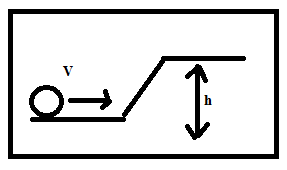
A solid sphere is rolling on a frictionless surface, shown in figure with a translational velocity v m/s. If it is to climb the inclined surface then v should be
A. \[\ge \sqrt{\dfrac{10}{7}}gh\]
B. \[\ge \sqrt{2gh}\]
C. \[2gh\]
D. \[\dfrac{10}{7}gh\]
Answer
 Verified
616.8k+ views
Hint: Use conservation energy principle to solve this problem. That is total energy after climbing at height h. Assume final velocity to be zero for obtaining the minimum value of velocity. Do not forget potential energy.
Complete step-by-step answer:
In general for any object total energy is the sum of Kinetic and Potential energy.
So, for this problem
According to conservation law of energy we can equate total initial energy and total final energy.
\[\mathop{\text{(Total energy)}}_{\text{initial}}=\mathop{\text{(Total energy)}}_{\text{final}}\]
\[\mathop{(K.E.)}_{i}+\mathop{(P.E.)}_{i}=\mathop{(K.E.)}_{f}+\mathop{(P.E.)}_{f}\]
Where
K.E. = kinetic energy
P.E = potential energy
\[\mathop{(K.E.)}_{i}+\mathop{(P.E.)}_{i}=\mathop{(K.E.)}_{f}+\mathop{(P.E.)}_{f}\] …. 1
\[\mathop{(K.E.)}_{i}\]: As the sphere is rolling it will have both translational energy and rotational energy.
As it is rolling
\[v=rw\]
\[w=\dfrac{v}{r}\] …… 2
\[\mathop{(K.E.)}_{i}=\dfrac{1}{2}m\mathop{v}^{2}+\dfrac{1}{2}m\mathop{w}^{2}\]
\[=\dfrac{1}{2}m\mathop{v}^{2}+\dfrac{2}{5}m\mathop{r}^{2}\mathop{\left( \dfrac{v}{r} \right)}^{2}\] [I solid sphere =\[\dfrac{2}{5}m\mathop{r}^{2}\]]
\[=\dfrac{1}{2}m\mathop{v}^{2}+\mathop{\dfrac{mv}{5}}^{2}\]
\[=\mathop{(K.E.)}_{i}=\mathop{\dfrac{7mv}{10}}^{2}\] .... 3
\[\mathop{(K.E.)}_{f}\]: As the sphere will stop translating, that is final velocity is zero for obtaining the minimum velocity.
\[\mathop{(K.E.)}_{f}=\dfrac{1}{2}m\mathop{v}^{2}+\dfrac{1}{2}I\mathop{w}^{2}\]
\[=\dfrac{1}{2}m\mathop{(0)}^{2}+\dfrac{1}{2}I\mathop{(0)}^{2}\]
\[\mathop{(K.E.)}_{f}=0\] ….. 4
Change in potential energy \[\mathop{(P.E}_{f}-\mathop{P.E}_{i})\]
As we know that potential energy cannot be defined at a particular time and position. It can be calculated as a change in quantity.
So,
\[\mathop{(P.E}_{f}-\mathop{P.E}_{i})=mg(h)\]
\[\mathop{(P.E)}_{f}-\mathop{(P.E)}_{i}=mgh\]
Using equation 1
\[\mathop{(K.E.)}_{i}=\mathop{(K.E.)}_{f}+(\mathop{(P.E)}_{f}-\mathop{(P.E)}_{i}\]
\[\mathop{\dfrac{7mv}{10}}^{2}=0+mgh\]
\[v=\sqrt{\dfrac{10gh}{7}}\]
Minimum value of velocity to reach a height \[h=\sqrt{\dfrac{10gh}{7}}\]
\[v\ge \mathop{v}_{\min imum}\]
\[v\ge \sqrt{\dfrac{10}{7}}gh\]
Hence option A.
Note: This can be done using this change in potential energy = change in kinetic energy. Conservation of energy principle needs to be remembered to solve this kind of problem. In this question, it was given that the surface is frictionless. So we didn't consider the frictional force. If the surface will not be frictionless, then we have to consider the frictional force.
Complete step-by-step answer:
In general for any object total energy is the sum of Kinetic and Potential energy.
So, for this problem
According to conservation law of energy we can equate total initial energy and total final energy.
\[\mathop{\text{(Total energy)}}_{\text{initial}}=\mathop{\text{(Total energy)}}_{\text{final}}\]
\[\mathop{(K.E.)}_{i}+\mathop{(P.E.)}_{i}=\mathop{(K.E.)}_{f}+\mathop{(P.E.)}_{f}\]
Where
K.E. = kinetic energy
P.E = potential energy
\[\mathop{(K.E.)}_{i}+\mathop{(P.E.)}_{i}=\mathop{(K.E.)}_{f}+\mathop{(P.E.)}_{f}\] …. 1
\[\mathop{(K.E.)}_{i}\]: As the sphere is rolling it will have both translational energy and rotational energy.
As it is rolling
\[v=rw\]
\[w=\dfrac{v}{r}\] …… 2
\[\mathop{(K.E.)}_{i}=\dfrac{1}{2}m\mathop{v}^{2}+\dfrac{1}{2}m\mathop{w}^{2}\]
\[=\dfrac{1}{2}m\mathop{v}^{2}+\dfrac{2}{5}m\mathop{r}^{2}\mathop{\left( \dfrac{v}{r} \right)}^{2}\] [I solid sphere =\[\dfrac{2}{5}m\mathop{r}^{2}\]]
\[=\dfrac{1}{2}m\mathop{v}^{2}+\mathop{\dfrac{mv}{5}}^{2}\]
\[=\mathop{(K.E.)}_{i}=\mathop{\dfrac{7mv}{10}}^{2}\] .... 3
\[\mathop{(K.E.)}_{f}\]: As the sphere will stop translating, that is final velocity is zero for obtaining the minimum velocity.
\[\mathop{(K.E.)}_{f}=\dfrac{1}{2}m\mathop{v}^{2}+\dfrac{1}{2}I\mathop{w}^{2}\]
\[=\dfrac{1}{2}m\mathop{(0)}^{2}+\dfrac{1}{2}I\mathop{(0)}^{2}\]
\[\mathop{(K.E.)}_{f}=0\] ….. 4
Change in potential energy \[\mathop{(P.E}_{f}-\mathop{P.E}_{i})\]
As we know that potential energy cannot be defined at a particular time and position. It can be calculated as a change in quantity.
So,
\[\mathop{(P.E}_{f}-\mathop{P.E}_{i})=mg(h)\]
\[\mathop{(P.E)}_{f}-\mathop{(P.E)}_{i}=mgh\]
Using equation 1
\[\mathop{(K.E.)}_{i}=\mathop{(K.E.)}_{f}+(\mathop{(P.E)}_{f}-\mathop{(P.E)}_{i}\]
\[\mathop{\dfrac{7mv}{10}}^{2}=0+mgh\]
\[v=\sqrt{\dfrac{10gh}{7}}\]
Minimum value of velocity to reach a height \[h=\sqrt{\dfrac{10gh}{7}}\]
\[v\ge \mathop{v}_{\min imum}\]
\[v\ge \sqrt{\dfrac{10}{7}}gh\]
Hence option A.
Note: This can be done using this change in potential energy = change in kinetic energy. Conservation of energy principle needs to be remembered to solve this kind of problem. In this question, it was given that the surface is frictionless. So we didn't consider the frictional force. If the surface will not be frictionless, then we have to consider the frictional force.
Recently Updated Pages
Master Class 11 Social Science: Engaging Questions & Answers for Success

Master Class 11 Physics: Engaging Questions & Answers for Success
Master Class 11 Maths: Engaging Questions & Answers for Success
Master Class 11 Economics: Engaging Questions & Answers for Success
Master Class 11 Computer Science: Engaging Questions & Answers for Success
Master Class 11 Chemistry: Engaging Questions & Answers for Success
Trending doubts
One Metric ton is equal to kg A 10000 B 1000 C 100 class 11 physics CBSE
There are 720 permutations of the digits 1 2 3 4 5 class 11 maths CBSE
1 Quintal is equal to a 110 kg b 10 kg c 100kg d 1000 class 11 physics CBSE
State and prove Bernoullis theorem class 11 physics CBSE
Difference Between Prokaryotic Cells and Eukaryotic Cells
Discuss the various forms of bacteria class 11 biology CBSE