




A solid metallic right circular cone 20cm height whose vertical angle is ${60^0}$, is cut into two parts at the middle of its height by a plane parallel to its base. If the frustum is so obtained to be drawn into a wire of diameter 1/12 cm, find the length of the wire?
Answer
 Verified
654.9k+ views
Hint: Here we go through by first making the diagram of a right circular cone and then bisecting it at the middle of its height and by the properties of trigonometry we will find the radius of frustum of cone. And then equate the volume of frustum of cone to the volume of cylindrical wire.
Complete step-by-step answer:
Here in the question it is given that a solid metallic right circular cone 20cm height whose vertical angle is${60^0}$, is cut into two parts at the middle of its height by a plane parallel to its base.
Now we have to first draw the diagram according to the question.
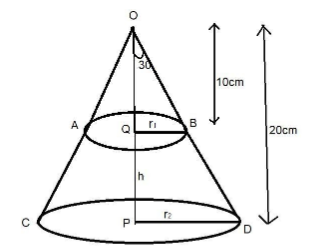
Now let, OCD be the metallic cone and ABDC be the required frustum.
In the question it is given that the height of the cone is 20cm.
And let the radius of upper circle be ${r_1}$and lower circle be ${r_2}$
Through the figure we can say that $\angle QOB = \angle POD = {30^0}$ because the perpendicular line bisect the angle of cone.
Now by applying the trigonometry properties we can write it as,
$\tan {30^0} = \dfrac{{PD}}{{OP}}$ And $\tan {30^0} = \dfrac{{QB}}{{OB}}$ as we know $\tan \theta $ is the ratio of perpendicular to base.
Now by putting the values we get,
$\tan {30^0} = \dfrac{1}{{\sqrt 3 }} = \dfrac{{{r_2}}}{{20}}$ And $\tan {30^0} = \dfrac{1}{{\sqrt 3 }} = \dfrac{{{r_1}}}{{10}}$
${r_2} = \dfrac{{20}}{{\sqrt 3 }}cm,{r_1} = \dfrac{{10}}{{\sqrt 3 }}$
Now as we know the volume of frustum of cone is $\dfrac{1}{3}\pi h({r_1}^2 + {r_2}^2 + {r_1}{r_2})$
Now by putting the values in the formula we get,
$
= \dfrac{{\pi \times 10}}{3}\left( {{{\left( {\dfrac{{20}}{{\sqrt 3 }}} \right)}^2} + {{\left( {\dfrac{{10}}{{\sqrt 3 }}} \right)}^2} + \left( {\dfrac{{20}}{{\sqrt 3 }}} \right) \times \left( {\dfrac{{10}}{{\sqrt 3 }}} \right)} \right) \\
= \dfrac{{10\pi }}{3}\left( {\dfrac{{900}}{3} + \dfrac{{100}}{3} + \dfrac{{200}}{3}} \right) \\
= \dfrac{{10\pi }}{3}\left( {\dfrac{{700}}{3}} \right) = \dfrac{{7000\pi }}{3}c{m^3} \\
$
And in the question it says that the cylindrical wire is made from the frustum of cone it means that the volume of frustum of cone is equal to the volume of cylindrical wire.
And in the question it is given that the diameter of wire is $\dfrac{1}{{12}}m$
Volume of wire = volume of frustum
$
\Rightarrow \pi {r^2}h = \dfrac{{7000\pi }}{3} \\
\Rightarrow h = \dfrac{{7000}}{3} \times {\left( {\dfrac{1}{{\dfrac{1}{{24}}}}} \right)^2} = 7964.4m \\
\therefore h = 7964.4m \\
$
Hence the required length of wire is 7964.4m
Note: Whenever we face such a type of question the key concept for solving the question is to first find out the volume of new shapes that are cut out from the old shape. By applying the properties of trigonometry relation. We will also apply here the property of a similar triangle to find out the radius of the frustum of cone. And then solve it by just comparing the volume of each figure.
Complete step-by-step answer:
Here in the question it is given that a solid metallic right circular cone 20cm height whose vertical angle is${60^0}$, is cut into two parts at the middle of its height by a plane parallel to its base.
Now we have to first draw the diagram according to the question.
Now let, OCD be the metallic cone and ABDC be the required frustum.
In the question it is given that the height of the cone is 20cm.
And let the radius of upper circle be ${r_1}$and lower circle be ${r_2}$
Through the figure we can say that $\angle QOB = \angle POD = {30^0}$ because the perpendicular line bisect the angle of cone.
Now by applying the trigonometry properties we can write it as,
$\tan {30^0} = \dfrac{{PD}}{{OP}}$ And $\tan {30^0} = \dfrac{{QB}}{{OB}}$ as we know $\tan \theta $ is the ratio of perpendicular to base.
Now by putting the values we get,
$\tan {30^0} = \dfrac{1}{{\sqrt 3 }} = \dfrac{{{r_2}}}{{20}}$ And $\tan {30^0} = \dfrac{1}{{\sqrt 3 }} = \dfrac{{{r_1}}}{{10}}$
${r_2} = \dfrac{{20}}{{\sqrt 3 }}cm,{r_1} = \dfrac{{10}}{{\sqrt 3 }}$
Now as we know the volume of frustum of cone is $\dfrac{1}{3}\pi h({r_1}^2 + {r_2}^2 + {r_1}{r_2})$
Now by putting the values in the formula we get,
$
= \dfrac{{\pi \times 10}}{3}\left( {{{\left( {\dfrac{{20}}{{\sqrt 3 }}} \right)}^2} + {{\left( {\dfrac{{10}}{{\sqrt 3 }}} \right)}^2} + \left( {\dfrac{{20}}{{\sqrt 3 }}} \right) \times \left( {\dfrac{{10}}{{\sqrt 3 }}} \right)} \right) \\
= \dfrac{{10\pi }}{3}\left( {\dfrac{{900}}{3} + \dfrac{{100}}{3} + \dfrac{{200}}{3}} \right) \\
= \dfrac{{10\pi }}{3}\left( {\dfrac{{700}}{3}} \right) = \dfrac{{7000\pi }}{3}c{m^3} \\
$
And in the question it says that the cylindrical wire is made from the frustum of cone it means that the volume of frustum of cone is equal to the volume of cylindrical wire.
And in the question it is given that the diameter of wire is $\dfrac{1}{{12}}m$
Volume of wire = volume of frustum
$
\Rightarrow \pi {r^2}h = \dfrac{{7000\pi }}{3} \\
\Rightarrow h = \dfrac{{7000}}{3} \times {\left( {\dfrac{1}{{\dfrac{1}{{24}}}}} \right)^2} = 7964.4m \\
\therefore h = 7964.4m \\
$
Hence the required length of wire is 7964.4m
Note: Whenever we face such a type of question the key concept for solving the question is to first find out the volume of new shapes that are cut out from the old shape. By applying the properties of trigonometry relation. We will also apply here the property of a similar triangle to find out the radius of the frustum of cone. And then solve it by just comparing the volume of each figure.
Recently Updated Pages
Which will be the least stable resonating structure class 11 chemistry CBSE

How many 5 digit telephone numbers can be construc-class-11-maths-CBSE
How do you find the angle of the resultant vector class 11 physics CBSE
Draw labelled diagram of the following i Gram seed class 11 biology CBSE
What is the need and importance of classification class 11 biology CBSE
The way in which the sparrows expressed their sorrow class 11 english CBSE
Trending doubts
One Metric ton is equal to kg A 10000 B 1000 C 100 class 11 physics CBSE
Find the value of the expression given below sin 30circ class 11 maths CBSE
1 Quintal is equal to a 110 kg b 10 kg c 100kg d 1000 class 11 physics CBSE
Draw a diagram of nephron and explain its structur class 11 biology CBSE
10 examples of friction in our daily life
Proton was discovered by A Thomson B Rutherford C Chadwick class 11 chemistry CBSE