




A solid is in the form of a right circular cylinder, with a hemisphere at one end and a cone at the other end. The radius of the common base is 3.5 cm and the height of the cylinder and conical portions are 10 cm and 6 cm respectively. Find the total surface area of the solid. $\left( Use\ \pi =\dfrac{22}{7} \right)$
Answer
 Verified
642.9k+ views
Hint: We will find the surface area of the cylinder, cone and hemisphere and finally we will use all three areas to get the total surface area. Formula used are:
(1) Surface area of hemisphere $=2\pi {{r}^{2}}$
(2) Surface area of cylinder $=2\pi rH$
(3) Surface area of cone $=\pi rl$
Complete step-by-step answer:
It is given the question that a solid is in the form of a right circular cylinder, with a hemisphere at one end and cone at the other end. Also, the radius of the common base of cone and cylinder and hemisphere is 3.5 cm and height of the cylinder and conical portions are 10 cm and 6 cm respectively. We have to find the total surface area of the solid.
Let us draw a figure with all the details given in the question as shown below,
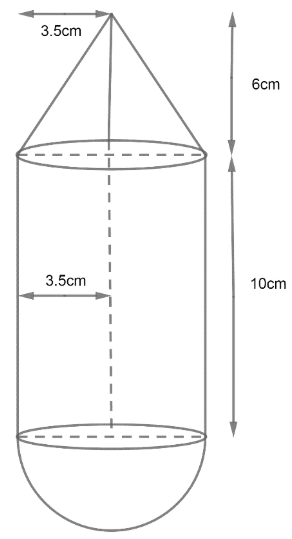
Now, we will calculate the surface area of the cone, cylinder and hemisphere individually and finally we will add all three surface areas to get the total surface area of the solid.
Now, first we will calculate the surface area of the cone. So, we know that the curved surface area of the cone is $\left( {{s}_{1}} \right)=\pi rl$. Also, we have given that radius of the cone is 3.5 cm and height of cone can be calculated as,
$\left( l \right)=\sqrt{{{\left( r \right)}^{2}}+{{\left( h \right)}^{2}}}$
Considering just the cone from the above figure, we have the figure as:
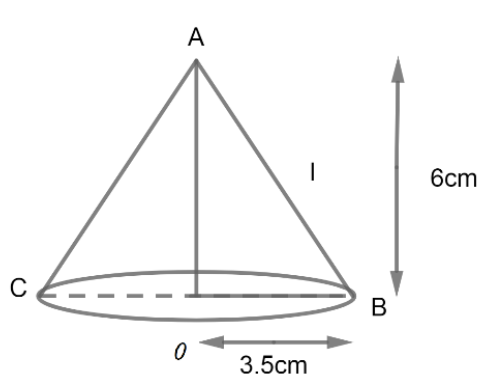
From the figure of the cone, we can say that AOB is a right angle triangle which is right angled at $\angle AOB$. We know that Pythagoras theorem for any right angled triangle is given by,
${{\left( base \right)}^{2}}+{{\left( height \right)}^{2}}={{\left( hypotenuse \right)}^{2}}$
Here in $\Delta AOB$, we have Base = (OB) = 3.5 cm, Height = (DA) = 6 cm and Hypotenuse = (AB) = (l). So, from Pythagoras theorem, we get;
\[\begin{align}
& {{\left( OA \right)}^{2}}+{{\left( OB \right)}^{2}}={{\left( AB \right)}^{2}} \\
& \Rightarrow {{\left( AB \right)}^{2}}={{\left( OB \right)}^{2}}+{{\left( OA \right)}^{2}} \\
& \Rightarrow {{\left( l \right)}^{2}}={{\left( 3.5 \right)}^{2}}+{{\left( 6 \right)}^{2}} \\
& \Rightarrow {{\left( l \right)}^{2}}=12.25+36 \\
& \Rightarrow {{\left( l \right)}^{2}}=48.25 \\
& \Rightarrow l=\sqrt{48.25} \\
\end{align}\]
Also, we know that the curve surface area of cones is $\pi rl$. So, on putting the value of $\pi \ as\ \dfrac{22}{7}$, radius as 3.5 cm and $l\ as\ \sqrt{48.25}cm$, we get;
Curved surface area of cone $=\pi rl$
$\begin{align}
& =\dfrac{22}{7}\times 3.5\times \sqrt{48.25} \\
& =\dfrac{22\times 3.5\times 6.95}{7} \\
& =\dfrac{535.15}{17} \\
& =76.45c{{m}^{2}} \\
\end{align}$
Thus, we get a curved surface area of cone \[=76c{{m}^{2}}\].
Similarly, we will calculate the area of the cylinder. We know that the curved surface area of the cylinder is $2\pi rh$. Let us consider the cylinder portion in the figure below,
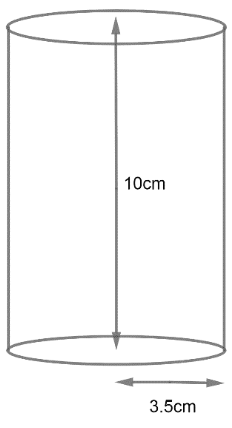
We have been given that the radius of the cylinder is 3.5 cm and the height of the cylinder is 10 cm. So, on putting the value of radius as 3.5 cm and height as 10 cm in the formula of curved surface area of cylinder, we get;
Curved surface area of cylinder $\left( {{s}_{2}} \right)=2\pi rh$
$\begin{align}
& =2\times \dfrac{22}{7}\times 3.5\times 10 \\
& =\dfrac{44\times 35}{7} \\
& =\dfrac{1540}{7} \\
& =220c{{m}^{2}} \\
\end{align}$
Now, we will calculate the curved surface area of the hemisphere. We know that the curved surface area of the hemisphere is $2\pi {{r}^{2}}$. Also we have been given that the radius of the hemisphere is 3.5 cm. So, on putting the value of radius as 3.5 cm in the formula of curved surface area of hemisphere, we get;
Curved surface area of hemisphere $\left( {{s}_{3}} \right)=2\pi {{r}^{2}}$
$\begin{align}
& =2\times \dfrac{22}{7}\times 3.5\times 3.5 \\
& =\dfrac{44\times 12.25}{7} \\
& =\dfrac{539}{7} \\
& =77c{{m}^{2}} \\
\end{align}$
Now, we have all three curved surface areas required to find the total surface area of the given solid. So, total surface area of the solid = curved surface area of cone $\left( {{s}_{1}} \right)$ + curved surface area of cylinder $\left( {{s}_{2}} \right)$+ curved surface area of hemisphere $\left( {{s}_{3}} \right)$
$\begin{align}
& {{s}_{total}}={{s}_{1}}+{{s}_{2}}+{{s}_{3}} \\
& =\left( 76.45+220+77 \right)c{{m}^{2}} \\
& =373.45c{{m}^{3}} \\
\end{align}$
Thus, the total surface area of solid is $373.45c{{m}^{3}}$.
Note: We have not considered the total surface area of cylinder, cone or hemisphere because the base portion of all the three shapes is overlapped with each other. Also, all of the bases are hidden in the solid. So, whenever we have such a condition, then we consider curved surface area to find surface area and not the total surface area. So, we must refrain from making such mistakes while solving the question.
(1) Surface area of hemisphere $=2\pi {{r}^{2}}$
(2) Surface area of cylinder $=2\pi rH$
(3) Surface area of cone $=\pi rl$
Complete step-by-step answer:
It is given the question that a solid is in the form of a right circular cylinder, with a hemisphere at one end and cone at the other end. Also, the radius of the common base of cone and cylinder and hemisphere is 3.5 cm and height of the cylinder and conical portions are 10 cm and 6 cm respectively. We have to find the total surface area of the solid.
Let us draw a figure with all the details given in the question as shown below,
Now, we will calculate the surface area of the cone, cylinder and hemisphere individually and finally we will add all three surface areas to get the total surface area of the solid.
Now, first we will calculate the surface area of the cone. So, we know that the curved surface area of the cone is $\left( {{s}_{1}} \right)=\pi rl$. Also, we have given that radius of the cone is 3.5 cm and height of cone can be calculated as,
$\left( l \right)=\sqrt{{{\left( r \right)}^{2}}+{{\left( h \right)}^{2}}}$
Considering just the cone from the above figure, we have the figure as:
From the figure of the cone, we can say that AOB is a right angle triangle which is right angled at $\angle AOB$. We know that Pythagoras theorem for any right angled triangle is given by,
${{\left( base \right)}^{2}}+{{\left( height \right)}^{2}}={{\left( hypotenuse \right)}^{2}}$
Here in $\Delta AOB$, we have Base = (OB) = 3.5 cm, Height = (DA) = 6 cm and Hypotenuse = (AB) = (l). So, from Pythagoras theorem, we get;
\[\begin{align}
& {{\left( OA \right)}^{2}}+{{\left( OB \right)}^{2}}={{\left( AB \right)}^{2}} \\
& \Rightarrow {{\left( AB \right)}^{2}}={{\left( OB \right)}^{2}}+{{\left( OA \right)}^{2}} \\
& \Rightarrow {{\left( l \right)}^{2}}={{\left( 3.5 \right)}^{2}}+{{\left( 6 \right)}^{2}} \\
& \Rightarrow {{\left( l \right)}^{2}}=12.25+36 \\
& \Rightarrow {{\left( l \right)}^{2}}=48.25 \\
& \Rightarrow l=\sqrt{48.25} \\
\end{align}\]
Also, we know that the curve surface area of cones is $\pi rl$. So, on putting the value of $\pi \ as\ \dfrac{22}{7}$, radius as 3.5 cm and $l\ as\ \sqrt{48.25}cm$, we get;
Curved surface area of cone $=\pi rl$
$\begin{align}
& =\dfrac{22}{7}\times 3.5\times \sqrt{48.25} \\
& =\dfrac{22\times 3.5\times 6.95}{7} \\
& =\dfrac{535.15}{17} \\
& =76.45c{{m}^{2}} \\
\end{align}$
Thus, we get a curved surface area of cone \[=76c{{m}^{2}}\].
Similarly, we will calculate the area of the cylinder. We know that the curved surface area of the cylinder is $2\pi rh$. Let us consider the cylinder portion in the figure below,
We have been given that the radius of the cylinder is 3.5 cm and the height of the cylinder is 10 cm. So, on putting the value of radius as 3.5 cm and height as 10 cm in the formula of curved surface area of cylinder, we get;
Curved surface area of cylinder $\left( {{s}_{2}} \right)=2\pi rh$
$\begin{align}
& =2\times \dfrac{22}{7}\times 3.5\times 10 \\
& =\dfrac{44\times 35}{7} \\
& =\dfrac{1540}{7} \\
& =220c{{m}^{2}} \\
\end{align}$
Now, we will calculate the curved surface area of the hemisphere. We know that the curved surface area of the hemisphere is $2\pi {{r}^{2}}$. Also we have been given that the radius of the hemisphere is 3.5 cm. So, on putting the value of radius as 3.5 cm in the formula of curved surface area of hemisphere, we get;
Curved surface area of hemisphere $\left( {{s}_{3}} \right)=2\pi {{r}^{2}}$
$\begin{align}
& =2\times \dfrac{22}{7}\times 3.5\times 3.5 \\
& =\dfrac{44\times 12.25}{7} \\
& =\dfrac{539}{7} \\
& =77c{{m}^{2}} \\
\end{align}$
Now, we have all three curved surface areas required to find the total surface area of the given solid. So, total surface area of the solid = curved surface area of cone $\left( {{s}_{1}} \right)$ + curved surface area of cylinder $\left( {{s}_{2}} \right)$+ curved surface area of hemisphere $\left( {{s}_{3}} \right)$
$\begin{align}
& {{s}_{total}}={{s}_{1}}+{{s}_{2}}+{{s}_{3}} \\
& =\left( 76.45+220+77 \right)c{{m}^{2}} \\
& =373.45c{{m}^{3}} \\
\end{align}$
Thus, the total surface area of solid is $373.45c{{m}^{3}}$.
Note: We have not considered the total surface area of cylinder, cone or hemisphere because the base portion of all the three shapes is overlapped with each other. Also, all of the bases are hidden in the solid. So, whenever we have such a condition, then we consider curved surface area to find surface area and not the total surface area. So, we must refrain from making such mistakes while solving the question.
Recently Updated Pages
Master Class 12 Business Studies: Engaging Questions & Answers for Success

Master Class 12 Biology: Engaging Questions & Answers for Success
Master Class 12 Chemistry: Engaging Questions & Answers for Success
Class 12 Question and Answer - Your Ultimate Solutions Guide
Master Class 11 Social Science: Engaging Questions & Answers for Success
Master Class 11 English: Engaging Questions & Answers for Success
Trending doubts
Why is it 530 pm in india when it is 1200 afternoon class 10 social science CBSE
What is the full form of POSCO class 10 social science CBSE
Fill the blanks with proper collective nouns 1 A of class 10 english CBSE
A Paragraph on Pollution in about 100-150 Words
Distinguish between the reserved forests and protected class 10 biology CBSE
Write a letter to the principal requesting him to grant class 10 english CBSE