




A solid is composed of a cylinder with hemispherical ends. If the length of the cylindrical part is 104 cm and the radius of each of the hemispherical ends is 7 cm. Find the cost of polishing its surface at the rate of Rs. 10 per \[d{m^2}\].
Answer
 Verified
636k+ views
Hint:Determine the curved surface area of the cylinder, that is, \[2\pi rh\] and the outer surface area of the hemispherical ends, that is, \[2\pi {r^2}\] each and then multiply the total surface area with 10 to get the desired answer
Complete Step-by-step answer:
We need to find the cost of polishing the solid composed of cylinders with hemispherical ends.
Hence, we need to find the total surface area of the solid. It is equal to the sum of the curved surface area of the cylinder and surface area of the two hemispheres.
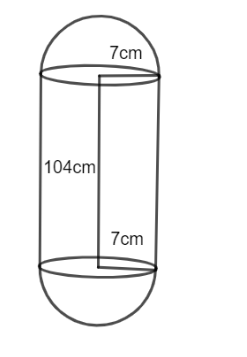
We know that the curved surface area of a cylinder with radius r and height h is given as follows:
\[S = 2\pi rh.........(1)\]
The curved surface area of the cylinder with radius 7 cm and height 104 cm is given by equation (1) as follows:
\[{S_C} = 2 \times \dfrac{{22}}{7} \times 7 \times 104\]
\[{S_C} = 2 \times 22 \times 104\]
\[{S_C} = 4576c{m^2}...........(2)\]
We, now, find the surface area of the hemispherical ends.
The surface area of a hemisphere is given by:
\[S = 2\pi {r^2}...........(3)\]
The surface area of two hemispherical ends of radius 7 cm is given as follows:
\[{S_H} = 2 \times 2 \times \dfrac{{22}}{7} \times {7^2}\]
\[{S_H} = 2 \times 2 \times 22 \times 7\]
\[{S_H} = 616c{m^2}...........(4)\]
The total surface area of the solid is then the sum of equation (3) and equation (4).
\[S = {S_C} + {S_H}\]
\[S = 4576 + 616\]
\[S = 5192c{m^2}\]
The cost of polishing is Rs. 10 per \[d{m^2}\]. The cost per \[c{m^2}\] is given as follows:
\[10per{\text{ }}d{m^2} = \dfrac{{10}}{{{{10}^2}}}per{\text{ }}c{m^2}\]
\[10per{\text{ }}d{m^2} = 0.1per{\text{ }}c{m^2}\]
Hence, the total cost of painting is given as follows:
Total cost = \[5192 \times 0.1\]
Total cost = \[Rs.519.2\]
Hence, the total cost of painting the solid is Rs. 519.2.
Note:Always multiply only numbers with the same units or convert them into the same system of units before multiplying. In this case, convert every quantity in \[c{m^2}\] or \[d{m^2}\] before multiplying.
Complete Step-by-step answer:
We need to find the cost of polishing the solid composed of cylinders with hemispherical ends.
Hence, we need to find the total surface area of the solid. It is equal to the sum of the curved surface area of the cylinder and surface area of the two hemispheres.
We know that the curved surface area of a cylinder with radius r and height h is given as follows:
\[S = 2\pi rh.........(1)\]
The curved surface area of the cylinder with radius 7 cm and height 104 cm is given by equation (1) as follows:
\[{S_C} = 2 \times \dfrac{{22}}{7} \times 7 \times 104\]
\[{S_C} = 2 \times 22 \times 104\]
\[{S_C} = 4576c{m^2}...........(2)\]
We, now, find the surface area of the hemispherical ends.
The surface area of a hemisphere is given by:
\[S = 2\pi {r^2}...........(3)\]
The surface area of two hemispherical ends of radius 7 cm is given as follows:
\[{S_H} = 2 \times 2 \times \dfrac{{22}}{7} \times {7^2}\]
\[{S_H} = 2 \times 2 \times 22 \times 7\]
\[{S_H} = 616c{m^2}...........(4)\]
The total surface area of the solid is then the sum of equation (3) and equation (4).
\[S = {S_C} + {S_H}\]
\[S = 4576 + 616\]
\[S = 5192c{m^2}\]
The cost of polishing is Rs. 10 per \[d{m^2}\]. The cost per \[c{m^2}\] is given as follows:
\[10per{\text{ }}d{m^2} = \dfrac{{10}}{{{{10}^2}}}per{\text{ }}c{m^2}\]
\[10per{\text{ }}d{m^2} = 0.1per{\text{ }}c{m^2}\]
Hence, the total cost of painting is given as follows:
Total cost = \[5192 \times 0.1\]
Total cost = \[Rs.519.2\]
Hence, the total cost of painting the solid is Rs. 519.2.
Note:Always multiply only numbers with the same units or convert them into the same system of units before multiplying. In this case, convert every quantity in \[c{m^2}\] or \[d{m^2}\] before multiplying.
Recently Updated Pages
Master Class 12 Business Studies: Engaging Questions & Answers for Success

Master Class 12 Biology: Engaging Questions & Answers for Success
Master Class 12 Chemistry: Engaging Questions & Answers for Success
Class 12 Question and Answer - Your Ultimate Solutions Guide
Master Class 11 Social Science: Engaging Questions & Answers for Success
Master Class 11 English: Engaging Questions & Answers for Success
Trending doubts
Find the sum of series 1 + 2 + 3 + 4 + 5 + + 100 class 9 maths CBSE
Name 10 Living and Non living things class 9 biology CBSE
On an outline map of India show its neighbouring c class 9 social science CBSE
Write an Article on Save Earth Save Life
On an outline map of India mark the Karakoram range class 9 social science CBSE
If HCF of 210 and 55 is expressed in the form of 210 class 9 maths CBSE