




A solid cylinder rolls up on an inclined plane of an angle of inclination $ {30^0} $ . At the bottom of the inclined plane, the center of mass of the cylinder has a speed of $ 5m/s $ .
1. How far will the cylinder go up the plane?
2. How long will it take to return to the bottom?
Answer
 Verified
555k+ views
Hint: The angle of inclination and the velocity with which the cylinder moves upward is also given. We can use the law of conservation of mechanical energy and form an equation. And from this equation, we can find the height reached by the cylinder. Once we find the height using the trigonometric formula we can find the displacement of the cylinder.
Complete answer:
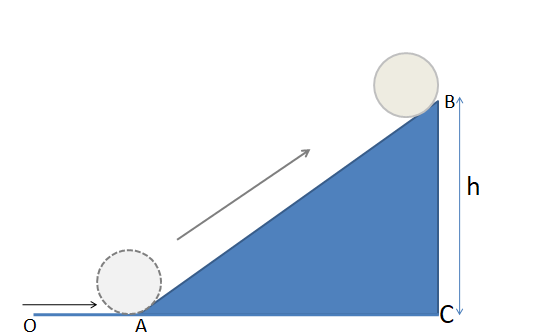
The cylinder is moving upwards. The angle of inclination $ \theta $ $ = 3{0^0} $
We know from the law of conservation of mechanical energy, the potential energy is equal to the kinetic energy.
The energy of the cylinder at the starting point is,
$ K.{E_{rot}} + K.{E_{trans}} = 0 $
We know the formula for both the rotational and kinetic energy,
$ \dfrac{1}{2}I{\omega ^2} + \dfrac{1}{2}m{v^2} = 0 $ ………… (1)
This equation (1) will be equal to the potential energy at the final position of the cylinder
$ P.E = mgh $ ……… (2)
Equating equations (1) and (2)
$ \dfrac{1}{2}I{\omega ^2} + \dfrac{1}{2}m{v^2} = mgh $ …………. (3)
The Formula for the moment of inertia of the solid cylinder is given as,
$ I = \dfrac{1}{2}m{r^2} $ ……… (4)
Substituting equation (4) in equation (3)
$ \dfrac{1}{2}(\dfrac{1}{2}m{r^2}){\omega ^2} + \dfrac{1}{2}m{v^2} = mgh $
Simplifying the above equation we get,
$ \dfrac{1}{4}m{r^2}{\omega ^2} + \dfrac{1}{2}m{v^2} = mgh $
Also, we have the relation between the angular velocity and the linear velocity as
$ v = r\omega $ ……….. (5)
Substituting (5) in the above equation we get,
$ \dfrac{1}{4}m{v^2} + \dfrac{1}{2}m{v^2} = mgh $
Canceling the $ m $ term on both sides of the equation,
$ \dfrac{1}{4}{v^2} + \dfrac{1}{2}{v^2} = gh $
$ \Rightarrow \dfrac{3}{4}{v^2} = gh $
$ \Rightarrow h = \dfrac{3}{4}\dfrac{{{v^2}}}{g} $
Substituting for $ v = 5m/s $ and $ g = 9.8 $
$ h = \dfrac{3}{4} \times \dfrac{{5 \times 5}}{{9.8}} $
$ \Rightarrow h = 1.91m $
From the triangle in the above diagram,
$ \sin \theta = \dfrac{{{\text{Opposite}}}}{{{\text{Hypotenuse}}}} $
Here hypotenuse is the total displacement of the cylinder therefore we can say it as $ s $
Opposite is the height $ h $ , rearranging the above formula to find out $ s $
$ s = \dfrac{h}{{\sin \theta }} $
$ \Rightarrow s = \dfrac{{1.91m}}{{\sin {{30}^0}}} $
$ \Rightarrow s = 3.82m $
Time taken to return to the bottom is given by,
$ t = \dfrac{s}{v} $
$ \Rightarrow t = \dfrac{{AB}}{{{{(\dfrac{4}{3} \times g \times AB\sin \theta )}^{1/2}}}} = {(\dfrac{{3AB}}{{4g\sin \theta }})^{1/2}} $
$ \Rightarrow t = {(\dfrac{{11.46}}{{19.6}})^{1/2}} = 0.764s $
Therefore the time taken for the cylinder to come back to the original position is
$ 2 \times 0.764s = 1.53s $ .
Note:
Note that the formula for the time taken from the following derivation,
For the radius of gyration K, the velocity of the cylinder at the instant when it rolls back to the bottom is given by the relation:
$ v = {\left( {\dfrac{{2gh}}{{1 + \dfrac{{{K^2}}}{{{R^2}}}}}} \right)^{1/2}} $
$ \Rightarrow v = {\left( {\dfrac{{2gAB\sin \theta }}{{1 + \dfrac{{{K^2}}}{{{R^2}}}}}} \right)^{1/2}} $
But we know that for a solid cylinder $ {K^2} = \dfrac{{{R^2}}}{2} $ , substituting this in the above equation we get,
$ v = {\left( {\dfrac{{2gAB\sin \theta }}{{1 + \dfrac{1}{2}}}} \right)^{1/2}} $
$ \Rightarrow v = {(\dfrac{4}{3}gAB\sin \theta )^{1/2}} $
This given velocity will be substituted in the time formula.
Complete answer:
The cylinder is moving upwards. The angle of inclination $ \theta $ $ = 3{0^0} $
We know from the law of conservation of mechanical energy, the potential energy is equal to the kinetic energy.
The energy of the cylinder at the starting point is,
$ K.{E_{rot}} + K.{E_{trans}} = 0 $
We know the formula for both the rotational and kinetic energy,
$ \dfrac{1}{2}I{\omega ^2} + \dfrac{1}{2}m{v^2} = 0 $ ………… (1)
This equation (1) will be equal to the potential energy at the final position of the cylinder
$ P.E = mgh $ ……… (2)
Equating equations (1) and (2)
$ \dfrac{1}{2}I{\omega ^2} + \dfrac{1}{2}m{v^2} = mgh $ …………. (3)
The Formula for the moment of inertia of the solid cylinder is given as,
$ I = \dfrac{1}{2}m{r^2} $ ……… (4)
Substituting equation (4) in equation (3)
$ \dfrac{1}{2}(\dfrac{1}{2}m{r^2}){\omega ^2} + \dfrac{1}{2}m{v^2} = mgh $
Simplifying the above equation we get,
$ \dfrac{1}{4}m{r^2}{\omega ^2} + \dfrac{1}{2}m{v^2} = mgh $
Also, we have the relation between the angular velocity and the linear velocity as
$ v = r\omega $ ……….. (5)
Substituting (5) in the above equation we get,
$ \dfrac{1}{4}m{v^2} + \dfrac{1}{2}m{v^2} = mgh $
Canceling the $ m $ term on both sides of the equation,
$ \dfrac{1}{4}{v^2} + \dfrac{1}{2}{v^2} = gh $
$ \Rightarrow \dfrac{3}{4}{v^2} = gh $
$ \Rightarrow h = \dfrac{3}{4}\dfrac{{{v^2}}}{g} $
Substituting for $ v = 5m/s $ and $ g = 9.8 $
$ h = \dfrac{3}{4} \times \dfrac{{5 \times 5}}{{9.8}} $
$ \Rightarrow h = 1.91m $
From the triangle in the above diagram,
$ \sin \theta = \dfrac{{{\text{Opposite}}}}{{{\text{Hypotenuse}}}} $
Here hypotenuse is the total displacement of the cylinder therefore we can say it as $ s $
Opposite is the height $ h $ , rearranging the above formula to find out $ s $
$ s = \dfrac{h}{{\sin \theta }} $
$ \Rightarrow s = \dfrac{{1.91m}}{{\sin {{30}^0}}} $
$ \Rightarrow s = 3.82m $
Time taken to return to the bottom is given by,
$ t = \dfrac{s}{v} $
$ \Rightarrow t = \dfrac{{AB}}{{{{(\dfrac{4}{3} \times g \times AB\sin \theta )}^{1/2}}}} = {(\dfrac{{3AB}}{{4g\sin \theta }})^{1/2}} $
$ \Rightarrow t = {(\dfrac{{11.46}}{{19.6}})^{1/2}} = 0.764s $
Therefore the time taken for the cylinder to come back to the original position is
$ 2 \times 0.764s = 1.53s $ .
Note:
Note that the formula for the time taken from the following derivation,
For the radius of gyration K, the velocity of the cylinder at the instant when it rolls back to the bottom is given by the relation:
$ v = {\left( {\dfrac{{2gh}}{{1 + \dfrac{{{K^2}}}{{{R^2}}}}}} \right)^{1/2}} $
$ \Rightarrow v = {\left( {\dfrac{{2gAB\sin \theta }}{{1 + \dfrac{{{K^2}}}{{{R^2}}}}}} \right)^{1/2}} $
But we know that for a solid cylinder $ {K^2} = \dfrac{{{R^2}}}{2} $ , substituting this in the above equation we get,
$ v = {\left( {\dfrac{{2gAB\sin \theta }}{{1 + \dfrac{1}{2}}}} \right)^{1/2}} $
$ \Rightarrow v = {(\dfrac{4}{3}gAB\sin \theta )^{1/2}} $
This given velocity will be substituted in the time formula.
Recently Updated Pages
If x a + bt + ct2 where x is in meters and t is in class 11 physics CBSE

A car covers the first half distance between two places class 11 physics CBSE
The resultant of two vectors overrightarrow P and overrightarrow class 11 physics CBSE
Find the value of cos 135 class 11 maths CBSE
A mass M is held in place by an applied force F and class 11 physics CBSE
A solution of glucose in water is labelled as 10 dfracwv class 11 chemistry CBSE
Trending doubts
One Metric ton is equal to kg A 10000 B 1000 C 100 class 11 physics CBSE
Find the value of the expression given below sin 30circ class 11 maths CBSE
What do you mean by retardation What is its SI uni class 11 physics CBSE
Draw a diagram of nephron and explain its structur class 11 biology CBSE
10 examples of friction in our daily life
Difference between physical and chemical change class 11 chemistry CBSE