




A solid cylinder of mass 50kg and radius 0.5m is free to rotate about the horizontal axis. A massless string is wound round the cylinder with one end attached to it and other hanging freely. Tension in the string required to produce an angular acceleration of 2 $ { revolutions }/{ { s }^{ -2 } }$ is:-
A. 25 N
B. 50 N
C. 78.5 N
D. 157 N
Answer
 Verified
637.5k+ views
Hint: Use the formula of torque in terms of tension and radius. But we know, torque is also related to angular acceleration and inertia. Now, write inertia in terms of mass and radius. Substitute the values and calculate tension in the string.
Formula used:
$ \tau \quad =\quad T\quad \times \quad r$
$ \tau \quad =\quad I\quad \times \quad \alpha$
$ I\quad =\quad \dfrac { m{ R }^{ 2 } }{ 2 }$
Complete answer:
Given: Mass of solid cylinder (m) = 50kg
Radius of cylinder (R)= 0.5m
Angular acceleration ($\alpha$)= $ 2\quad { rev }/{ { s }^{ -2 } }$ = $ 2\quad \times \quad 2\pi { { rad }/{ { s }^{ -2 } } }$
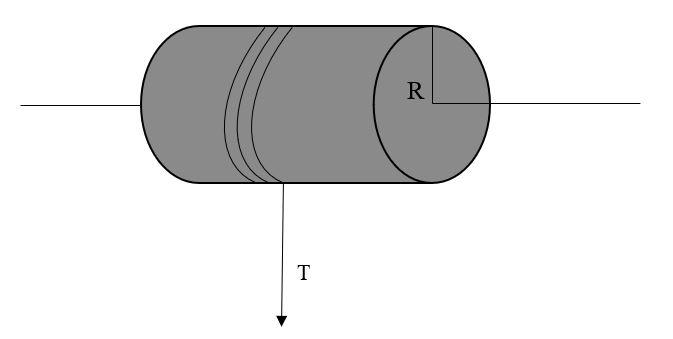
Torque is given by,
$ \tau \quad =\quad T\quad \times \quad r$ …(1)
where, $\tau$ : Torque
T : Tension in the string
R: Radius of cylinder
Rearranging equation.(1) we get,
$ T=\quad \dfrac { \tau }{ R }$ …(2)
We know, $ \tau \quad =\quad I\quad \times \quad \alpha$
Therefore, equation.(2) becomes
$ T\quad =\quad \dfrac { I\quad \times \quad \alpha }{ R }$
where, I: Rotational Inertia
But, $ I\quad =\quad \dfrac { m{ R }^{ 2 } }{ 2 }$
$ \Rightarrow T\quad =\quad \dfrac { m{ R }^{ 2 } }{ 2 } \times \quad \dfrac { \alpha }{ R }$
$ \Rightarrow T\quad =\quad \dfrac { m{ R }\alpha }{ 2 }$
$ \Rightarrow T\quad =\quad \dfrac { 50\quad \times \quad { 0.5\quad \times \quad }4\pi }{ 2 }$
$ \Rightarrow T\quad =\quad 157.08$
Therefore, tension in the string required to produce an angular acceleration of 2 revolutions $ { s }^{ -2 }$ is 157N.
So, the correct answer is “Option D”.
Note:
Make sure you convert unit of angular acceleration from $ { revolutions }/{ { s }^{ -2 } }$ to $ { { rad }/{ { s }^{ -2 } } }$. There are 2$\pi$ radians in a complete revolution. So to get total angular acceleration, multiply $ { revolutions }/{ { s }^{ -2 } }$ with $ 2\pi { { rad }/{ { s }^{ -2 } } }$.
Formula used:
$ \tau \quad =\quad T\quad \times \quad r$
$ \tau \quad =\quad I\quad \times \quad \alpha$
$ I\quad =\quad \dfrac { m{ R }^{ 2 } }{ 2 }$
Complete answer:
Given: Mass of solid cylinder (m) = 50kg
Radius of cylinder (R)= 0.5m
Angular acceleration ($\alpha$)= $ 2\quad { rev }/{ { s }^{ -2 } }$ = $ 2\quad \times \quad 2\pi { { rad }/{ { s }^{ -2 } } }$
Torque is given by,
$ \tau \quad =\quad T\quad \times \quad r$ …(1)
where, $\tau$ : Torque
T : Tension in the string
R: Radius of cylinder
Rearranging equation.(1) we get,
$ T=\quad \dfrac { \tau }{ R }$ …(2)
We know, $ \tau \quad =\quad I\quad \times \quad \alpha$
Therefore, equation.(2) becomes
$ T\quad =\quad \dfrac { I\quad \times \quad \alpha }{ R }$
where, I: Rotational Inertia
But, $ I\quad =\quad \dfrac { m{ R }^{ 2 } }{ 2 }$
$ \Rightarrow T\quad =\quad \dfrac { m{ R }^{ 2 } }{ 2 } \times \quad \dfrac { \alpha }{ R }$
$ \Rightarrow T\quad =\quad \dfrac { m{ R }\alpha }{ 2 }$
$ \Rightarrow T\quad =\quad \dfrac { 50\quad \times \quad { 0.5\quad \times \quad }4\pi }{ 2 }$
$ \Rightarrow T\quad =\quad 157.08$
Therefore, tension in the string required to produce an angular acceleration of 2 revolutions $ { s }^{ -2 }$ is 157N.
So, the correct answer is “Option D”.
Note:
Make sure you convert unit of angular acceleration from $ { revolutions }/{ { s }^{ -2 } }$ to $ { { rad }/{ { s }^{ -2 } } }$. There are 2$\pi$ radians in a complete revolution. So to get total angular acceleration, multiply $ { revolutions }/{ { s }^{ -2 } }$ with $ 2\pi { { rad }/{ { s }^{ -2 } } }$.
Recently Updated Pages
Basicity of sulphurous acid and sulphuric acid are

Master Class 11 English: Engaging Questions & Answers for Success
Master Class 11 Physics: Engaging Questions & Answers for Success
Master Class 11 Computer Science: Engaging Questions & Answers for Success
Master Class 11 Chemistry: Engaging Questions & Answers for Success
Master Class 11 Social Science: Engaging Questions & Answers for Success
Trending doubts
Difference Between Prokaryotic Cells and Eukaryotic Cells
Two of the body parts which do not appear in MRI are class 11 biology CBSE
One Metric ton is equal to kg A 10000 B 1000 C 100 class 11 physics CBSE
10 examples of friction in our daily life
Draw a diagram of nephron and explain its structur class 11 biology CBSE
What will happen if the mucus is not secreted by the class 11 biology CBSE