




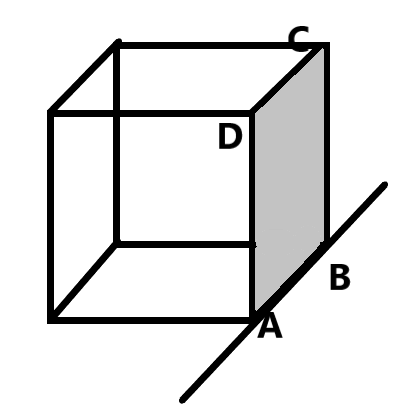
A solid cube of wood of side 2a and mass M is resting on a horizontal surface as shown in the figure. The cube is free to rotate about the fixed axis AB. A bullet of mass m is very less than M and speed v is shot horizontally at the face opposite to ABCD at a height h above the surface to impart the cube an angular speed \[{{\omega }_{c}}\] so that the cube just topples over. (Note: the moment of inertia of the cube about an axis perpendicular to the face and passing through the centre of mass is \[\left( \dfrac{2M{{a}^{2}}}{3} \right)\]. Then, \[{{\omega }_{c}}\] is:
\[\begin{align}
& \text{A) }\sqrt{\dfrac{3gM}{2ma}} \\
& \text{B) }\sqrt{\dfrac{3g}{4h}} \\
& \text{C) }\sqrt{\dfrac{3g(\sqrt{2}-1)}{2a}} \\
& D)\sqrt{\dfrac{3g(\sqrt{2}-1)}{4a}} \\
\end{align}\]
Answer
 Verified
588.6k+ views
Hint: We have to use the relation between the moment of inertia of the given mass about the axis AB and the angular velocity due to the force at which the bullet hits the opposite face of the face ABCD of the given solid cube as per the figure.
Complete answer:
Let us consider the solid cube which can rotate about the axis AB as shown in the figure. A bullet of mass ‘m’ strikes the opposite side of the face ABCD with a velocity ‘v’ which topples the solid cube about the axis AB. We know that the moment of inertia is the rotational analog of mass. It is the quantity of mass which causes the solid to rotate along the given axis. It is generally given as -
\[I=M{{R}^{2}}\]
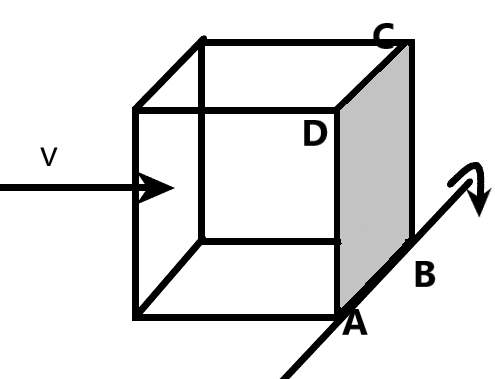
In the given situation, the moment of inertia needs to be calculated using the Parallel axis theorem as –
\[\begin{align}
& I={{I}_{cm}}+m{{a}^{2}} \\
& \Rightarrow I=\dfrac{2}{3}M{{a}^{2}}+M{{a}^{2}} \\
& \Rightarrow I=\dfrac{8}{3}M{{a}^{2}} \\
\end{align}\]
Where \[{{I}_{cm}}\] is the moment of inertia along the centre of mass.
Now, let us calculate the angular velocity possessed by the solid cube when hit by a bullet by using the conservation of energy. The energy due to the moment of inertia and the potential energy difference can be equated as –
\[\begin{align}
& \dfrac{1}{2}I{{\omega }_{0}}^{2}=Mg({{h}_{f}}-{{h}_{i}}) \\
& \Rightarrow \dfrac{1}{2}\dfrac{8}{3}M{{a}^{2}}{{\omega }_{0}}^{2}=Mg({{h}_{f}}-{{h}_{i}}) \\
& \Rightarrow \dfrac{4}{3}{{a}^{2}}{{\omega }_{0}}^{2}=g({{h}_{f}}-{{h}_{i}}) \\
& \Rightarrow {{\omega }_{0}}^{2}=\dfrac{3g({{h}_{f}}-{{h}_{i}})}{4{{a}^{2}}} \\
& \Rightarrow {{\omega }_{0}}=\dfrac{\sqrt{3g({{h}_{f}}-{{h}_{i}})}}{2a} \\
& \text{but,} \\
& \text{(}{{\text{h}}_{f}}-{{h}_{i}})=(\sqrt{2}-1)a \\
& \Rightarrow {{\omega }_{0}}=\sqrt{\dfrac{3g(\sqrt{2}-1)}{4a}} \\
\end{align}\]
This is the required angular velocity.
So, the correct answer is “Option D”.
Note:
We can use the parallel axis theorem when the moment of inertia of a parallel side and the moment of inertia about the centre of mass is already known. The perpendicular axes theorem is used to find the moment of inertia about a third axis which is perpendicular to two given axes.
Complete answer:
Let us consider the solid cube which can rotate about the axis AB as shown in the figure. A bullet of mass ‘m’ strikes the opposite side of the face ABCD with a velocity ‘v’ which topples the solid cube about the axis AB. We know that the moment of inertia is the rotational analog of mass. It is the quantity of mass which causes the solid to rotate along the given axis. It is generally given as -
\[I=M{{R}^{2}}\]
In the given situation, the moment of inertia needs to be calculated using the Parallel axis theorem as –
\[\begin{align}
& I={{I}_{cm}}+m{{a}^{2}} \\
& \Rightarrow I=\dfrac{2}{3}M{{a}^{2}}+M{{a}^{2}} \\
& \Rightarrow I=\dfrac{8}{3}M{{a}^{2}} \\
\end{align}\]
Where \[{{I}_{cm}}\] is the moment of inertia along the centre of mass.
Now, let us calculate the angular velocity possessed by the solid cube when hit by a bullet by using the conservation of energy. The energy due to the moment of inertia and the potential energy difference can be equated as –
\[\begin{align}
& \dfrac{1}{2}I{{\omega }_{0}}^{2}=Mg({{h}_{f}}-{{h}_{i}}) \\
& \Rightarrow \dfrac{1}{2}\dfrac{8}{3}M{{a}^{2}}{{\omega }_{0}}^{2}=Mg({{h}_{f}}-{{h}_{i}}) \\
& \Rightarrow \dfrac{4}{3}{{a}^{2}}{{\omega }_{0}}^{2}=g({{h}_{f}}-{{h}_{i}}) \\
& \Rightarrow {{\omega }_{0}}^{2}=\dfrac{3g({{h}_{f}}-{{h}_{i}})}{4{{a}^{2}}} \\
& \Rightarrow {{\omega }_{0}}=\dfrac{\sqrt{3g({{h}_{f}}-{{h}_{i}})}}{2a} \\
& \text{but,} \\
& \text{(}{{\text{h}}_{f}}-{{h}_{i}})=(\sqrt{2}-1)a \\
& \Rightarrow {{\omega }_{0}}=\sqrt{\dfrac{3g(\sqrt{2}-1)}{4a}} \\
\end{align}\]
This is the required angular velocity.
So, the correct answer is “Option D”.
Note:
We can use the parallel axis theorem when the moment of inertia of a parallel side and the moment of inertia about the centre of mass is already known. The perpendicular axes theorem is used to find the moment of inertia about a third axis which is perpendicular to two given axes.
Recently Updated Pages
Basicity of sulphurous acid and sulphuric acid are

Master Class 11 Business Studies: Engaging Questions & Answers for Success
Master Class 11 Computer Science: Engaging Questions & Answers for Success
Master Class 11 Economics: Engaging Questions & Answers for Success
Master Class 11 Social Science: Engaging Questions & Answers for Success
Master Class 11 English: Engaging Questions & Answers for Success
Trending doubts
One Metric ton is equal to kg A 10000 B 1000 C 100 class 11 physics CBSE
State and prove Bernoullis theorem class 11 physics CBSE
Actinoid contraction is more than lanthanoid contraction class 11 chemistry CBSE
The transition element that has lowest enthalpy of class 11 chemistry CBSE
Can anyone list 10 advantages and disadvantages of friction
State the laws of reflection of light