




A solid cube of side 12cm is cut into 8 cubes of equal volume. What will be the side length of the new cube? Also, find the ratios between their surface areas.
Answer
 Verified
574.5k+ views
Hint: We solve this problem by equating the volume of the original cube with the combined volume of 8 new cubes. The formula for the volume of a cube having the side length as \['a'\] is given as
\[V={{a}^{3}}\]
After that we find the ratio of surface areas of the original cube to the new cube by using the surface area formula of a cube having side length as \['a'\] is given as
\[S.A=6{{a}^{2}}\]
Complete step by step solution:
We are given that the side length of the original cube as 12cm
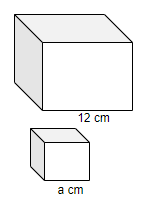
Let us assume that the side length of original cube as
\[\Rightarrow A=12cm\]
Let us assume that the volume of original cube as \[{{V}_{1}}\]
We know that the formula for volume of a cube having the side length as \['a'\] is given as
\[V={{a}^{3}}\]
By using the above formula we get the volume of original cube as
\[\begin{align}
& \Rightarrow {{V}_{1}}={{\left( 12cm \right)}^{3}} \\
& \Rightarrow {{V}_{1}}=1728c{{m}^{3}} \\
\end{align}\]
Let us assume that the side length of new cube as \['a'\]
Let us assume that the volume of new cube as \[{{V}_{2}}\]
By using the volume formula we get the volume of new cube as
\[\Rightarrow {{V}_{2}}={{a}^{3}}\]
We are given that the original cube is divided into 8 cubes of equal volume.
By converting the above statement into mathematical equation we get
\[\Rightarrow {{V}_{1}}=8\times {{V}_{2}}\]
By substituting the required values in above equation we get
\[\begin{align}
& \Rightarrow 1728c{{m}^{3}}=8{{a}^{3}} \\
& \Rightarrow {{a}^{3}}=216c{{m}^{3}} \\
& \Rightarrow a=6cm \\
\end{align}\]
Therefore the side length of the new cube formed is 6cm.
Now, let us assume that the surface area of original cube as \[{{A}_{1}}\]
We know that the formula of the surface area formula of cube having side length as \['a'\] is given as
\[S.A=6{{a}^{2}}\]
By using the above formula we get the surface area of original cube as
\[\Rightarrow {{A}_{1}}=6{{A}^{2}}.......equation(i)\]
Let us assume that the surface area of new cube as \[{{A}_{2}}\]
Now, by using the surface area of cube formula we get the surface area of new cube as
\[\Rightarrow {{A}_{2}}=6{{a}^{2}}......equation(ii)\]
Now, by dividing the equation (i) with equation (ii) we get
\[\Rightarrow \dfrac{{{A}_{1}}}{{{A}_{2}}}=\dfrac{{{A}^{2}}}{{{a}^{2}}}\]
Now, by substituting the required values in above equation we get
\[\begin{align}
& \Rightarrow \dfrac{{{A}_{1}}}{{{A}_{2}}}=\dfrac{{{12}^{2}}}{{{6}^{2}}} \\
& \Rightarrow \dfrac{{{A}_{1}}}{{{A}_{2}}}=\dfrac{144}{36}=\dfrac{4}{1} \\
\end{align}\]
We know that from the definition of ratios that is
\[\Rightarrow a:b=\dfrac{a}{b}\]
By using the above formula we get the ratio of surface areas as
\[\Rightarrow {{A}_{1}}:{{A}_{2}}=4:1\]
Therefore the ratio of surface areas of original cube to new cube is \[4:1\]
Note: Students may make mistakes in the calculation of side length of new cube. We are given that the original cube is divided into 8 cubes of equal volume. By converting the above statement into a mathematical equation we get
\[\Rightarrow {{V}_{1}}=8\times {{V}_{2}}\]
But students do mistake and take the mathematical equation as
\[\Rightarrow A=8\times a\]
This gives the wrong answer because they said that the original cube is divided into 8 cubes of equal volume, not equal side length.
Also, while finding the ratio of surface area we find \[{{A}_{1}}:{{A}_{2}}\] but not \[{{A}_{1}}:8\times {{A}_{2}}\]
This point needs to be taken care of.
\[V={{a}^{3}}\]
After that we find the ratio of surface areas of the original cube to the new cube by using the surface area formula of a cube having side length as \['a'\] is given as
\[S.A=6{{a}^{2}}\]
Complete step by step solution:
We are given that the side length of the original cube as 12cm
Let us assume that the side length of original cube as
\[\Rightarrow A=12cm\]
Let us assume that the volume of original cube as \[{{V}_{1}}\]
We know that the formula for volume of a cube having the side length as \['a'\] is given as
\[V={{a}^{3}}\]
By using the above formula we get the volume of original cube as
\[\begin{align}
& \Rightarrow {{V}_{1}}={{\left( 12cm \right)}^{3}} \\
& \Rightarrow {{V}_{1}}=1728c{{m}^{3}} \\
\end{align}\]
Let us assume that the side length of new cube as \['a'\]
Let us assume that the volume of new cube as \[{{V}_{2}}\]
By using the volume formula we get the volume of new cube as
\[\Rightarrow {{V}_{2}}={{a}^{3}}\]
We are given that the original cube is divided into 8 cubes of equal volume.
By converting the above statement into mathematical equation we get
\[\Rightarrow {{V}_{1}}=8\times {{V}_{2}}\]
By substituting the required values in above equation we get
\[\begin{align}
& \Rightarrow 1728c{{m}^{3}}=8{{a}^{3}} \\
& \Rightarrow {{a}^{3}}=216c{{m}^{3}} \\
& \Rightarrow a=6cm \\
\end{align}\]
Therefore the side length of the new cube formed is 6cm.
Now, let us assume that the surface area of original cube as \[{{A}_{1}}\]
We know that the formula of the surface area formula of cube having side length as \['a'\] is given as
\[S.A=6{{a}^{2}}\]
By using the above formula we get the surface area of original cube as
\[\Rightarrow {{A}_{1}}=6{{A}^{2}}.......equation(i)\]
Let us assume that the surface area of new cube as \[{{A}_{2}}\]
Now, by using the surface area of cube formula we get the surface area of new cube as
\[\Rightarrow {{A}_{2}}=6{{a}^{2}}......equation(ii)\]
Now, by dividing the equation (i) with equation (ii) we get
\[\Rightarrow \dfrac{{{A}_{1}}}{{{A}_{2}}}=\dfrac{{{A}^{2}}}{{{a}^{2}}}\]
Now, by substituting the required values in above equation we get
\[\begin{align}
& \Rightarrow \dfrac{{{A}_{1}}}{{{A}_{2}}}=\dfrac{{{12}^{2}}}{{{6}^{2}}} \\
& \Rightarrow \dfrac{{{A}_{1}}}{{{A}_{2}}}=\dfrac{144}{36}=\dfrac{4}{1} \\
\end{align}\]
We know that from the definition of ratios that is
\[\Rightarrow a:b=\dfrac{a}{b}\]
By using the above formula we get the ratio of surface areas as
\[\Rightarrow {{A}_{1}}:{{A}_{2}}=4:1\]
Therefore the ratio of surface areas of original cube to new cube is \[4:1\]
Note: Students may make mistakes in the calculation of side length of new cube. We are given that the original cube is divided into 8 cubes of equal volume. By converting the above statement into a mathematical equation we get
\[\Rightarrow {{V}_{1}}=8\times {{V}_{2}}\]
But students do mistake and take the mathematical equation as
\[\Rightarrow A=8\times a\]
This gives the wrong answer because they said that the original cube is divided into 8 cubes of equal volume, not equal side length.
Also, while finding the ratio of surface area we find \[{{A}_{1}}:{{A}_{2}}\] but not \[{{A}_{1}}:8\times {{A}_{2}}\]
This point needs to be taken care of.
Recently Updated Pages
Master Class 10 Computer Science: Engaging Questions & Answers for Success

Master Class 10 General Knowledge: Engaging Questions & Answers for Success
Master Class 10 English: Engaging Questions & Answers for Success
Master Class 10 Social Science: Engaging Questions & Answers for Success
Master Class 10 Maths: Engaging Questions & Answers for Success
Master Class 10 Science: Engaging Questions & Answers for Success
Trending doubts
What is the median of the first 10 natural numbers class 10 maths CBSE
Which women's tennis player has 24 Grand Slam singles titles?
Who is the Brand Ambassador of Incredible India?
Why is there a time difference of about 5 hours between class 10 social science CBSE
Write a letter to the principal requesting him to grant class 10 english CBSE
A moving boat is observed from the top of a 150 m high class 10 maths CBSE