




A snail is climbing up a square window of height $20\,cm$, starting at the lower left corner and climbing towards the upper right corner. If the magnitude of the snail’s speed is $0.300\,cm{s^{ - 1}}$, how long will it take for the snail to traverse the window?
A. $133\,s$
B. $94.3\,s$
C. $77.0\,s$
D. $66.7\,s$
E. $47.1\,s$
Answer
 Verified
583.2k+ views
Hint:Here we have to use the distance formula first and then the distance, time and speed formula to get the final answer.
Distance = speed $ \times $ time
Complete step by step formula:
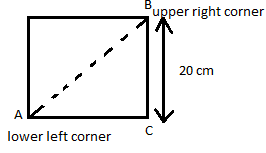
Given,
Side of the square $ = 20\,cm$
Since, it is a square, so, all its sides are equal.
Speed of the snail $ = 0.300cm{s^{ - 1}}$
According to distance formula,
$ A{B^2} = A{C^2} + B{C^2} \\
\Rightarrow AB = \sqrt {A{C^2} + B{C^2}} \\
\Rightarrow AB = \sqrt {{{\left( {20} \right)}^2} + {{\left( {20} \right)}^2}} \\
\Rightarrow AB = \sqrt {800} \\
\Rightarrow AB = 28.28\,cm \\
$
Hence, we got the distance travelled by the snail.
Now we can find the time using the formula:
Time = $\dfrac{{{\text{distance}}}}
{{{\text{speed}}}}$
$
t = \dfrac{{28.28}}{{0.300}} \\
\Rightarrow t = 94.3\,s \\
$
Hence, option B is correct.
The time taken by the snail to traverse the window is $94.3\,s$.
Additional information:
-Distance is a scalar quantity that during its motion corresponds to how much ground an object has covered. Displacement is a quantity of a vector that corresponds to how far out of place an object is. It is the total shift of direction of the object.
-Speed is a scalar quantity that corresponds to how quickly an object goes. Speed can be considered as the pace at which a distance is travelled by an object. An object with no motion at all has a velocity of zero.
-We must know the approximate distance an object travels and the approximate elapsed time of its entire journey to measure the average speed of an object.
-Time is calculated by how much distance an object has travelled and at how much speed.
If we keep the velocity of an object steady and increase the weight of the object, the force of the impact will increase.
Note:
Here we have to pay attention as to the direction in which the snail is travelling. If the snail would have travelled from any other corner the answer would have been different.
Distance = speed $ \times $ time
Complete step by step formula:
Given,
Side of the square $ = 20\,cm$
Since, it is a square, so, all its sides are equal.
Speed of the snail $ = 0.300cm{s^{ - 1}}$
According to distance formula,
$ A{B^2} = A{C^2} + B{C^2} \\
\Rightarrow AB = \sqrt {A{C^2} + B{C^2}} \\
\Rightarrow AB = \sqrt {{{\left( {20} \right)}^2} + {{\left( {20} \right)}^2}} \\
\Rightarrow AB = \sqrt {800} \\
\Rightarrow AB = 28.28\,cm \\
$
Hence, we got the distance travelled by the snail.
Now we can find the time using the formula:
Time = $\dfrac{{{\text{distance}}}}
{{{\text{speed}}}}$
$
t = \dfrac{{28.28}}{{0.300}} \\
\Rightarrow t = 94.3\,s \\
$
Hence, option B is correct.
The time taken by the snail to traverse the window is $94.3\,s$.
Additional information:
-Distance is a scalar quantity that during its motion corresponds to how much ground an object has covered. Displacement is a quantity of a vector that corresponds to how far out of place an object is. It is the total shift of direction of the object.
-Speed is a scalar quantity that corresponds to how quickly an object goes. Speed can be considered as the pace at which a distance is travelled by an object. An object with no motion at all has a velocity of zero.
-We must know the approximate distance an object travels and the approximate elapsed time of its entire journey to measure the average speed of an object.
-Time is calculated by how much distance an object has travelled and at how much speed.
If we keep the velocity of an object steady and increase the weight of the object, the force of the impact will increase.
Note:
Here we have to pay attention as to the direction in which the snail is travelling. If the snail would have travelled from any other corner the answer would have been different.
Recently Updated Pages
Master Class 11 Computer Science: Engaging Questions & Answers for Success

Master Class 11 Business Studies: Engaging Questions & Answers for Success
Master Class 11 Economics: Engaging Questions & Answers for Success
Master Class 11 English: Engaging Questions & Answers for Success
Master Class 11 Maths: Engaging Questions & Answers for Success
Master Class 11 Biology: Engaging Questions & Answers for Success
Trending doubts
One Metric ton is equal to kg A 10000 B 1000 C 100 class 11 physics CBSE
There are 720 permutations of the digits 1 2 3 4 5 class 11 maths CBSE
Discuss the various forms of bacteria class 11 biology CBSE
Draw a diagram of a plant cell and label at least eight class 11 biology CBSE
State the laws of reflection of light
Explain zero factorial class 11 maths CBSE