




A small piece of wire bent into an L shape with up-right and horizontal portions of equal lengths, is placed with a horizontal portion along the axis of the concave mirror whose radius of curvature is 10 cm. If the bend is 20 cm from the pole of the mirror, then the ratio of the lengths of the images of the upright and horizontal portions of the wire is
A. 1:2
B. 3:1
C. 1:3
D. 2:1
Answer
 Verified
579.9k+ views
Hint: In this question we have been asked to calculate the ratio of lengths of the images of the upright and horizontal portions of the given wire. To solve this question, we shall first find the image distance of the given wire. Later, we shall find the vertical height of the image and we shall use the formula of lateral magnification. The horizontal height shall be calculated by using the magnification formula. Later, we shall take the ratio of these values and calculate our final answer.
Formula used:
\[\dfrac{1}{f}=\dfrac{1}{v}+\dfrac{1}{u}\]
\[m=\dfrac{-v}{u}\]
m is the magnification
\[{{m}_{l}}=\dfrac{{{f}^{2}}}{{{(u-f)}^{2}}}\]
\[{{m}_{l}}\] is the lateral magnification
Complete answer:
It is given that a wire is bent in L shape with vertical and horizontal sides of length 10 cm. This wire is placed in front of a concave mirror as shown in the figure. The radius of curvature of the lens is given as 10 cm. Therefore, we know the focal length is given as,
\[f=\dfrac{R}{2}\]
Therefore, the focal length is 5 cm.
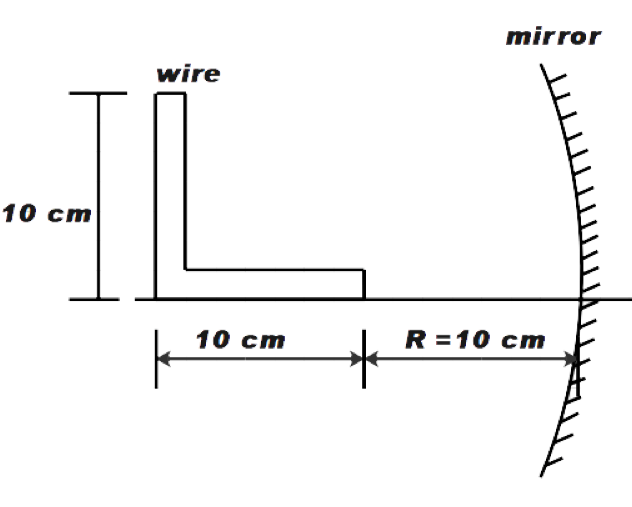
Now from mirror formula
We know,
\[\dfrac{1}{f}=\dfrac{1}{v}+\dfrac{1}{u}\]
Solving for image distance
\[\dfrac{1}{v}=\dfrac{1}{f}-\dfrac{1}{u}\]
Now, we know that object distance and focal length of concave mirrors are taken as negative due to sign conventions.
Therefore, after substituting the given values
We get,
\[\dfrac{1}{v}=\dfrac{1}{-5}-\dfrac{1}{-20}\]
Therefore,
\[v=-\dfrac{20}{3}\] ………………. (1)
Now, the horizontal length of image can be given by magnification formula
Therefore,
\[m=\dfrac{-v}{u}\]
After substituting values
We get,
\[m=-\dfrac{\left( -\dfrac{20}{3} \right)}{-20}\] ……………. (from (1))
Therefore,
\[m=-\dfrac{1}{3}\]
Now, for ratios we shall only consider the magnitude.
Therefore, taking modulus
We get,
\[\left| m \right|=\dfrac{1}{3}\] …………………… (2)
Similarly, the vertical length of image can be given by formula for lateral magnification
Therefore, we know
\[{{m}_{l}}=\dfrac{{{f}^{2}}}{{{(u-f)}^{2}}}\]
After substituting values
We get,
\[{{m}_{l}}=\dfrac{{{(-5)}^{2}}}{{{(-20-(-5))}^{2}}}\]
Therefore,
\[{{m}_{l}}=\dfrac{1}{9}\] ……………….. (3)
Taking the ratio
\[\dfrac{\left| m \right|}{{{m}_{l}}}=\dfrac{{}^{1}/{}_{3}}{{}^{1}/{}_{9}}\] ……………………. (from (2) and (3))
\[\dfrac{\left| m \right|}{{{m}_{l}}}=\dfrac{3}{1}\]
So, the correct answer is “Option B”.
Note:
The mirror formula states the relation between object distance, image distance and the focal length of the mirror. The lateral magnification of an object refers to the ratio of length of image to object measured in a plane perpendicular to the optical axis of the mirror. For a concave mirror the rays converge in front of the mirror after reflection. Therefore, it is also called a converging mirror. Concave mirror can produce real as well as virtual images. The image can be upright or inverted as well.
Formula used:
\[\dfrac{1}{f}=\dfrac{1}{v}+\dfrac{1}{u}\]
\[m=\dfrac{-v}{u}\]
m is the magnification
\[{{m}_{l}}=\dfrac{{{f}^{2}}}{{{(u-f)}^{2}}}\]
\[{{m}_{l}}\] is the lateral magnification
Complete answer:
It is given that a wire is bent in L shape with vertical and horizontal sides of length 10 cm. This wire is placed in front of a concave mirror as shown in the figure. The radius of curvature of the lens is given as 10 cm. Therefore, we know the focal length is given as,
\[f=\dfrac{R}{2}\]
Therefore, the focal length is 5 cm.
Now from mirror formula
We know,
\[\dfrac{1}{f}=\dfrac{1}{v}+\dfrac{1}{u}\]
Solving for image distance
\[\dfrac{1}{v}=\dfrac{1}{f}-\dfrac{1}{u}\]
Now, we know that object distance and focal length of concave mirrors are taken as negative due to sign conventions.
Therefore, after substituting the given values
We get,
\[\dfrac{1}{v}=\dfrac{1}{-5}-\dfrac{1}{-20}\]
Therefore,
\[v=-\dfrac{20}{3}\] ………………. (1)
Now, the horizontal length of image can be given by magnification formula
Therefore,
\[m=\dfrac{-v}{u}\]
After substituting values
We get,
\[m=-\dfrac{\left( -\dfrac{20}{3} \right)}{-20}\] ……………. (from (1))
Therefore,
\[m=-\dfrac{1}{3}\]
Now, for ratios we shall only consider the magnitude.
Therefore, taking modulus
We get,
\[\left| m \right|=\dfrac{1}{3}\] …………………… (2)
Similarly, the vertical length of image can be given by formula for lateral magnification
Therefore, we know
\[{{m}_{l}}=\dfrac{{{f}^{2}}}{{{(u-f)}^{2}}}\]
After substituting values
We get,
\[{{m}_{l}}=\dfrac{{{(-5)}^{2}}}{{{(-20-(-5))}^{2}}}\]
Therefore,
\[{{m}_{l}}=\dfrac{1}{9}\] ……………….. (3)
Taking the ratio
\[\dfrac{\left| m \right|}{{{m}_{l}}}=\dfrac{{}^{1}/{}_{3}}{{}^{1}/{}_{9}}\] ……………………. (from (2) and (3))
\[\dfrac{\left| m \right|}{{{m}_{l}}}=\dfrac{3}{1}\]
So, the correct answer is “Option B”.
Note:
The mirror formula states the relation between object distance, image distance and the focal length of the mirror. The lateral magnification of an object refers to the ratio of length of image to object measured in a plane perpendicular to the optical axis of the mirror. For a concave mirror the rays converge in front of the mirror after reflection. Therefore, it is also called a converging mirror. Concave mirror can produce real as well as virtual images. The image can be upright or inverted as well.
Recently Updated Pages
Master Class 10 Computer Science: Engaging Questions & Answers for Success

Master Class 10 General Knowledge: Engaging Questions & Answers for Success
Master Class 10 English: Engaging Questions & Answers for Success
Master Class 10 Social Science: Engaging Questions & Answers for Success
Master Class 10 Maths: Engaging Questions & Answers for Success
Master Class 10 Science: Engaging Questions & Answers for Success
Trending doubts
What is the median of the first 10 natural numbers class 10 maths CBSE
Which women's tennis player has 24 Grand Slam singles titles?
Who is the Brand Ambassador of Incredible India?
Why is there a time difference of about 5 hours between class 10 social science CBSE
Write a letter to the principal requesting him to grant class 10 english CBSE
A moving boat is observed from the top of a 150 m high class 10 maths CBSE