




A small body is initially at a distance r from the centre of earth. r is greater than the radius of the earth. If it takes W joules of work to move the body from this position to another position at a distance 2r measured from the centre of earth, then how many joules would be required to move it from this position to a new position at a distance of 3r from the centre of the earth.
$\begin{align}
& \left( A \right)\dfrac{W}{5} \\
& \left( B \right)\dfrac{W}{3} \\
& \left( C \right)\dfrac{W}{2} \\
& \left( D \right)\dfrac{W}{6} \\
\end{align}$
Answer
 Verified
574.2k+ views
Hint: Gravitational potential energy can be described as the energy stored by a body at a given position. According to the forces acting on the body if the position of the object changes then the change in potential energy of the body can be explained as the work done by the body. Thus calculate the work done by the body at those instances using the concept of gravitational potential energy. Then by comparing both the equations we will get the solution.
Formula used:
Gravitational potential energy,
$U=-\dfrac{GMm}{r}$
where, G is the gravitational constant
M is the mass of earth
m is the mass of planet
r is the separating distance
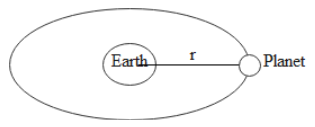
Complete answer:
The work done in order to move a body can be described as the change in gravitational potential energy of the body.
That is,
$W=-\dfrac{GMm}{2r}-\left( \dfrac{-GMm}{r} \right)$
$\Rightarrow W=\dfrac{GMm}{2r}$
After that when that moves from the position 2r to 3r then the change in gravitational potential energy of the body is,
$W'=-\dfrac{GMm}{3r}-\left( -\dfrac{GMm}{2r} \right)$
$\Rightarrow W'=-\dfrac{GMm}{3r}+\dfrac{GMm}{2r}$
$\begin{align}
& \Rightarrow W'=-\dfrac{2GMm}{6r}+\dfrac{3GMm}{6r} \\
& \therefore W'=\dfrac{GMm}{6r} \\
\end{align}$
This can also be written as,
$W'=\dfrac{1}{3}\dfrac{GMm}{2r}$
We know that $W=\dfrac{GMm}{2r}$
Substitute this in the above equation we get,
$W'=\dfrac{1}{3}W$
Hence, option (B) is correct.
Note:
The force of gravity can be considered as a conservative force since the work done doesn’t depend up on the path followed. The potential energy arises due to this force is called gravitational potential energy. Also Newton’s law of universal gravitation states that the gravitational force of attraction between any two particles of different masses separated by a distance will have a magnitude ‘F’. That is, the force of gravity. Here we get a new constant called gravitational constant.
Formula used:
Gravitational potential energy,
$U=-\dfrac{GMm}{r}$
where, G is the gravitational constant
M is the mass of earth
m is the mass of planet
r is the separating distance
Complete answer:
The work done in order to move a body can be described as the change in gravitational potential energy of the body.
That is,
$W=-\dfrac{GMm}{2r}-\left( \dfrac{-GMm}{r} \right)$
$\Rightarrow W=\dfrac{GMm}{2r}$
After that when that moves from the position 2r to 3r then the change in gravitational potential energy of the body is,
$W'=-\dfrac{GMm}{3r}-\left( -\dfrac{GMm}{2r} \right)$
$\Rightarrow W'=-\dfrac{GMm}{3r}+\dfrac{GMm}{2r}$
$\begin{align}
& \Rightarrow W'=-\dfrac{2GMm}{6r}+\dfrac{3GMm}{6r} \\
& \therefore W'=\dfrac{GMm}{6r} \\
\end{align}$
This can also be written as,
$W'=\dfrac{1}{3}\dfrac{GMm}{2r}$
We know that $W=\dfrac{GMm}{2r}$
Substitute this in the above equation we get,
$W'=\dfrac{1}{3}W$
Hence, option (B) is correct.
Note:
The force of gravity can be considered as a conservative force since the work done doesn’t depend up on the path followed. The potential energy arises due to this force is called gravitational potential energy. Also Newton’s law of universal gravitation states that the gravitational force of attraction between any two particles of different masses separated by a distance will have a magnitude ‘F’. That is, the force of gravity. Here we get a new constant called gravitational constant.
Recently Updated Pages
Master Class 11 Computer Science: Engaging Questions & Answers for Success

Master Class 11 Business Studies: Engaging Questions & Answers for Success
Master Class 11 Economics: Engaging Questions & Answers for Success
Master Class 11 English: Engaging Questions & Answers for Success
Master Class 11 Maths: Engaging Questions & Answers for Success
Master Class 11 Biology: Engaging Questions & Answers for Success
Trending doubts
One Metric ton is equal to kg A 10000 B 1000 C 100 class 11 physics CBSE
There are 720 permutations of the digits 1 2 3 4 5 class 11 maths CBSE
Discuss the various forms of bacteria class 11 biology CBSE
Draw a diagram of a plant cell and label at least eight class 11 biology CBSE
State the laws of reflection of light
Explain zero factorial class 11 maths CBSE