




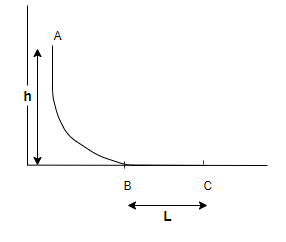
A small ball of mass m starts at a point A with speed \[{v_0}\] and moves along a frictionless track AB as shown. The track BC has coefficient of friction \[\mu \]. The ball comes to stop at C after travelling a distance \[L\]. Find \[L\].
(A) \[\dfrac{{2h}}{\mu } + \dfrac{{\mathop v\nolimits_0^2 }}{{2\mu g}}\]
(B) \[\dfrac{h}{\mu } + \dfrac{{\mathop v\nolimits_0^2 }}{{2\mu g}}\]
(C) \[\dfrac{h}{{2\mu }} + \dfrac{{\mathop v\nolimits_0^2 }}{{\mu g}}\]
(D) \[\dfrac{{4h}}{\mu } + \dfrac{{\mathop v\nolimits_0^2 }}{{2\mu g}}\]
Answer
 Verified
588k+ views
Hint: The given problem is an example of motion of a particle in frictionless and frictional track. As in this problem the particle is at some height \[h\] and then starts moving along the given track from A to C and stops at C. So, this problem can be solved using the law of energy conservation.
Step-by-step solution:
Step 1: As in the question it is given that the particle starts moving from point A where track AB is frictionless and then from point B to C where track BC is frictional track with coefficient of friction\[\mu \].
Let us consider that the initial velocity of the particle (say mass of the particle is \[m\]) is \[\mathop v\nolimits_0 \]and initial height from which the particle starts moving along the given track, is \[h\].
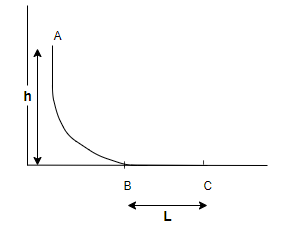
Step 2: From the above figure we can see that –
Total energy of the ball at point A will be equal to the sum of kinetic energy at that point and potential energy at that point. So, total energy can be written as –
Total energy at A = kinetic energy + potential energy
\[\mathop {\left( {\mathop E\nolimits_t } \right)}\nolimits_A = \dfrac{1}{2}m\mathop v\nolimits_0^2 + mgh\] …………………………..(1)
We know that energy is conserved in any closed system so the total energy at point B will be –
\[\mathop {\left( {\mathop E\nolimits_t } \right)}\nolimits_B = \dfrac{1}{2}m\mathop v\nolimits_0^2 + mgh\] …………………………..(2)
Step 3: Now, we know that friction opposes the relative motion of the ball so the energy that is at point B will be used against the work done by the frictional force while the particle is moving from point B to C.
But we know that frictional force is equal to the frictional coefficient \[\mu \] times the normal force on the body (i.e., R).
So, \[F = \mu R\]; where \[R = mg\], and \[m = \] mass of the body, and \[g = \]acceleration due to gravity
\[F = \mu mg\].........................................(3)
So, from the definition of work done against the frictional force –
\[W = F \times S\]; where \[S = L = \]distance covered by body from point B to C
Substituting the value from equation (3), we will get –
\[W = \mu mgL\] …………………………...(4)
Now, from the energy conservation law –
\[\mathop {\left( {\mathop E\nolimits_t } \right)}\nolimits_A \] or \[\mathop {\left( {\mathop E\nolimits_t } \right)}\nolimits_B = \] \[W\]
So, from equation (2) and (4), we will get –
\[\dfrac{1}{2}m\mathop v\nolimits_0^2 + mgh = \mu mgL\], on rearranging this equation
\[L = \dfrac{h}{\mu } + \dfrac{{\mathop v\nolimits_0^2 }}{{2\mu g}}\]
So, the correct option is (B).
Note:
-While solving these types of problems one should always remember that friction is a non-conservative force, i.e. work done against friction is path dependent.
-In the presence of friction, some energy is always lost in the form of heat etc. Because of the reason we can say mechanical energy is not conserved.
Step-by-step solution:
Step 1: As in the question it is given that the particle starts moving from point A where track AB is frictionless and then from point B to C where track BC is frictional track with coefficient of friction\[\mu \].
Let us consider that the initial velocity of the particle (say mass of the particle is \[m\]) is \[\mathop v\nolimits_0 \]and initial height from which the particle starts moving along the given track, is \[h\].
Step 2: From the above figure we can see that –
Total energy of the ball at point A will be equal to the sum of kinetic energy at that point and potential energy at that point. So, total energy can be written as –
Total energy at A = kinetic energy + potential energy
\[\mathop {\left( {\mathop E\nolimits_t } \right)}\nolimits_A = \dfrac{1}{2}m\mathop v\nolimits_0^2 + mgh\] …………………………..(1)
We know that energy is conserved in any closed system so the total energy at point B will be –
\[\mathop {\left( {\mathop E\nolimits_t } \right)}\nolimits_B = \dfrac{1}{2}m\mathop v\nolimits_0^2 + mgh\] …………………………..(2)
Step 3: Now, we know that friction opposes the relative motion of the ball so the energy that is at point B will be used against the work done by the frictional force while the particle is moving from point B to C.
But we know that frictional force is equal to the frictional coefficient \[\mu \] times the normal force on the body (i.e., R).
So, \[F = \mu R\]; where \[R = mg\], and \[m = \] mass of the body, and \[g = \]acceleration due to gravity
\[F = \mu mg\].........................................(3)
So, from the definition of work done against the frictional force –
\[W = F \times S\]; where \[S = L = \]distance covered by body from point B to C
Substituting the value from equation (3), we will get –
\[W = \mu mgL\] …………………………...(4)
Now, from the energy conservation law –
\[\mathop {\left( {\mathop E\nolimits_t } \right)}\nolimits_A \] or \[\mathop {\left( {\mathop E\nolimits_t } \right)}\nolimits_B = \] \[W\]
So, from equation (2) and (4), we will get –
\[\dfrac{1}{2}m\mathop v\nolimits_0^2 + mgh = \mu mgL\], on rearranging this equation
\[L = \dfrac{h}{\mu } + \dfrac{{\mathop v\nolimits_0^2 }}{{2\mu g}}\]
So, the correct option is (B).
Note:
-While solving these types of problems one should always remember that friction is a non-conservative force, i.e. work done against friction is path dependent.
-In the presence of friction, some energy is always lost in the form of heat etc. Because of the reason we can say mechanical energy is not conserved.
Recently Updated Pages
Master Class 11 Computer Science: Engaging Questions & Answers for Success

Master Class 11 Business Studies: Engaging Questions & Answers for Success
Master Class 11 Economics: Engaging Questions & Answers for Success
Master Class 11 English: Engaging Questions & Answers for Success
Master Class 11 Maths: Engaging Questions & Answers for Success
Master Class 11 Biology: Engaging Questions & Answers for Success
Trending doubts
One Metric ton is equal to kg A 10000 B 1000 C 100 class 11 physics CBSE
There are 720 permutations of the digits 1 2 3 4 5 class 11 maths CBSE
Discuss the various forms of bacteria class 11 biology CBSE
Draw a diagram of a plant cell and label at least eight class 11 biology CBSE
State the laws of reflection of light
Explain zero factorial class 11 maths CBSE