




A small air bubble is trapped inside a transparent cube of size $12\;cm$. When viewed from one of the vertical faces, the bubble appears to be at $5\;cm$ from it. When viewed from opposite face, it appears at $3\;cm$ from it
(has multiple correct answer)
A. The distance of the air bubble from the first face is $7.5\;cm$
B. The distance of the air bubble from the first face is $9\;cm$
C. Refractive index of the material of the prism is $2$
D. Refractive index of the material of the prism is $1.5\;$
Answer
 Verified
579.9k+ views
Hint: We know that light undergoes refraction when it travels from one medium to another. From Snell’s law we also know that the angle of the refracted light also depends on the medium i.e. the refractive index of the medium and also on the nature of the light. We also know that this shift results in apparent depth of the objects.
Formula used:
$\dfrac{sin (i)}{sin (r)}=\dfrac{\mu_1}{\mu_2}=\dfrac{v_2}{v_1}$
$\mu=\dfrac{R.D}{A.D}$
Complete step by step solution:
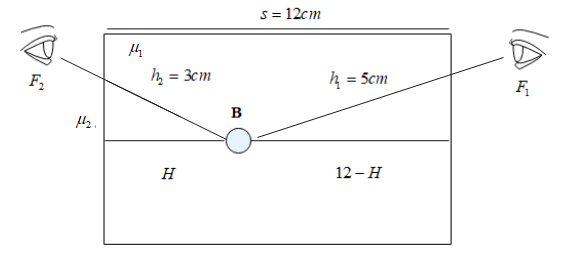
Consider the figure shown below. Let the side of the cube be $12\;cm$ and let $F_1$ and $F_2$ be the faces of the cube through which the bubble $B$ is seen. Let $H$ be the distance of the bubble from the $F_2$ and then the bubble is at a distance $12-H$ from $F_1$. Let the refractive index of the medium inside the cube be $\mu_1$ and that outside the cube be $\mu_2$.
From Snell’s law, we can say that $\mu_{1} sin( i)=\mu_{2} sin( r)$
$\implies \dfrac{sin (i)}{sin (r)}=\dfrac{\mu_1}{\mu_2}=\dfrac{v_2}{v_1}$
where $i$ is the angle of incidence of the light ray from the medium one whose refractive index is given as $\mu_{1}$ and velocity $v_1$, while $r$ is the angle of refraction of the light ray at the second medium whose refractive index is given as $\mu_{2}$ and velocity $v_2$.
Due to this bending of light at the interfaces, the bubble inside the cube looks much closer as compared to without the interface.
From apparent depth, we know that,
$\mu=\dfrac{R.D}{A.D}$
Where, $\mu$ is the refractive index of the medium and R.D and A.D are the real depth and the apparent depth of the object.
Here, the refractive index of the interface is given as $\mu=\dfrac{\mu_1}{\mu_2}$
Clearly, at $F_1$ $R.D=12-H$ and $A.D=5cm$
Then, we have $\dfrac{\mu_1}{\mu_2}=\dfrac{12-H}{5}$
$\implies 12-H=\dfrac{5\mu_1}{\mu_2}$
Similarly, at $F_2$ $R.D=H$ and $A.D=3cm$
Then, we have $\dfrac{\mu_1}{\mu_2}=\dfrac{H}{3}$
$\implies H=\dfrac{3\mu_1}{\mu_2}$
From the two, we have
$\implies 12-\dfrac{3\mu_1}{\mu_2}=\dfrac{5\mu_1}{\mu_2}$
$\implies 12=\dfrac{8\mu_1}{\mu_2}$
$\implies \dfrac{\mu_1}{\mu_2}=\dfrac{12}{8}=1.5$
Then, from $H=\dfrac{3\mu_1}{\mu_2}$, we have
$\implies H=3\times 1.5=7.5cm$
Hence the correct answer is
A. the distance of the air bubble from the first face is $7.5\;cm$ and D. Refractive index of the material of the prism is $1.5\;$
Note: This is a very easy sum, provided one draws the question and knows the relationship between the apparent depth and real depth. Also, it is important for one to assume the refractive index and the real depths to solve the problem, as that is what is asked for in the question.
Formula used:
$\dfrac{sin (i)}{sin (r)}=\dfrac{\mu_1}{\mu_2}=\dfrac{v_2}{v_1}$
$\mu=\dfrac{R.D}{A.D}$
Complete step by step solution:
Consider the figure shown below. Let the side of the cube be $12\;cm$ and let $F_1$ and $F_2$ be the faces of the cube through which the bubble $B$ is seen. Let $H$ be the distance of the bubble from the $F_2$ and then the bubble is at a distance $12-H$ from $F_1$. Let the refractive index of the medium inside the cube be $\mu_1$ and that outside the cube be $\mu_2$.
From Snell’s law, we can say that $\mu_{1} sin( i)=\mu_{2} sin( r)$
$\implies \dfrac{sin (i)}{sin (r)}=\dfrac{\mu_1}{\mu_2}=\dfrac{v_2}{v_1}$
where $i$ is the angle of incidence of the light ray from the medium one whose refractive index is given as $\mu_{1}$ and velocity $v_1$, while $r$ is the angle of refraction of the light ray at the second medium whose refractive index is given as $\mu_{2}$ and velocity $v_2$.
Due to this bending of light at the interfaces, the bubble inside the cube looks much closer as compared to without the interface.
From apparent depth, we know that,
$\mu=\dfrac{R.D}{A.D}$
Where, $\mu$ is the refractive index of the medium and R.D and A.D are the real depth and the apparent depth of the object.
Here, the refractive index of the interface is given as $\mu=\dfrac{\mu_1}{\mu_2}$
Clearly, at $F_1$ $R.D=12-H$ and $A.D=5cm$
Then, we have $\dfrac{\mu_1}{\mu_2}=\dfrac{12-H}{5}$
$\implies 12-H=\dfrac{5\mu_1}{\mu_2}$
Similarly, at $F_2$ $R.D=H$ and $A.D=3cm$
Then, we have $\dfrac{\mu_1}{\mu_2}=\dfrac{H}{3}$
$\implies H=\dfrac{3\mu_1}{\mu_2}$
From the two, we have
$\implies 12-\dfrac{3\mu_1}{\mu_2}=\dfrac{5\mu_1}{\mu_2}$
$\implies 12=\dfrac{8\mu_1}{\mu_2}$
$\implies \dfrac{\mu_1}{\mu_2}=\dfrac{12}{8}=1.5$
Then, from $H=\dfrac{3\mu_1}{\mu_2}$, we have
$\implies H=3\times 1.5=7.5cm$
Hence the correct answer is
A. the distance of the air bubble from the first face is $7.5\;cm$ and D. Refractive index of the material of the prism is $1.5\;$
Note: This is a very easy sum, provided one draws the question and knows the relationship between the apparent depth and real depth. Also, it is important for one to assume the refractive index and the real depths to solve the problem, as that is what is asked for in the question.
Recently Updated Pages
Master Class 11 English: Engaging Questions & Answers for Success

Master Class 11 Social Science: Engaging Questions & Answers for Success
Master Class 11 Maths: Engaging Questions & Answers for Success
Master Class 11 Biology: Engaging Questions & Answers for Success
Master Class 11 Physics: Engaging Questions & Answers for Success
Master Class 11 Chemistry: Engaging Questions & Answers for Success
Trending doubts
1 ton equals to A 100 kg B 1000 kg C 10 kg D 10000 class 11 physics CBSE
Find the value of the expression given below sin 30circ class 11 maths CBSE
What are hard magnetic materials class 11 physics CBSE
Draw a diagram of nephron and explain its structur class 11 biology CBSE
What is the atomic mass of Sodium a 22 gmol b 23 gmol class 11 chemistry CBSE
Lysosomes are known as suicidal bags of cell why class 11 biology CBSE