




A slightly conical wire of length L and radii ${r_1}$and ${r_2}$ is stretched by two forces applied parallel to length in opposite directions and normal to end faces. If \[Y\] denotes the young's modulus then the elongation of the wire is
$(A)\dfrac{{FL}}{{2\pi {r_1}{r_2}Y}}$
$(B)\dfrac{{FL}}{{\pi {r_1}{r_2}Y}}$
$(C)\dfrac{{2FL}}{{\pi {r_1}{r_2}Y}}$
$(D)\dfrac{{4FL}}{{\pi {r_1}{r_2}Y}}$
Answer
 Verified
523.5k+ views
Hint: Here, the total length of the conical wire before the extension is \[L\] and the ${r_1}$and ${r_2}$ are the radii of the conical wire. We are going to find the elongation of the wire when it was stretched by two equal and parallel forces acting in opposite directions. Young’s modulus is defined as the ratio of stress due to the applied load to longitudinal strain. We are going to derive the elongation of the wire with the young’s modulus formula.
Complete answer:
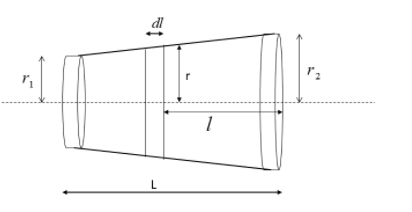
From the above figure, the radius $r$ can be calculated as given by,
$r = {r_1} + \dfrac{{\left( {{r_2} - {r_1}} \right)l}}{L}$
Where $l$ -length from one end of the wire at the radius $r$
\[L\] - the total length of the wire before elongation
The force acting on both sides is equal but opposite in direction. The elongation of the wire can be calculated at the point radius $r$
From young’s modulus formula,
$Y = \dfrac{{stress}}{{strain}}$
$stress = \dfrac{F}{A}$
Where \[F\] - force applied
\[A\] - cross sectional area of wire of radius r
$strain = \dfrac{{\Delta dl}}{{dl}}$
Where $\Delta dl$- change in length
$dl$- original length
Therefore young’s modulus becomes,
$Y = \dfrac{{\dfrac{F}{A}}}{{\dfrac{{\Delta dl}}{{dl}}}}$
$\Delta dl = \dfrac{{F.dl}}{{AY}}$
$\Delta dl = \dfrac{{F.dl}}{{\pi {r^2}Y}}$
Substituting the value of radius r in the above equation, we get
$\Delta dl = \dfrac{{F.dl}}{{\pi {{\left( {{r_1} + \dfrac{{\left( {{r_2} - {r_1}} \right)l}}{L}} \right)}^2}Y}}$
Integrating on both sides with limits from$0$to $L$, we get the net elongation is given by
$\int {\Delta dl} = \int\limits_0^L {\dfrac{{F.dl}}{{\pi {{\left( {{r_1} + \dfrac{{\left( {{r_2} - {r_1}} \right)l}}{L}} \right)}^2}Y}}} $
Net elongation$ = \dfrac{F}{{Y\pi }}\left[ {\dfrac{{ - 1}}{{\left( {{r_1} + \dfrac{{\left( {{r_2} - {r_1}} \right)l}}{L}} \right)\left( {\dfrac{{{r_2} - {r_1}}}{L}} \right)}}} \right]_0^L$
$ = \dfrac{1}{{\left( {\dfrac{{{r_2} - {r_1}}}{L}} \right)}} \times \dfrac{F}{{Y\pi }} \times \left( { - \dfrac{1}{{{r_2}}} + \dfrac{1}{{{r_1}}}} \right)$
\[ = \dfrac{{FL}}{{\left( {{r_2} - {r_1}} \right) \times Y\pi }} \times \dfrac{{\left( {{r_2} - {r_1}} \right)}}{{{r_1}.{r_2}}}\]
Net elongation$ = \dfrac{{FL}}{{{r_1}{r_2}Y\pi }}$
From the above derivation, the elongation of the wire $ = \dfrac{{FL}}{{{r_1}{r_2}Y\pi }}$
Note: The elongation means the material length is to be increased when it is subjected to tensile force acted axially in the material. The elongation of any material depends on the same material properties like density, ductility, etc., and the most important is the tensile force acting on the material. The elongation of material under stress is calculated in the percentage of elongation.
Complete answer:
From the above figure, the radius $r$ can be calculated as given by,
$r = {r_1} + \dfrac{{\left( {{r_2} - {r_1}} \right)l}}{L}$
Where $l$ -length from one end of the wire at the radius $r$
\[L\] - the total length of the wire before elongation
The force acting on both sides is equal but opposite in direction. The elongation of the wire can be calculated at the point radius $r$
From young’s modulus formula,
$Y = \dfrac{{stress}}{{strain}}$
$stress = \dfrac{F}{A}$
Where \[F\] - force applied
\[A\] - cross sectional area of wire of radius r
$strain = \dfrac{{\Delta dl}}{{dl}}$
Where $\Delta dl$- change in length
$dl$- original length
Therefore young’s modulus becomes,
$Y = \dfrac{{\dfrac{F}{A}}}{{\dfrac{{\Delta dl}}{{dl}}}}$
$\Delta dl = \dfrac{{F.dl}}{{AY}}$
$\Delta dl = \dfrac{{F.dl}}{{\pi {r^2}Y}}$
Substituting the value of radius r in the above equation, we get
$\Delta dl = \dfrac{{F.dl}}{{\pi {{\left( {{r_1} + \dfrac{{\left( {{r_2} - {r_1}} \right)l}}{L}} \right)}^2}Y}}$
Integrating on both sides with limits from$0$to $L$, we get the net elongation is given by
$\int {\Delta dl} = \int\limits_0^L {\dfrac{{F.dl}}{{\pi {{\left( {{r_1} + \dfrac{{\left( {{r_2} - {r_1}} \right)l}}{L}} \right)}^2}Y}}} $
Net elongation$ = \dfrac{F}{{Y\pi }}\left[ {\dfrac{{ - 1}}{{\left( {{r_1} + \dfrac{{\left( {{r_2} - {r_1}} \right)l}}{L}} \right)\left( {\dfrac{{{r_2} - {r_1}}}{L}} \right)}}} \right]_0^L$
$ = \dfrac{1}{{\left( {\dfrac{{{r_2} - {r_1}}}{L}} \right)}} \times \dfrac{F}{{Y\pi }} \times \left( { - \dfrac{1}{{{r_2}}} + \dfrac{1}{{{r_1}}}} \right)$
\[ = \dfrac{{FL}}{{\left( {{r_2} - {r_1}} \right) \times Y\pi }} \times \dfrac{{\left( {{r_2} - {r_1}} \right)}}{{{r_1}.{r_2}}}\]
Net elongation$ = \dfrac{{FL}}{{{r_1}{r_2}Y\pi }}$
From the above derivation, the elongation of the wire $ = \dfrac{{FL}}{{{r_1}{r_2}Y\pi }}$
Note: The elongation means the material length is to be increased when it is subjected to tensile force acted axially in the material. The elongation of any material depends on the same material properties like density, ductility, etc., and the most important is the tensile force acting on the material. The elongation of material under stress is calculated in the percentage of elongation.
Recently Updated Pages
Master Class 11 Social Science: Engaging Questions & Answers for Success

Master Class 11 Physics: Engaging Questions & Answers for Success
Master Class 11 Maths: Engaging Questions & Answers for Success
Master Class 11 Economics: Engaging Questions & Answers for Success
Master Class 11 Computer Science: Engaging Questions & Answers for Success
Master Class 11 Chemistry: Engaging Questions & Answers for Success
Trending doubts
One Metric ton is equal to kg A 10000 B 1000 C 100 class 11 physics CBSE
There are 720 permutations of the digits 1 2 3 4 5 class 11 maths CBSE
1 Quintal is equal to a 110 kg b 10 kg c 100kg d 1000 class 11 physics CBSE
State and prove Bernoullis theorem class 11 physics CBSE
Difference Between Prokaryotic Cells and Eukaryotic Cells
Which among the following are examples of coming together class 11 social science CBSE