




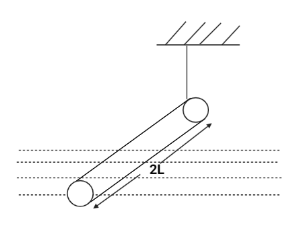
A Slender homogeneous of length $ 2L $ floats partly immersed in water, being supported by a straight fastened to one of its ends as shown. The specific gravity of the rod is $ 0.75 $ . The length of rod that extends out of water is:
A) $ L $
B) $ \dfrac{1}{2}L $
C) $ \dfrac{1}{4}L $
D) $ 3L $
Answer
 Verified
611.1k+ views
Hint :Buoyancy is the upward force experienced by an object when it is immersed into the water. The object displaces the water owing to its weight. We also know that as the depth of the water increases the pressure on the object also increases. Hence, this variation in pressure leads to an upward force which is known as Buoyancy.
Complete Step By Step Answer:
Let us consider the length of the rod immersed in water as $ x $ .
There are two forces acting on the rod. The buoyant force that acts on the length of the rod which is immersed in water pushes the rod upwards. Whereas, the force created due to the centre of gravity pulls the rod downwards. Since the rod is in equilibrium, the net torque produced by the rod will be zero.
Hence,
$ 0 = \sum {{\tau _0}} $
$ 0 = wl\cos \theta - {F_B}\left( {2l - \dfrac{x}{2}} \right)\cos \theta $
Substituting the values we get,
$
0 = {\rho _{rod}}gA(2l)(l\cos \theta ) - {\rho _{water}}Ax\left( {2l - \dfrac{x}{2}} \right) \\
0 = \left( {\dfrac{1}{2}{\rho _{water}}gA\cos \theta } \right)\left( {{x^2} - 4lx + 4\dfrac{{{\rho _{rod}}}}{{{\rho _{water}}}}{l^2}} \right) \\
$
Where A is the cross sectional area
Now, we solve the quadratic equation,
$
{x^2} - 4lx + 3{l^2} = 0 \\
{x^2} - lx - 3lx + 3{l^2} = 0 \\
x(x - l) - 3l(x - l) = 0 \\
(x - l)(x - 3l) = 0 \\
$
Hence, $ x = 3L,L $
Since, the total length of wire is $ 2L $ , hence length of rod immersed in water cannot be $ 3L $
Hence $ x = L $
The length of the rod that extends out of the water is $ 2L - L = L $ .
The correct option is (A).
Note :
There are two forces coming into play when an object is immersed in water. Buoyancy as well as the gravitational force. Hence there is both pulling upward and pulling downward force. These phenomena result in the floating of an object on a water surface.
Complete Step By Step Answer:
Let us consider the length of the rod immersed in water as $ x $ .
There are two forces acting on the rod. The buoyant force that acts on the length of the rod which is immersed in water pushes the rod upwards. Whereas, the force created due to the centre of gravity pulls the rod downwards. Since the rod is in equilibrium, the net torque produced by the rod will be zero.
Hence,
$ 0 = \sum {{\tau _0}} $
$ 0 = wl\cos \theta - {F_B}\left( {2l - \dfrac{x}{2}} \right)\cos \theta $
Substituting the values we get,
$
0 = {\rho _{rod}}gA(2l)(l\cos \theta ) - {\rho _{water}}Ax\left( {2l - \dfrac{x}{2}} \right) \\
0 = \left( {\dfrac{1}{2}{\rho _{water}}gA\cos \theta } \right)\left( {{x^2} - 4lx + 4\dfrac{{{\rho _{rod}}}}{{{\rho _{water}}}}{l^2}} \right) \\
$
Where A is the cross sectional area
Now, we solve the quadratic equation,
$
{x^2} - 4lx + 3{l^2} = 0 \\
{x^2} - lx - 3lx + 3{l^2} = 0 \\
x(x - l) - 3l(x - l) = 0 \\
(x - l)(x - 3l) = 0 \\
$
Hence, $ x = 3L,L $
Since, the total length of wire is $ 2L $ , hence length of rod immersed in water cannot be $ 3L $
Hence $ x = L $
The length of the rod that extends out of the water is $ 2L - L = L $ .
The correct option is (A).
Note :
There are two forces coming into play when an object is immersed in water. Buoyancy as well as the gravitational force. Hence there is both pulling upward and pulling downward force. These phenomena result in the floating of an object on a water surface.
Recently Updated Pages
Which will be the least stable resonating structure class 11 chemistry CBSE

How many 5 digit telephone numbers can be construc-class-11-maths-CBSE
How do you find the angle of the resultant vector class 11 physics CBSE
Draw labelled diagram of the following i Gram seed class 11 biology CBSE
1 Quintal is equal to a 110 kg b 10 kg c 100kg d 1000 class 11 physics CBSE
What is the need and importance of classification class 11 biology CBSE
Trending doubts
Find the value of the expression given below sin 30circ class 11 maths CBSE
One Metric ton is equal to kg A 10000 B 1000 C 100 class 11 physics CBSE
10 examples of friction in our daily life
Draw a diagram of a plant cell and label at least eight class 11 biology CBSE
Difference between physical and chemical change class 11 chemistry CBSE
Proton was discovered by A Thomson B Rutherford C Chadwick class 11 chemistry CBSE