



A slate is 35cm long and 20cm wide. It is surrounded by a wooden frame of width 2.5cm all around. John coloured the frame, do not consider the thickness of the frame. Find the area of the coloured frame.
Answer
 Verified
596.7k+ views
Hint: To find the area of the frame that is painted, find the area of the whole rectangular frame and subtract the area of the slate. The area of the rectangle is given by the product of length and breadth, and to find the length and breadth of the frame add 5 cm to both breadth and length of the slate.
Complete step-by-step answer:
Let us start the solution to the above question by drawing the diagram.
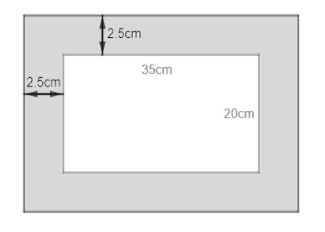
Let us start the solution by finding the area of the slate, which is the unpainted area in the above figure. Also, the length of the slate is 35cm and width is 20cm. Also, we know that the area of the rectangle is equal to the product of the length and the breadth, $l\times b$ .
$\text{Area of the slate}=l\times b=35\times 20=700c{{m}^{2}}$
Now let us move to the area of the frame that is painted, for which length is 5cm more than that of the picture, as 2.5cm wide from each end of the picture. Similar is the case with its breadth. So, length of the frame is 40cm and breadth is 25cm. Also, find the area of the whole rectangular frame and subtract the area of the slate to get the area that is painted.
$\text{Area of the frame painted}=\text{Area of the outer rectangle}-\text{Area of the inner rectangle}\text{. }$
$\Rightarrow \text{Area of the frame}=l\times b-700.\text{ }$
$\Rightarrow \text{Area of the frame}=40\times 25-700=1000-700=300c{{m}^{2}}\text{. }$
Therefore, the area of the frame that is painted is 300 sq cm.
Note:Remember that the frame is painted only from the front side and not from the backside, so we take the 2-D area only. Also, as it is mentioned that we have to neglect the height, if it is not mentioned you need to find the area of the side faces and consider it in the painted area because generally the side faces are painted.
Complete step-by-step answer:
Let us start the solution to the above question by drawing the diagram.
Let us start the solution by finding the area of the slate, which is the unpainted area in the above figure. Also, the length of the slate is 35cm and width is 20cm. Also, we know that the area of the rectangle is equal to the product of the length and the breadth, $l\times b$ .
$\text{Area of the slate}=l\times b=35\times 20=700c{{m}^{2}}$
Now let us move to the area of the frame that is painted, for which length is 5cm more than that of the picture, as 2.5cm wide from each end of the picture. Similar is the case with its breadth. So, length of the frame is 40cm and breadth is 25cm. Also, find the area of the whole rectangular frame and subtract the area of the slate to get the area that is painted.
$\text{Area of the frame painted}=\text{Area of the outer rectangle}-\text{Area of the inner rectangle}\text{. }$
$\Rightarrow \text{Area of the frame}=l\times b-700.\text{ }$
$\Rightarrow \text{Area of the frame}=40\times 25-700=1000-700=300c{{m}^{2}}\text{. }$
Therefore, the area of the frame that is painted is 300 sq cm.
Note:Remember that the frame is painted only from the front side and not from the backside, so we take the 2-D area only. Also, as it is mentioned that we have to neglect the height, if it is not mentioned you need to find the area of the side faces and consider it in the painted area because generally the side faces are painted.
Recently Updated Pages
Master Class 9 General Knowledge: Engaging Questions & Answers for Success

Master Class 9 Social Science: Engaging Questions & Answers for Success
Master Class 9 English: Engaging Questions & Answers for Success
Master Class 9 Maths: Engaging Questions & Answers for Success
Master Class 9 Science: Engaging Questions & Answers for Success
Class 9 Question and Answer - Your Ultimate Solutions Guide
Trending doubts
Difference Between Plant Cell and Animal Cell
Fill the blanks with the suitable prepositions 1 The class 9 english CBSE
Who is eligible for RTE class 9 social science CBSE
Which places in India experience sunrise first and class 9 social science CBSE
What is pollution? How many types of pollution? Define it
Name 10 Living and Non living things class 9 biology CBSE